Airth Research: Turning Everyday Air Conditioners into Affordable Air Purifiers
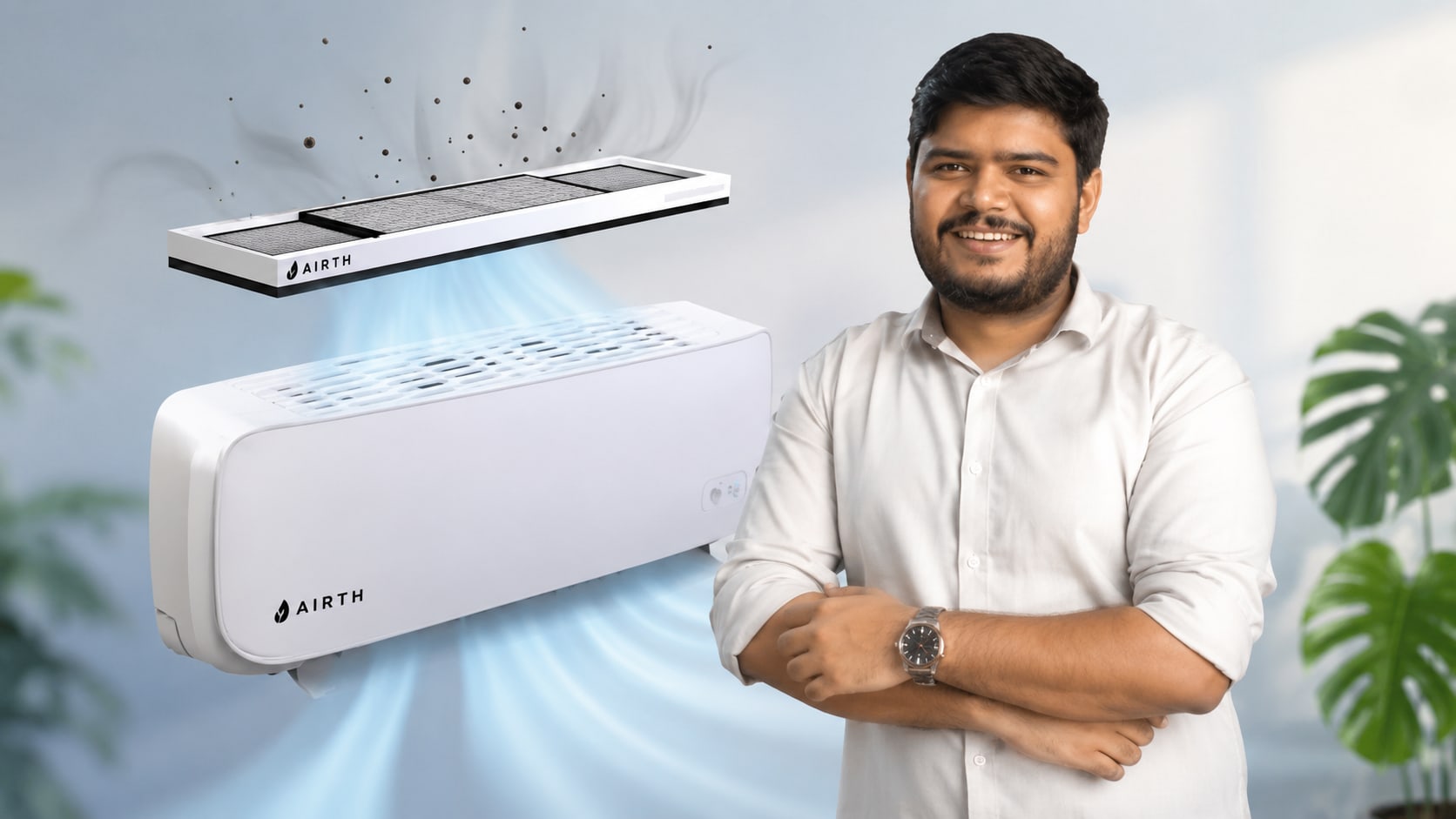
Air pollution has become a persistent problem in Indian cities, yet many households cannot justify the extra cost of a standalone air purifier. What if the air conditioner already running in most urban homes could also clean the air? That question led Ravi Kaushik, a Delhi-based aerosol scientist, to found Airth Research Private Limited, a startup that converts ordinary air conditioners into affordable air purification systems.
“I’ve worked on every air purification technology out there, even those still in development,” says Kaushik, who has studied aerosol science and collaborated with researchers from IIT Bombay, IIT Kanpur, IISc Bangalore and national laboratories. “My goal is to make clean air affordable for everyone.”
From Pandemic Research to a Practical Solution
Airth’s journey began in 2020 when Kaushik, then an entrepreneur-in-residence at Social Alpha, started developing affordable air-purification technology. The company’s first product line—anti-microbial air purifiers—was launched during the pandemic and tested against the COVID-19 virus in biosafety laboratories, including CSIR-IMTech.
Kaushik quickly observed a practical problem. Traditional purifiers were expensive, bulky, and often left unused. “People spend Rs 20,000 on a purifier, but it just sits in a corner,” he notes. He decided instead to embed purification into a device people already use every day: the air conditioner.
How FiltRIX Works
Airth began commercialising in 2023 with FiltRIX, an attachment that converts any air conditioner—split, window or commercial—into a high-efficiency purifier. The device uses a proprietary three-layer filter technology. Its “partial coverage” design addresses a common technical issue in air conditioning: pressure drop. Dense filters can slow airflow, reducing both cooling performance and purification efficiency. FiltRIX is engineered to minimise that trade-off.
“Our 3D filters are inspired by human lungs,” Kaushik explains. “They offer a large surface area, trap more dust, and deliver up to 90% purification within one to two hours.” The filters have been tested and certified by laboratories at IIT Bombay, IIT Delhi, IIT Kanpur and the Bureau of Energy Efficiency. According to the company, users often notice improved airflow and a slight reduction in energy consumption (around 1%) after three months of use. Installation is designed to be DIY—no technician is required.
Affordable Pricing and Hybrid Distribution
Airth operates a hybrid B2B and B2C model. Early institutional customers included the Reserve Bank of India and the Stock Holding Corporation of India. The company now serves around 100 active B2B clients, among them The Beacon School, Matrix Partners, Dell and DLF Camellias, alongside more than 60,000 retail users across India.
Products are sold through the company’s website and major e-commerce platforms including Amazon, Tata 1mg and Flipkart, with PharmEasy expected to follow. Each AC purifier is priced at approximately Rs 2,500. Replacement filters, required every 8–12 months, cost Rs 1,200. A second product line of air-quality monitors ranges from Rs 500 to Rs 5,000. “Everything is built for affordability and ease,” Kaushik says. “There’s no service needed; users can install and replace it themselves.”
Building and Manufacturing in Delhi
The 15-member team operates from Delhi, where assembly and warehousing are also based. Airth manufactures its air purifiers in-house; air-quality monitors are sourced from specialised vendors, while coating and final fitting remain internal.
So far the company has raised Rs 3.3 crore from friends and family, Whiteboard Capital, SIRMA and angel investors. It reported Rs 6 crore in revenue for FY24 and aims to double that figure in FY26 while preparing for another funding round to support global expansion.
Competing by Changing the Category
Kaushik acknowledges that the air-purifier market is crowded with established names such as Dyson, Sharp and Xiaomi. He responds that Airth is not simply another standalone device. “They sell bulky, expensive machines. We’re not selling another device—we’re changing how people think about clean air.”
Awareness remains the biggest hurdle. Air pollution is largely invisible, so many people do not prioritise prevention. “People spend on medicines, not on prevention,” Kaushik observes. Limited early funding and the absence of a ready sales network made customer acquisition difficult. Yet with more than 50,000 customers, the company believes it is gaining traction.
Next Steps: Smarter Air and Global Reach
Airth is now developing an AI-powered air-quality monitor that will automatically adjust an air conditioner’s fan speed according to pollution levels, aiming to save both energy and cost. The product is currently in research and development and is scheduled for launch in the near term. It marks the company’s move into intelligent climate control.
Internationally, Airth is exploring markets in the Middle East and Australia. Kaushik recently joined an Indian startup delegation at GITEX Dubai. “We’ve spent years on research, and now the world is ready for this,” he says.
India’s air-purifier market is projected to reach Rs 3,520 crore by 2034, with annual sales of around 500,000 units, according to Expert Market Research. Airth’s stated aim is not merely to compete within the existing market but to expand it by making clean air more accessible. By turning the air conditioner—already present in millions of homes and offices—into a dual-purpose device, the startup is testing whether affordability and convenience can finally bring air purification into everyday use.