Aule Space: Extending the Life of Billion-Dollar Satellites with a “Jetpack” Spacecraft
Picture yourself driving a car. You reach your destination, prepare for the return journey, and suddenly realise you’ve run out of fuel. You wouldn’t abandon the car on the roadside. So why, asks Jay Panchal, do we do exactly that with satellites?
Privately owned geostationary satellites worth more than $100 billion currently orbit Earth. Many still generate substantial revenue but are retired simply because they have exhausted their fuel. Launching an entirely new satellite can cost hundreds of millions of dollars. Extending the operational life of existing ones offers a far more economical alternative.
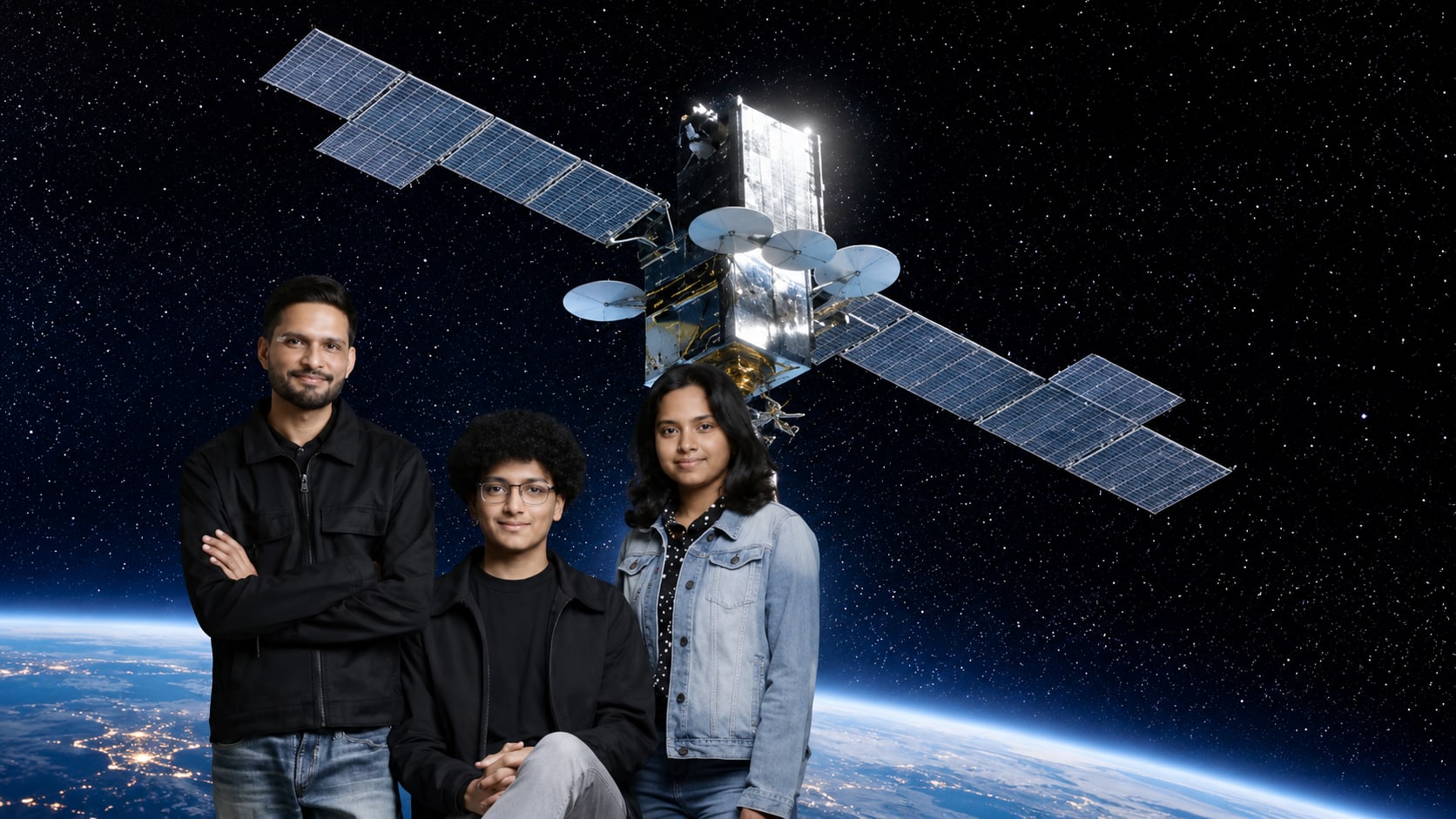
That is the problem Bengaluru-based deep-tech startup Aule Space is working to solve. Founded barely a year ago, the company is building what it calls a “jetpack satellite,” a spacecraft that docks with a fuel-depleted satellite, remains attached, and supplies propulsion from its own fuel reserves, allowing the client satellite to continue operating for several more years.
Early Traction and Funding
Aule Space raised $2 million in a pre-seed round earlier this year, led by pi Ventures. The startup has also participated in the Entrepreneurs First Accelerator Programme and received backing from Transpose Platform. In roughly eighteen months, the company has validated its technology at ISRO facilities and reached Technology Readiness Level (TRL) 6 on the NASA-developed scale. TRL 9 represents full readiness for commercial deployment.
“Once we successfully demonstrate docking in orbit next year, we’ll reach TRL 9,” says Jay Panchal, co-founder and CEO. At that point, the company expects to begin signing commercial contracts. Manish Singhal, founding partner of pi Ventures, notes that Aule will be among the very few companies globally to achieve this capability, and at a significantly lower price point. He anticipates commercial contracts within two to three years.
Competing on Cost and Capability
The only company to have demonstrated a similar satellite life-extension mission so far is the American aerospace firm Northrop Grumman, which completed a docking operation in 2020. Panchal’s ambition is to deliver comparable capability at roughly twenty times lower cost.
Earlier attempts at satellite servicing were extremely expensive. In one mission, astronauts physically captured a satellite, returned it to Earth and relaunched it—an operation that cost around a billion dollars and never became commercially viable. NASA’s autonomous robotic servicing missions also ran into the hundreds of millions of dollars. Aule aims to achieve similar results at a fraction of that cost.
In India, OrbitAID Aerospace is pursuing related work, but its focus is on-orbit refuelling rather than docking. Aule’s approach is different: instead of transferring fuel, its spacecraft attaches to the target satellite and functions like a tow truck, providing propulsion for up to six years.
Targeting High-Value Communication Satellites
Aule is concentrating on privately owned geostationary communication satellites. Roughly 320 such satellites are currently in orbit, with 20–25 running out of fuel each year. The broader on-orbit satellite servicing market—covering life extension, refuelling, repair, relocation and inspection—is projected to reach about $5.5 billion by 2030, growing at 10–11% CAGR, according to The Business Research Company.
The company’s goal is to extend a satellite’s life by approximately five years. One servicing spacecraft can dock with one satellite at a time, but it is not limited to a single customer for its entire operational life. After extending one satellite’s service by a few years, it can detach and move on to another. At the end of a mission, satellites can be relocated to a graveyard orbit above the operational geostationary belt.
Technical Approach: Docking Without Designed Interfaces
India demonstrated docking capability with ISRO’s SpaDeX mission in 2024. Aule’s challenge is more difficult. Those earlier missions involved cooperative satellites specifically designed with docking interfaces. Aule is attempting to dock with satellites that have no such interfaces.
Rather than relying on expensive LiDAR or radar systems, the team is developing vision-based navigation that uses cameras to determine a satellite’s position and orientation. Testing environments include a dark room with a sun simulator to recreate space lighting conditions and train computer-vision models, as well as an air-bearing platform that creates a near-frictionless surface to simulate force-free movement.
Team and Ambition
Panchal leads Aule alongside Nithyaa Giri (CTO) and Hrishit Tambi (COO). The team of roughly 23 people includes talent from Pixxel, Skyroot, ISRO and other organisations, along with advisors who have worked on India’s docking missions and major communication-satellite programmes.
Panchal’s own path began at Pixxel, where he worked on mechanical systems for six hyperspectral satellites. His interest in space started earlier, as part of a student satellite team in college. When he founded Aule, the original focus was space-debris removal. After discussions with customers and agencies, the team shifted priority to servicing high-value satellites as the more immediate commercial opportunity. The same core technology can later support debris-removal missions.
Looking further ahead, Aule’s ambition is to build a robotic workforce for space. Satellite servicing is the first application. As launch costs continue to fall, the company sees pathways into extraterrestrial robotics, in-space manufacturing and assembly, and eventually asteroid mining by 2050.
By developing a lighter, lower-cost docking spacecraft capable of working with existing satellites, Aule Space is attempting to turn a costly problem—premature satellite retirement—into a practical, commercially viable service. If the planned on-orbit demonstration succeeds, the company could open a new chapter in how operators manage their most valuable orbital assets.