BGauss Raises Rs 110 Crore in Series D to Scale Electric Scooter Business
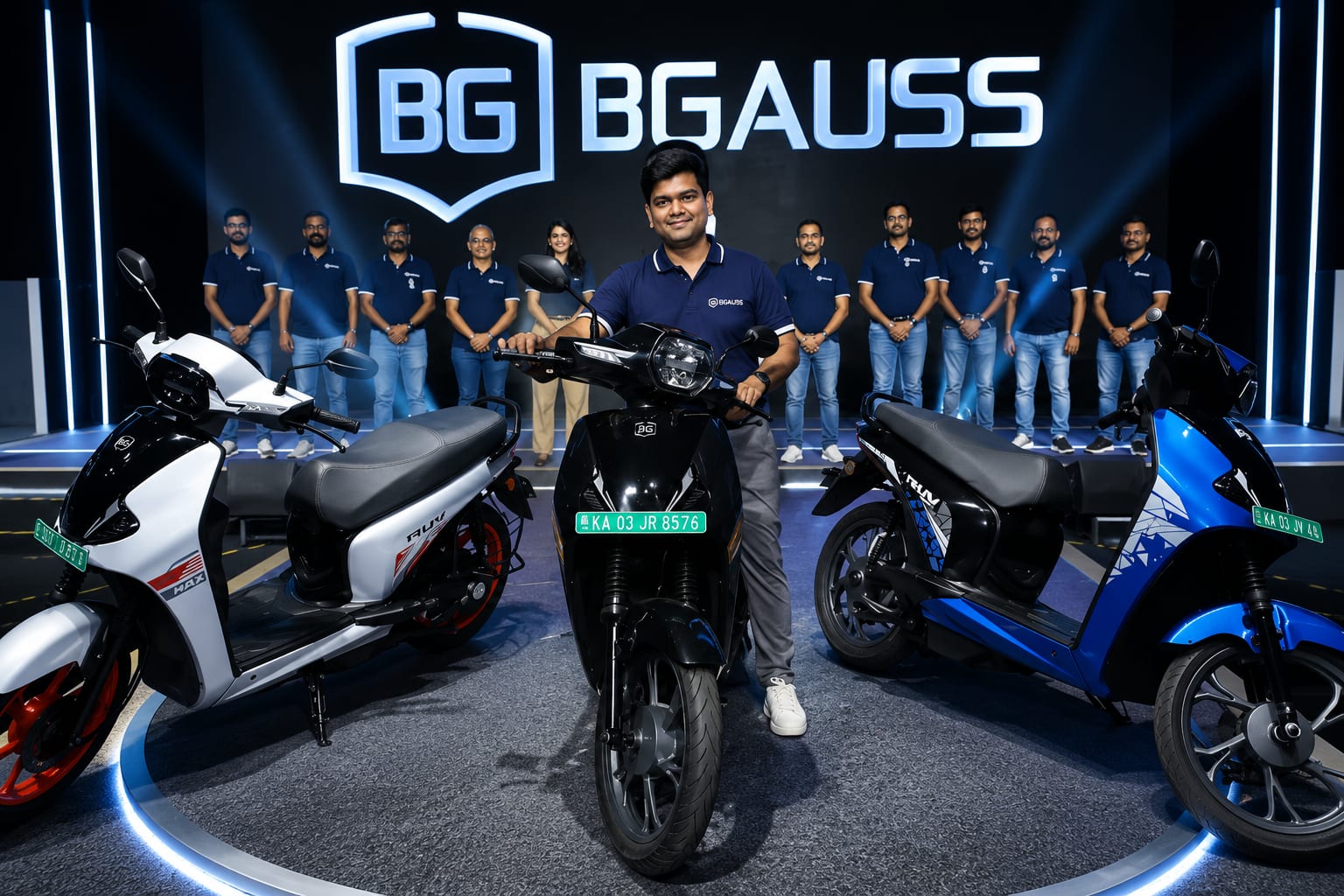
Electric two-wheeler maker BGauss has raised Rs 110 crore ($11.6 million) in a Series D funding round. The round was led by founder Hemant Mahendrakumar Kabra, with participation from existing investor Bharat Value Fund and other investors.
According to a regulatory filing sourced from the Registrar of Companies, the board of BGauss approved the allotment of 17,26,846 Series D compulsorily convertible preference shares (CCPS) at Rs 637 per share. This includes a face value of Rs 10 and a premium of Rs 627 per share.
Break-up of the Round
Founder Hemant Kabra led the investment with Rs 50 crore. Existing investor Bharat Value Fund contributed Rs 44 crore. Adesh Realtor LLP and Maithan Alloys invested Rs 10 crore and Rs 6 crore respectively.
The latest round values BGauss at approximately Rs 1,000–1,100 crore on a post-money basis. The company has indicated that the fresh capital will support operational scale-up, strengthen its product portfolio and fund expansion plans. The funding could form part of a larger round, in which case the final valuation may change.
Building Design-Led Electric Scooters
Founded in 2020 by Hemant Kabra, BGauss designs and manufactures electric scooters that combine styling with technology features. Its vehicles incorporate AI-enabled systems, IoT integration, fast charging and low-maintenance design. The positioning aims to appeal to urban buyers looking for practical electric mobility without compromising on design or convenience features.
The electric two-wheeler segment in India has grown rapidly in recent years, driven by rising fuel costs, improving battery technology, government incentives and increasing consumer acceptance of electric options for daily commuting.
Recent Performance
BGauss registered 5,518 retail registrations in July 2026, reflecting around threefold year-on-year growth. During the same month, the company held a 0.3% share of India’s electric two-wheeler market. While the absolute market share remains small, the sharp rise in registrations indicates improving traction and growing brand visibility.
For a relatively young player, consistent growth in retail registrations is an important signal. It suggests that product-market fit is strengthening and that distribution and customer acceptance are improving, even in a crowded market.
Competitive Landscape
BGauss operates in an increasingly competitive electric two-wheeler market. It faces pressure from both new-age EV startups and established two-wheeler manufacturers. Competitors include Ather Energy and River Mobility on the startup side, as well as larger players such as Ola Electric, Hero MotoCorp, TVS Motor and Bajaj Auto.
These companies are investing heavily in product development, battery technology, charging infrastructure, software features and dealer networks. In such an environment, smaller players need clear differentiation—whether through design, technology features, pricing, after-sales experience or targeted city-level expansion—to hold and grow market share.
Previous Funding
Before the Series D round, BGauss raised $18.6 million from Bharat Value Fund in January last year. Earlier, in April 2022, the company raised Rs 52 crore (around $6 million) from a group of investors led by Darshan Patel, founder of Vini Cosmetics.
The continued participation of Bharat Value Fund in the latest round signals ongoing investor confidence. The founder’s significant personal investment of Rs 50 crore also reflects strong internal conviction in the company’s trajectory.
Use of Capital and Market Context
The fresh funds are expected to help BGauss scale operations, expand its product range and support broader market reach. In the electric two-wheeler segment, capital is typically deployed toward manufacturing capacity, research and development, software and connectivity features, distribution networks and brand building.
The timing of the raise is notable. India’s electric two-wheeler market continues to attract investment as manufacturers intensify efforts to capture a larger share of the shift away from internal combustion engine vehicles. Companies are competing not only on vehicle performance and price but also on ecosystem elements such as charging convenience, residual value, service networks and digital features.
Challenges and Opportunities Ahead
For BGauss, the path forward involves converting improved registration numbers into sustained market share gains. Achieving this will require consistent product quality, reliable supply chains, effective after-sales support and the ability to stand out in a market where both startups and incumbents are aggressive.
At a valuation of roughly Rs 1,000–1,100 crore, the company now has a stronger balance sheet to pursue these goals. The founder-led nature of a large portion of the round may also give management greater flexibility in execution without the short-term pressures sometimes associated with purely external capital.
Looking Ahead
BGauss remains a small player in percentage terms, with a 0.3% market share in July 2026. However, the combination of sharp year-on-year registration growth, continued investor support and a founder-backed Series D provides a platform for the next phase of expansion.
As India’s electric two-wheeler market matures, success will depend less on early-mover novelty and more on execution—product reliability, customer experience, distribution strength and the ability to keep improving technology features at a competitive cost. With fresh capital in place, BGauss has the resources to test whether its design-and-technology positioning can translate into a more meaningful share of a rapidly evolving market.