Chai Kings: How a Chennai Startup Turned Everyday Chai into a Growing F&B Brand
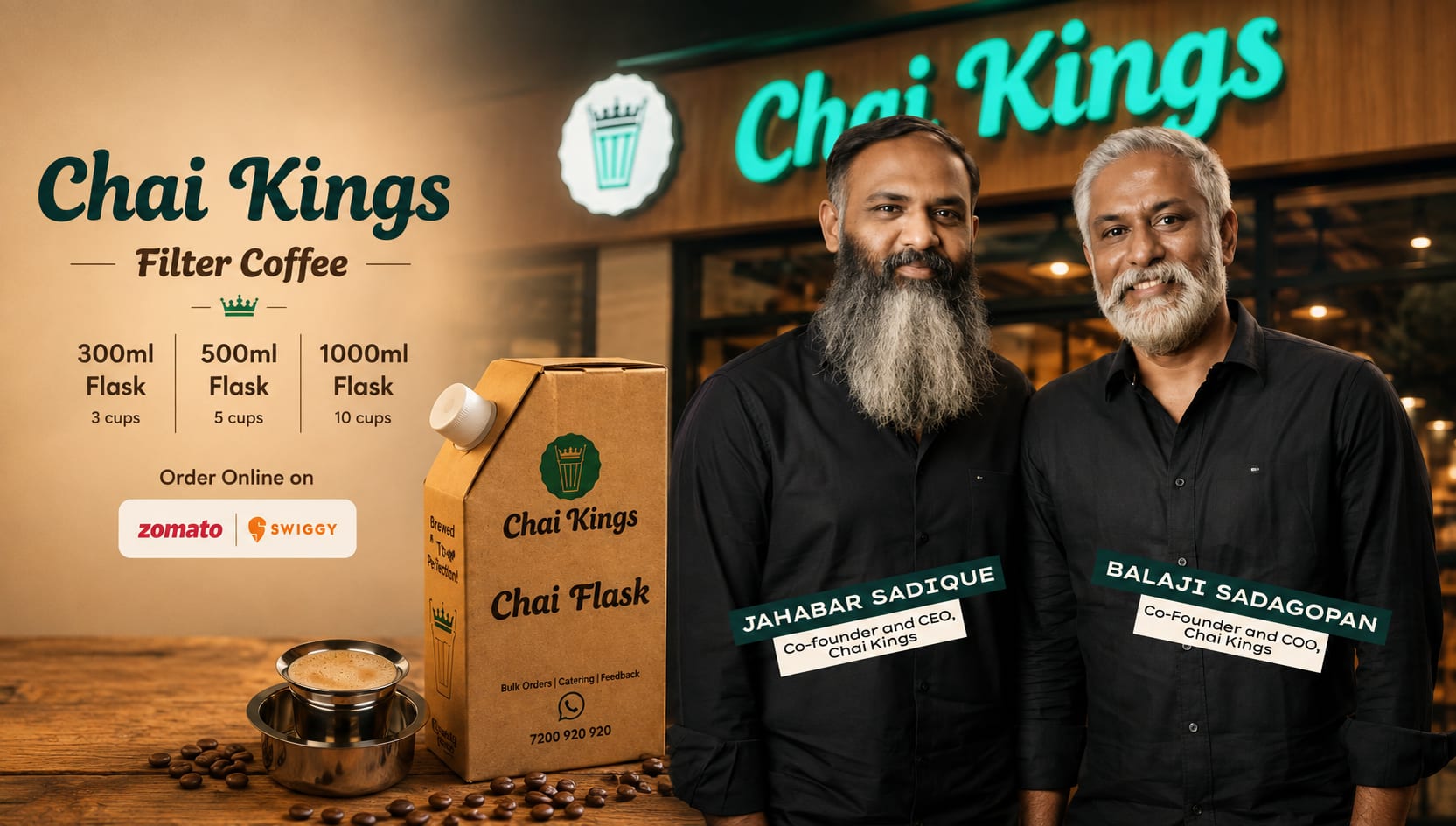
In a city where the aroma of filter coffee seems to linger everywhere, Chai Kings has quietly built a chai-centric movement of its own.
While filter kaapi remains deeply tied to Chennai’s identity and the city is famous for its coffee houses, chai is actually the preferred beverage for most of the day, says Jahabar Sadique, Co-founder and CEO of Chai Kings.
Initially, founders Sadique and Balaji Sadagopan had planned to launch a coffee product. Their research and observations, however, pointed them firmly toward chai—and they opened their first outlet in the city.
That decision has paid off. Starting with a single outlet in Chennai in 2016, Chai Kings has grown to 56 outlets today (50 of them in Chennai), serves over 32,000 cups every day, and generated ₹48 crore in revenue in the last financial year.
“We found that while Chennai residents enjoy filter coffee, they typically limit themselves to just one cup a day. Interestingly, tea is the preferred beverage throughout the rest of the day,” says Sadique.
Spotting the Gap in a Crowded Market
Creating space for a modern chai brand in a city synonymous with filter coffee presented both a challenge and an opportunity.
Chennai has around 25,000 tea stalls, most of them constantly packed. What was missing, the founders observed, was a pleasant environment where people—especially the young—could enjoy chai with family and friends.
“Chennai has about 25,000 tea stalls, mostly always packed, but they lack a fancy place popular with the young, which provides a good atmosphere for spending time with family and friends,” Sadique explains.
To fill this gap, the founders invested ₹1.4 crore to launch the flagship Chai Kings outlet in Kilpauk in 2016, focusing on quality beverages in an appealing ambience.
Today, the network includes 50 outlets in Chennai, six in Hyderabad and Coimbatore, and a presence in nine IT parks in the city.
From IT Careers to Entrepreneurship
After 12 years in the IT industry, Sadique and Sadagopan felt the pull of entrepreneurship. Between 2012 and 2016, they experimented with various franchise businesses, including salons and sandwich outlets. That experience proved valuable when they finally zeroed in on chai.
The first two years were slow as the founders learned the market. Momentum built between 2018 and 2020, when the brand added around 40 outlets. In 2020, Chai Kings raised $1 million from Chennai Angels, Hyderabad Angels, and TiE India Angels.
The pandemic then forced a two-year period of consolidation (2020 to mid-2022). “Our focus shifted to improving efficiency and profitability, which we achieved,” says Sadique.
The brand is currently seeing 12% month-on-month sales growth.
Expansion Plans and Funding Ambitions
For the past couple of years, Chai Kings has been looking for funding to support further growth. Raising capital has been challenging amid tough market conditions.
“While we can maintain operations profitably without external funding, scaling requires significant capital—around ₹14 to 18 lakh per new outlet. However, we are now raising and aim to close this round by the end of August,” Sadique says.
The company plans to raise $2 million to expand to 130 outlets within 18 months and target ₹120 crore in revenue. Beyond Chennai, it is eyeing Coimbatore, Hyderabad, and Bengaluru.
“In the next four years, our vision is to elevate our brand to a national presence,” says COO Balaji Sadagopan.
A Diverse and Expanding Menu
Over the years, Chai Kings has moved well beyond classic masala chai and ginger chai. Its menu now includes black tea, herbal teas, bubble tea, green tea, iced tea, hot and cold chocolates, milkshakes, and premium options such as saffron chai and Kashmiri Kahwa.
The brand offers more than 200 products across eight categories, priced between ₹30 and ₹400. Bubble tea variants (matcha, mocha, taro), inspired by Hong Kong recipes, have become especially popular with children and young adults.
Beverages still account for about 62% of business, while desserts and savouries such as puffs, sandwiches, samosas, and wraps make up the rest. Tea remains dominant at 78% of beverage sales (led by ginger chai, masala chai, and dum chai), with coffee contributing 20% and other drinks just 2%.
To improve profitability, the brand has shifted toward higher-margin food items priced at ₹100–150 and operates larger 500–600 sq ft stores that support this strategy. About 45% of revenue comes from online platforms such as Swiggy and Zomato, while 6% comes from B2B corporate orders.
Consistency Across Outlets
Maintaining quality and consistency is critical in food and beverage. Chai Kings uses SAP Business One for real-time inventory management across locations, helping optimise stock, reduce waste, and forecast demand.
Ingredients are centrally sourced from a single vendor to ensure uniformity. Because water quality varies by location, every outlet uses a six-stage filtration system for cleaning, drinking, and chai preparation.
The company has deliberately chosen a company-owned model rather than franchising to retain full control over quality, consistency, and brand standards.
Navigating a Competitive Market
The Indian tea market was valued at $11,702.3 million in 2024 and is projected to reach $17,934.1 million by 2033, growing at a CAGR of 4.19%. Competitors include brands such as Chaayos, Chai Sutta Bar, Chai Point, and others.
Chennai is a demanding market. “Chennai ranks high in food spending, after Delhi and Pune… However, Chennai’s discerning customers demand exceptional value and experiences,” Sadique notes.
Chai Kings’ approach centres on authenticity, competitive pricing, consistent quality, a diverse menu, and accessibility (roughly one outlet every 8 km). The brand also builds local connections through music shows, sporting events, and neighbourhood walking tours that include chai stories.
“Understanding local dynamics and adapting to local preferences while maintaining consistent brand values is key,” Sadique says.
As Chai Kings prepares to expand beyond Chennai, these lessons will travel with it—helping the brand take its modern chai experience to new cities while staying true to what made it succeed in the first place.