PRESS RELEASE
Fibrotech: Two Brothers Betting on FRP to Change Indian Infrastructure
India, September 8, 2026: What if the next generation of India’s infrastructure is not built around steel and concrete? It is a question that two brothers in Bengaluru have spent years trying to answer.
Steel rusts. Concrete deteriorates. Cast iron disappears from a site overnight. Yet these materials remain deeply embedded in the country’s infrastructure, from drainage systems and substations to electrical installations, service corridors and civic projects.
Fibrotech FRP is taking a different route: change the material, and change what is possible.
Founded and run by two brothers, Fibrotech manufactures Fibre Reinforced Polymer (FRP) components for infrastructure, industrial, electrical and civic applications. Its proposition is deceptively simple: engineer products that are lighter to handle, resistant to corrosion, and built to perform in the environments where conventional materials fail fastest.
The company is well past the experimental stage. Its products are deployed across more than 500 infrastructure projects, with a growing presence in real estate, metro and power. Its portfolio has expanded from a handful of products into more than a dozen categories.
And the ambition is getting bigger.
FROM ONE PRODUCT TO A MATERIAL PLATFORM
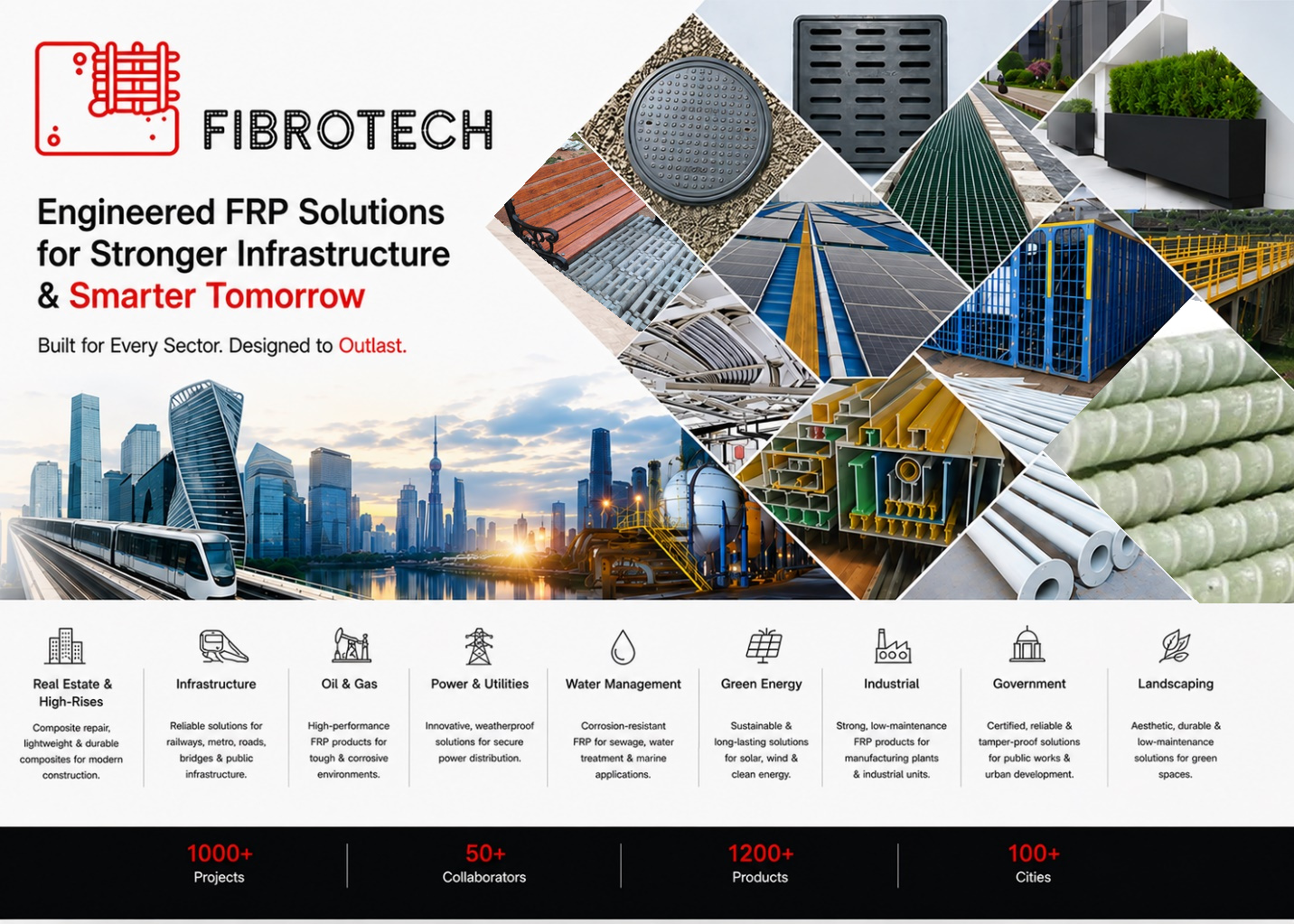
Fibrotech started with manhole covers and gratings, products that look mundane but sit at the heart of India’s infrastructure. From there the company expanded into gully tops, inspection chambers, pultruded profiles, cable trays, handrails, transformer fencing, wall brackets, planters, benches and other FRP components.
The underlying idea is consistent. Wherever a conventional component corrodes, is difficult to handle, is expensive to maintain or is simply heavier than it needs to be, FRP offers an alternative. That makes Fibrotech’s story less about any single product and more about material substitution.
THE REAL BATTLE IS WON BEFORE THE PRODUCT REACHES SITE
In building materials, manufacturing the product is only half the battle. Getting architects, consultants, engineers, developers and project teams to specify it is harder. Fibrotech has focused on earning that confidence through completed work. Its products have been installed in airport projects, in major residential and commercial developments by leading builder groups, and in smart city programmes.
That matters more than a project list suggests. A new material has to overcome years of habit. Engineers know steel. Contractors know concrete. Procurement teams understand conventional specifications. Changing that behaviour takes more than a sales pitch; it takes performance in the field. Every successful project therefore becomes more than an installation. It becomes the reference point for the next one.
WHERE CONVENTIONAL MATERIALS BEGIN TO STRUGGLE
The strongest argument for FRP appears where infrastructure is exposed: moisture, humidity, chemicals, and the corrosion that follows all three. These are precisely the conditions in which conventional metal components demand regular maintenance or outright replacement.
Fibrotech manufactures using pultrusion and moulding, with E-Glass fibre reinforcement and resin systems selected by application, including isophthalic, vinyl ester and fire-retardant systems.
The company’s FRP wall brackets are a useful example. Used to support cable trays, electrical utilities and industrial installations, the bracket has to provide structural support in environments that are hostile to metal. Its substantially lower weight also makes handling and installation easier, reducing dependence on heavy lifting equipment. The advantage is therefore not corrosion resistance alone. It is less weight, faster installation and lower maintenance across the life of the asset.
THE NEXT FRONTIER IS NOT A COVER. IT IS THE STRUCTURE ITSELF.
Fibrotech’s next moves suggest a company thinking beyond component replacement. It has entered the FRP crash-barrier segment and is preparing to enter FRP reinforcement bars. The second category is the more significant of the two.
Instead of replacing a component attached to a structure, FRP reinforcement bars address the material inside the concrete itself, where corrosion of steel reinforcement is a recognised long-term challenge.
That is a far bigger proposition than replacing a manhole cover. It is about changing the material that goes into the structure.
THE SECRET WEAPON IS SOMETHING MOST PEOPLE NEVER SEE
The visible products tell only part of the story. Behind the growing portfolio sits an in-house R&D and mould-development capability. In composites manufacturing, every new product begins with a critical piece of tooling: the mould. Developing that capability internally lets the company move from identifying a problem to designing a solution, building the mould and producing the finished component, without waiting on anyone else.
At least one product in the current portfolio was developed entirely in-house rather than adapted from an existing market product. That ability to develop, test and manufacture new solutions matters more as Fibrotech moves into specialised applications.
FROM BENGALURU TO INDIA AND BEYOND
The company is expanding across Indian cities while preparing its next phase of growth on two new fronts: exports and government infrastructure. FRP’s low weight is an advantage when products have to travel across markets. And government procurement is increasingly an arena where the conversation moves beyond purchase price towards durability, maintenance and whole-life cost. That shift favours materials designed not to be cheapest on day one, but to last longer and demand less attention over a service life.
THE BIGGER BET
India is building at a scale few countries can match. Every new road, metro system, residential development, industrial facility, electrical installation and civic project creates thousands of components that have to survive real-world conditions for years. Fibrotech’s bet is that many of those components do not have to be made from the materials traditionally used.
The company is not claiming FRP will replace steel and concrete everywhere. The bet is more practical, and more powerful for it: where conventional materials are expensive to maintain, vulnerable to corrosion, too heavy or difficult to install, composites offer a different answer.
For two brothers building a manufacturing company out of Bengaluru, that is an ambitious proposition. And if India’s infrastructure story is ultimately about building faster, lasting longer and maintaining less, the quiet shift from poured and welded to moulded and engineered may already have begun.
ABOUT FIBROTECH
Fibrotech is an Indian manufacturer of Fibre Reinforced Polymer (FRP) products serving infrastructure, industrial, electrical and civic applications. Its portfolio includes FRP manhole covers, gratings, gully tops, inspection chambers, cable trays, pultruded profiles, handrails, transformer fencing, wall brackets, planters, benches and crash barriers, with FRP reinforcement bars in development. The company manufactures at its facility near Hosur, Tamil Nadu, and supplies projects across India.