From a Needle Factory in England to 10 Lakh Bikes a Year: The Royal Enfield Success Story
Before Royal Enfield Built a Legend
In 1891, two Englishmen, Albert Eadie and Robert Walker Smith, acquired a small needle-making business called George Townsend and Co. in Redditch, Worcestershire. They were not thinking about motorcycles. Nobody was. The internal combustion engine was barely a decade old, and the idea of putting one on a bicycle frame was still being debated in engineering circles.
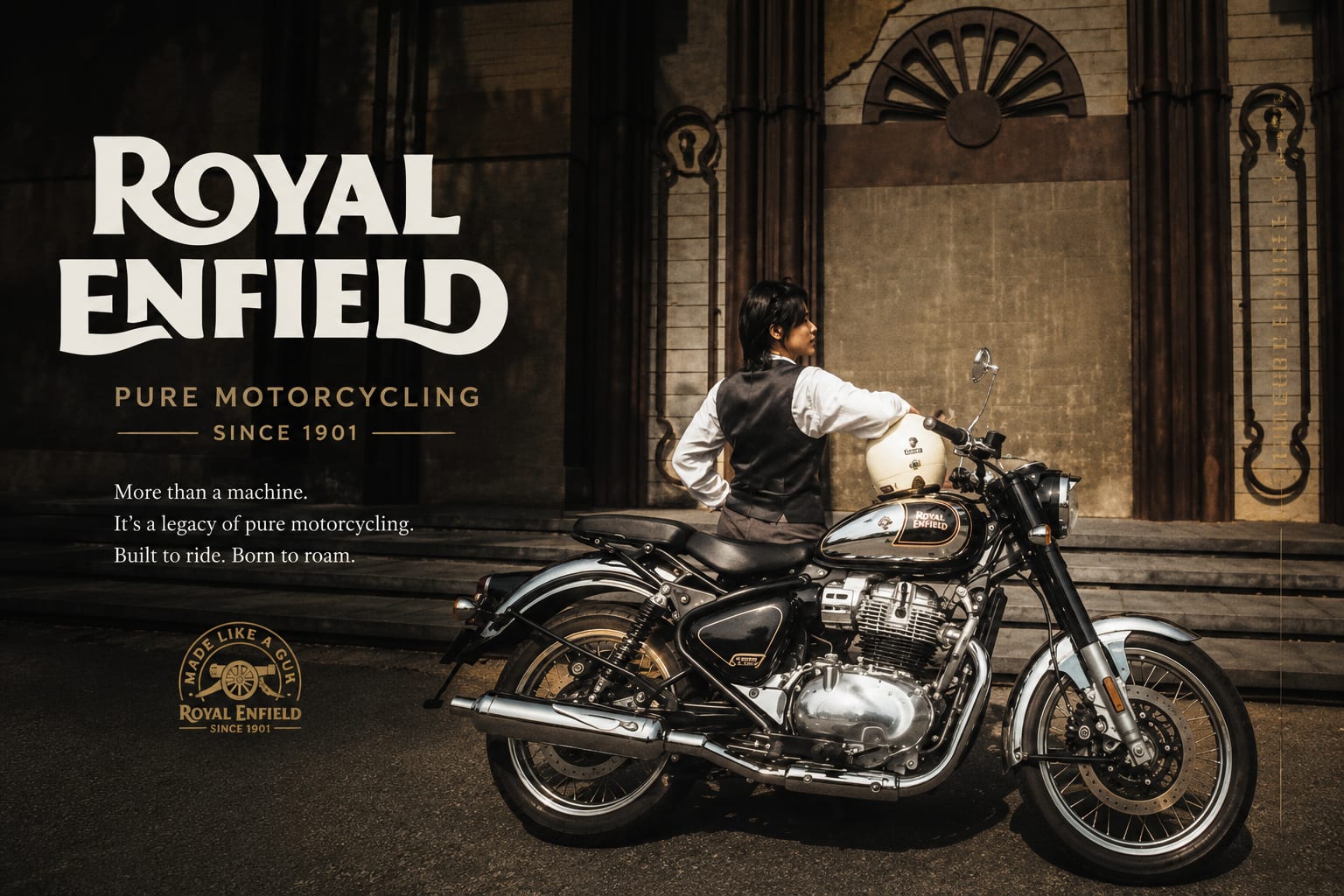
For the next several years, Eadie and Smith supplied precision parts to the Royal Small Arms Factory in Enfield, Middlesex. That government contract gave them two things: the word "Royal" in their name and a reputation for engineering built to military standards. The company slogan, Made Like a Gun, was not marketing. It was a description of where they came from.
In 1901, the company hired a French engineer named Jules Gobiet and partnered with chief designer Bob Walker Smith to build its first motorcycle. They debuted it at the Stanley Cycle Show in London in November 1901, alongside two quadricycles and a motorised bicycle. The motorcycle used a Belgian-made Minerva engine clipped onto the frame in front of the main down tube. It was rough. It was loud. And it was the beginning of the world's oldest motorcycle brand, still in production today.
The Government Order That Changed Royal Enfield Forever
Royal Enfield had been selling motorcycles in India since 1949, but the moment that changed everything came in 1955. The Indian government was looking for a motorcycle capable of patrolling the country's rugged Himalayan and Rajasthan borders. Several options were evaluated. The Bullet 350 was selected. The Indian Army placed an initial order for 800 units, which was a large order by any measure at that time. Soon after, more orders followed from both the army and state police forces across the country.
To fulfil these orders at scale, the Redditch company partnered with Madras Motors in India to form Enfield India in 1955. A purpose-built factory was constructed at Tiruvottiyur near Madras. Initially, bikes were shipped from England in kit form and assembled in India. By 1957, tooling equipment was also sent over, and by 1962, the Tiruvottiyur factory was manufacturing complete motorcycles from scratch.
The Bullet was proving eminently suitable for the tough terrain it had been chosen for. It was hardy. It was easy to maintain. And it had a character and presence that no other motorcycle in India could match.
The Company That Survived After Its Creator Died
Back in England, things were not going as well. The British motorcycle industry struggled through the 1960s and 1970s against cheaper, more reliable Japanese imports. The original Enfield Cycle Company's spare parts operations were sold to Velocette in 1967. The remaining motorcycle business went to Norton Villiers in 1967 and eventually closed in 1978.
But in India, the story was different. The Indian entity had taken on a life of its own. The Bullet had developed a following that no other motorcycle in the country could claim. It was used by armies, cherished by riders in rural India for its durability, and was slowly developing a cult status among a certain kind of Indian who valued character over convenience.
In 1990, Royal Enfield India began a collaboration with the Eicher Group, an automotive and manufacturing conglomerate. By 1994, Eicher had acquired full control of the company. And by the late 1990s, the brand that had survived the death of its original owner was now facing a crisis of its own making.
The Company That Nearly Died Twice
By 2000, Royal Enfield was in serious trouble. Production capacity was 6,000 bikes a month. Actual production was 2,000. The engines leaked oil. Gear shifts were unreliable. Accelerator cables snapped. Clutch cables failed. Electrical systems were inconsistent. The Japanese two-wheeler manufacturers had entered India with products that were more reliable, more fuel-efficient, and easier to ride. Royal Enfield was losing customers it could not afford to lose.
Vikram Lal, the chairman of Eicher Motors, looked at the numbers and made a decision. The company would shut Royal Enfield down.
His son Siddhartha Lal, who was 26 years old and had just joined the company after graduating, asked for a chance. He asked for two years to turn things around. His father gave him the company not out of confidence, but because things were going so badly they could hardly get worse. "It was not because of its confidence in me, but because the business was doing so badly it could hardly get any worse," Siddhartha later said.
The 26-Year-Old Who Refused to Give Up
Siddhartha Lal's first move was deliberate and symbolic. He told every employee in the company to stop using their company cars and commute only on Royal Enfield motorcycles. He wanted the team to feel every problem that a real rider felt, every vibration, every oil leak, every sticky gear, every electrical failure. You could not fix what you had not experienced.
He then began fixing things methodically. First the gears. Then the oil leaks. Then the snapping accelerator cables, the clutch cables, the electrical failures. The old cast iron engine was eventually replaced with a new aluminium engine that solved the emissions and leakage problems while keeping around 70% of the original thump that the brand's loyal riders had always loved.
When Siddhartha took over as CEO of Eicher Group in 2004, he did something even more dramatic. The Eicher Group had around 15 business lines at the time, spanning tractors, trucks, motorcycles, components, footwear, and garments. None of them were market leader. Siddhartha chose to divest 13 of those businesses and focus every resource the group had behind two: Royal Enfield and the trucks business.
It was the kind of bet that ends careers if it goes wrong.
The Bike That Changed Everything
All the years of repair work, platform development, and focused investment finally came together in 2010 with the launch of the Royal Enfield Classic.
The Classic blended the visual identity of the vintage Bullet with a new platform and modern engineering underneath. It was the motorcycle that loyal old riders recognised immediately and that a new generation of urban consumers wanted to own for the first time. It became an instant sensation on launch, achieving 100% capacity utilisation immediately. Waiting periods stretched to 6 to 8 months. The company had to triple production capacity to 1.5 lakh units just to keep up.
Sales that had been 50,000 units in 2010 hit 5,89,293 units by 2014. The numbers kept climbing from there. The Himalayan followed in 2016, the Interceptor 650 in 2018, the Hunter 350 in 2022, the Guerrilla 450 and Bear 650 in 2024.
Where Royal Enfield Stands Today
In FY25, Royal Enfield crossed 10 lakh bikes sold in a single year for the first time in its 125-year history, recording 10,02,893 units, a 10% year-on-year increase. Domestic sales rose to 9,02,757 units while exports surged nearly 30% to 1,00,136 units, spread across more than 50 countries.
Eicher Motors, Royal Enfield's parent company, reported its best-ever annual revenue of ₹18,870 crore in FY25 with a net profit of ₹4,734 crore. The company's market capitalisation currently stands at ₹1,96,875 crore, making it one of India's most valuable automobile companies. The brand has also launched Flying Flea, its first electric motorcycle brand, with the FF-C6 and FF-S6 models expected to go on sale in FY26.
More Than Just a Motorcycle
Royal Enfield is not a brand people buy because it is the fastest, the most fuel-efficient, or the most technically advanced motorcycle in its segment. It has never competed on those terms and has no intention of starting now.
People buy it because of how it sounds. Because of how it feels on an empty road at six in the morning. Because of the Ladakh stories and the Rajasthan rides and the annual gatherings where thousands of strangers show up on the same bike and instantly feel like they know each other.
A needle factory from 1891. A contract to make gun parts. An army order for 800 bikes in 1955. A 26-year-old asking for two years to save something his father had given up on.
That is the whole story. And it fits in a sentence: some brands survive because they are useful, but Royal Enfield survives because it means something.