From a Soap Bar to a ₹10 Lakh Crore Empire: The Comfort Success Story
The Hidden Problem with Traditional Laundry
In the 1960s, washing machines were becoming common in British homes. Detergents were doing their job. Clothes were coming out clean. But there was a problem nobody had named yet: they also came out stiff, rough, and uncomfortable to wear. Frequent washing was stripping fibres of their natural softness, and nothing existed to restore it. Market research confirmed what homemakers already felt. Getting clothes clean was no longer the issue. How the clothes felt afterward was.
Lever Brothers, already the UK's leading detergent manufacturer through its Persil and Surf brands, saw the gap and decided to fill it. In 1969, they launched Comfort nationally in the UK as the world's first commercial fabric conditioner. The idea was straightforward: add it to the final rinse cycle and it would coat fabric fibres, restore softness and springiness, and leave clothes feeling the way freshly washed clothes should. The product was new. The habit, however, took years to build.
The Challenge of Building Trust in a New Category
Comfort's early years were not a runaway success. The idea was slow to catch on, partly because washing machines at the time did not have separate compartments for powder and fabric conditioner. Using Comfort required an extra manual step that most homemakers found inconvenient to add to an already established routine.
Lever Brothers kept at it. They educated consumers through advertising, simplified usage instructions, and waited patiently for washing machine manufacturers to catch up with separate conditioner compartments. As machines evolved and consumers became more familiar with the concept, adoption grew. The 1970s and 1980s saw Comfort firmly establish itself as a British household staple. By 1984, the brand launched the first-ever concentrated fabric conditioner, three times more potent than the regular version, reducing plastic use and offering better value per wash.
In 1929, Lever Brothers merged with the Dutch company Margarine Unie to form Unilever. Under this new ownership, Comfort became part of one of the world's most powerful distribution and marketing platforms, giving the brand the infrastructure to expand far beyond the UK.
How Comfort Went Global
Through the 1990s, Comfort expanded aggressively across Europe and Asia. The brand underwent a new logo and modern packaging in 1992. In 1993, it became the first fabric conditioner with a fully biodegradable formulation. In 1998, Comfort replaced bulky cartons with lightweight, crushable bottles, reducing packaging waste, launched its first hypoallergenic variant for sensitive skin, and introduced tumble dryer sheets.
Each decade brought an innovation. Each new market brought a new challenge in consumer behaviour. In some Asian markets, Comfort was sold under different names. In Chile, it was called Soft. In Indonesia, Molto. In Israel, Badin. The brand adapted its name and fragrance profiles to local preferences while keeping the core product promise identical everywhere.
By the time Comfort entered India in 2008, it was already the world's number one fabric conditioner brand, ranking first in 14 of the 23 countries it operated in.
The Brand That Changed India’s Laundry Routine
India in 2008 presented a genuinely novel challenge. Hindustan Unilever was not launching Comfort into an existing fabric conditioner market. There was no market. The ₹12,700 crore Indian fabric care segment was almost entirely made up of washing powders at 55%, washing bars at 35%, and soaps at 10%. Fabric conditioners occupied a fraction too small to measure.
Indian consumers had never been given a reason to try one. The concept was alien. The benefit, softer clothes, felt invisible compared to the clear outcome of cleaner clothes. And the price, ₹35 for 100ml and ₹100 for 800ml, was an additional cost most households had never budgeted for.
HUL's approach was methodical. Small sachets and 200ml bottles of Comfort were bundled alongside Rin and Surf detergent packs, letting consumers try the product for free before committing to a standalone purchase. Neck tags attached to detergent packs explained what fabric conditioner does and how to use it. HUL described the effort clearly internally as market development, not brand marketing.
"There's a great need for market development, and as the leader, the onus is on us," said Sudhanshu Vats, HUL's Vice-President of Home Care at the time.
Why the Indian Consumer Eventually Said Yes
The product did not convince India with advertising. It convinced India by working. Comfort offered softness, long-lasting fragrance, anti-static protection, reduced wrinkling, and faster drying, all from a single step added to the final rinse. For households with young children, for anyone who machine-washes delicate clothes, and for a growing middle class that was spending more on quality clothing and wanting it to last longer, the benefit eventually became tangible and worth paying for.
HUL's own leadership was surprised to spot a bottle of Comfort in a home in a small town in Andhra Pradesh faster than expected. The product had travelled beyond its expected urban consumer base through word of mouth and trial. Once people tried it, they came back.
The Product That Never Stopped Evolving
Comfort has continued updating its formulation and range every few years. In 2021, Unilever launched Comfort Ultimate Care with Pro-fibre technology, offering fibre protection, colour retention, and shape preservation. In 2023, concentrated variants with Stay Fresh Technology were introduced, promising 100 days of freshness from a single wash. In May 2024, Comfort launched a botanical-inspired range with natural fragrances for consumers seeking a cleaner, nature-derived laundry experience.
In December 2024, Comfort India underwent a full relaunch with improved formulations and updated packaging, reinforcing its leadership position in the fabric conditioner category in India as it continues its steady growth.
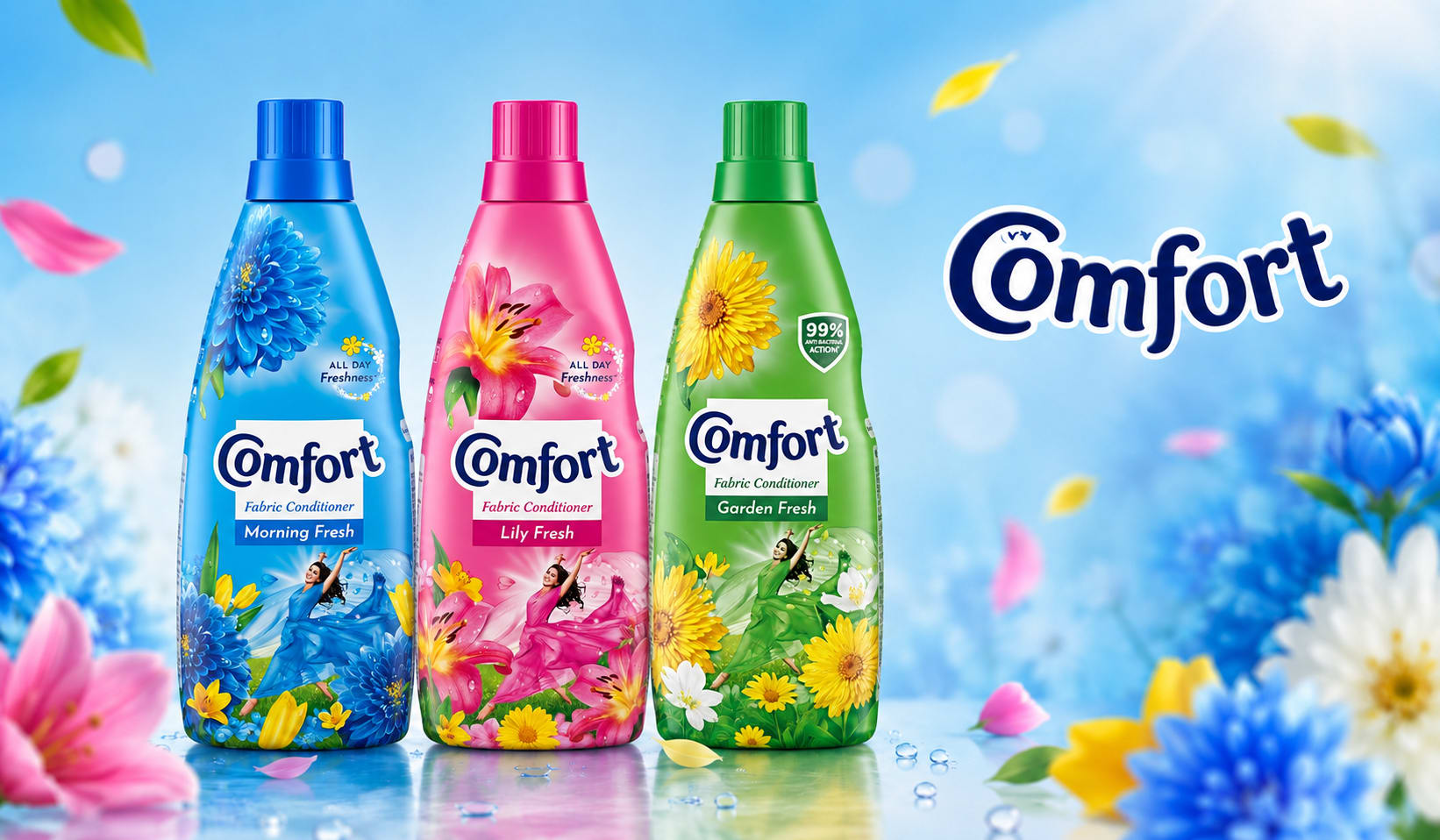
The iconic pink pouch became one of the most recognisable pieces of FMCG packaging in India. It required no explanation. It communicated exactly what the brand stood for the moment a consumer spotted it on a shelf.
Where Comfort Stands Today
As of 2025, Comfort generates approximately ₹12,000 crore in annual global sales, with around 40 units sold every second worldwide. It is available in 26 markets globally and sits within Unilever's Home Care division, which reported approximately ₹1,09,000 crore in turnover in 2024. The global fabric softener and conditioner market was valued at approximately ₹1,22,000 crore in 2023 and is projected to reach ₹1,54,000 crore by 2030.
In India, Comfort remains the leading fabric conditioner brand within HUL's home care portfolio, operating in a market that is growing steadily as washing machine penetration rises and a new generation of consumers adopts more considered laundry habits.
More Than Just a Fabric Conditioner
Comfort's journey spans 56 years, 26 countries, and a habit that did not exist anywhere in the world before 1969. It was built on a simple observation: clothes were clean, but they did not feel good. And someone at Lever Brothers decided that was a problem worth solving. The brand did not just create a product. It created a new step in the laundry routine, convinced generations of sceptical consumers to take it, and then travelled across the world, earning trust one wash at a time.
Some products solve existing problems. Comfort solved a problem most people had not yet thought to name.