How an Amitabh Bachchan-Led Studio Is Redefining Indian Gaming
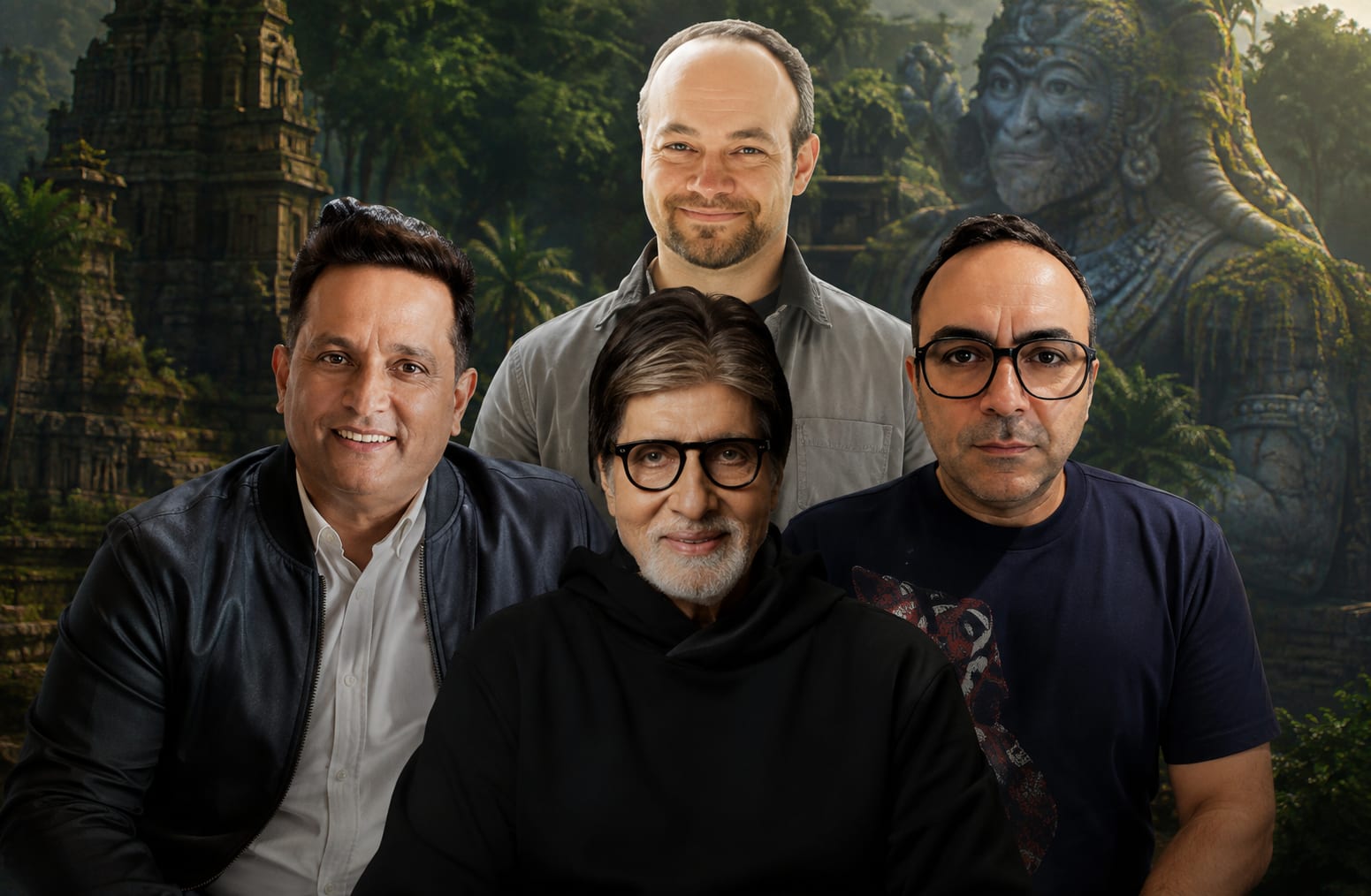
When the Chinese title Black Myth: Wukong sold 20 million units in its first month, it proved that Eastern mythologies could captivate a global gaming audience. That success prompted Nouredine Abboud, a former Ubisoft producer and now CEO of Novaquark, and Nicolas Granatino, President of Novaquark and founder of Paris-based accelerator StemAI.vc, to look eastward for their next project.
They first considered the Middle East, but found the region already explored in games like Prince of Persia. India, with its rich mythos of the Ramayana and the Mahabharata, felt fresher and surprisingly modern. To adapt those stories into a compelling fictional narrative, they partnered with bestselling author Amish Tripathi, known for The Shiva Trilogy and the Ram Chandra Series.
In 2024, Tara Gaming was born in Pune. Abboud and Tripathi serve as co-founders, with Granatino as executive chairman. The studio now employs an international team of 140 people, including 40 based in Pune. Their debut project, The Age of Bhaarat, is positioned as one of India’s first true AAA game titles defined by large development budgets, high production values, and extensive marketing support.
The trailer, released in May, was narrated by legendary actor Amitabh Bachchan, who also joined as a co-founder. Citing his lifelong commitment to storytelling, Bachchan said: “When I heard Amish’s and Nouredine’s vision, I was instantly drawn to the potential of creating something truly monumental. India has always been a land of powerful stories, and through this game, we have an opportunity to share our epics, creativity, and imagination with the world.”
Reimagining the Ramayana for Players
The Age of Bhaarat is envisioned as a dark fantasy action-adventure RPG set in a fictionalised world inspired by ancient Indian epics. Granatino describes it as leaning more toward adventure in the vein of the Uncharted series, rather than pure action like Black Myth: Wukong.
Players will not control figures such as Lord Rama. Instead, Tripathi explains, the Ramayana serves as the overarching meta-narrative; Rama’s conflict with Ravana remains the backdrop. The playable micro-narrative unfolds in the forests of Dandakaranya, where wardens battle junior rakshasas from Ravana’s army. This approach allows players freedom within a richly built universe rather than a tightly controlled linear story.
Writing for games required a major mindset shift for Tripathi. “In books, the author retains narrative control. The reader has to follow it. But in a game, the player decides where to go. So, instead of building a story, I will have to set up an entire universe.”
To balance Indian authenticity with global accessibility, Tara Gaming’s writing room, led by Tripathi, includes talent from multiple countries. “What’s obvious to an Indian might be incomprehensible for an American. A diverse team ensures that we maintain the accessibility of the narrative without losing its essence,” he notes.
Building Momentum and Ecosystem Impact
The trailer generated strong global interest. Popular streamer Asmongold, with over four million subscribers, reacted positively and noted similarities to Black Myth: Wukong. Granatino points out that Sun Wukong, the Monkey King at the heart of that game, is traditionally linked to Hanuman—suggesting shared mythological roots. More importantly, he hopes The Age of Bhaarat can do for India what Assassin’s Creed did for Montreal or The Witcher for Poland: put a nation’s cultural stories firmly on the global gaming map.
India’s gaming industry has long struggled to produce AAA titles, held back by high development costs, investor scepticism, and tax challenges. Granatino believes Tara Gaming’s backers share a conviction that Indian culture and epics deserve a place alongside the world’s biggest gaming franchises. The studio has raised $20 million so far and is structured similarly to other major AAA projects, which often require budgets exceeding $60 million over several years, supported by tools like Unreal Engine.
An alpha version for PC and consoles is targeted for the end of 2026. Recognising that India’s market remains heavily mobile-driven, the team also plans a mobile version later. Their broader strategy is franchise-first: a console and PC AAA core, expanded through mobile, film, series, and other media.
Both Granatino and Tripathi see Bachchan’s involvement as a cultural signal. Mainstream entertainment figures are beginning to recognise gaming’s growing influence. Granatino notes that the Game Awards attract far larger audiences than the Academy Awards. Tripathi adds that personal connections helped: Bachchan’s son Abhishek is a gamer, just as Tripathi’s own son celebrated the Asmongold reaction as a sign that his father had “arrived” in gaming culture.
Competing on Cultural Strength
Tara Gaming enters a competitive field that includes ambitious Indian studios and global heavyweights such as FromSoftware. Its differentiator is a clear commitment to placing Indian myths at the centre of a modern fantasy experience, crafted for worldwide players without diluting their essence.
Structured funding rounds are planned around key milestones such as the vertical slice demo and alpha. The aspiration is ambitious yet clear: to make The Age of Bhaarat not only India’s first global AAA game, but one of the country’s largest cultural exports on a scale comparable to The Witcher.
For a country whose stories have shaped literature, cinema, and television for generations, the leap into high-end interactive entertainment feels overdue. With an experienced international team, a celebrated storyteller, and one of India’s most iconic voices on board, Tara Gaming is attempting to bridge that gap one carefully built universe at a time.