How IG Drones Is Building Indigenous Technology for the Indian Army and Beyond
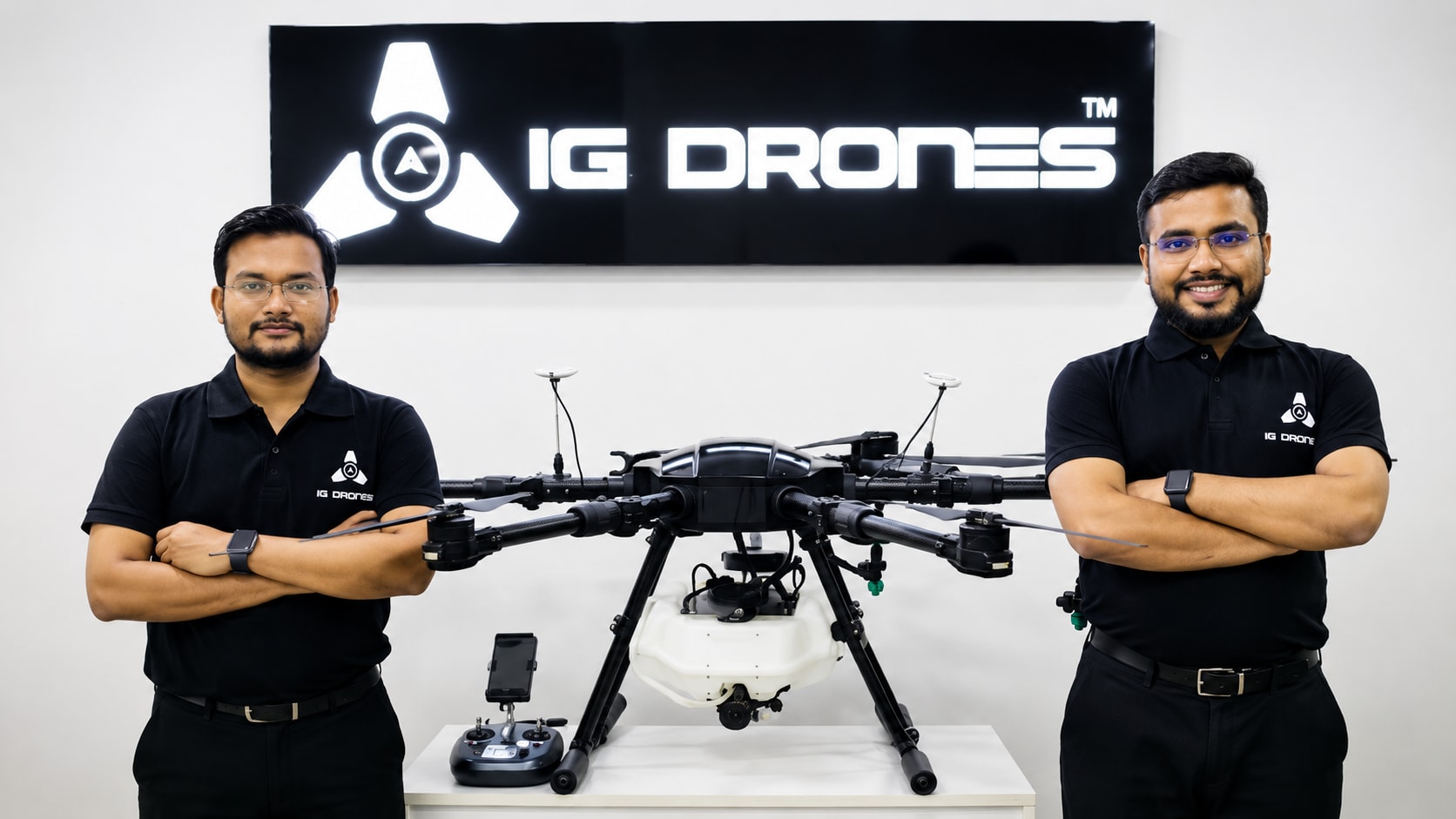
India’s drone industry is undergoing rapid change, and Gurugram-based IG Drones is working to shape that transformation with a clear focus on indigenous technology. Founded in 2018 by Bodhisattwa Sanghapriya and Om Prakash, the startup is tackling two of the sector’s biggest constraints: heavy reliance on foreign suppliers and a shortage of skilled professionals.
By prioritising advanced research and development, IG Drones aims to deliver solutions tailored to Indian needs while reducing dependence on imported hardware and software. “By offering advanced, indigenous drone tech solutions, IG Drones tackles critical industry hurdles and plays a pivotal role in advancing India’s drone ecosystem,” says Sanghapriya, the company’s CEO.
The bootstrapped startup has developed products including military simulators and AI-powered systems, among them what it describes as India’s first 5G-enabled drone. It also plans to expand a network of Drone Centres of Excellence to train new talent and drive further innovation. Today the company provides surveying, mapping and inspection services and works with the Indian Army, state governments and large enterprises.
From Student Rocketry to Drone Innovation
The founders’ journey began at Veer Surendra Sai University of Technology (VSSUT) in Odisha, the state’s oldest technical university. During their engineering studies, Sanghapriya and Prakash led Asia’s first student rocketry mission. The project received widespread recognition, including from Prime Minister Narendra Modi, and was later adopted by ISRO.
“This milestone highlighted the transformative potential of aerospace technology to solve real-world challenges. Also, we took it as a challenge that India is capable of making its own satellite if young talent is nurtured right from the school or college level,” Sanghapriya reflects.
That experience shaped the decision to launch IG Drones. The company set out to address operational inefficiencies, dependence on foreign providers, and the lack of trained professionals in the drone sector. Through indigenous, AI-powered solutions it has worked across defence, agriculture and infrastructure. The startup has also received international recognition, including the Global Airwards, and has set a goal of capturing 5% of the drone industry market share by 2025.
Product Portfolio and Technology
IG Drones offers a range of specialised systems. Its Jaga platform is an AI-powered 5G-enabled surveillance drone designed for security, defence, agriculture, precision mapping, surveying, inspection and infrastructure monitoring. For agriculture, the company provides Kissan, built for spraying and spreading. SKYHAWK supports delivery, mapping, security and surveillance, while DELTA 400 is focused on advanced mapping and inspection.
“IG Drones provides extraordinary drone services for power line monitoring, road inspection, smart city, mine survey, industrial survey, pipeline survey, agricultural survey, railway survey, river mapping, and disaster management by taking care of client needs in line with Industry 4.0,” Sanghapriya says.
By combining drone hardware with AI and analytics, the company claims to have served more than 500 organisations, including the Indian Army, government agencies and leading corporates. Sanghapriya reports 250% year-on-year growth over the past three years and expects the company to significantly expand revenue as demand for accessible indigenous solutions rises.
Building Skills Alongside Technology
Beyond products and services, IG Drones has placed strong emphasis on training. Through its Drone Centres of Excellence it has trained more than 50,000 individuals and maintains partnerships with over 15 institutions, including IIT Bhubaneswar and IIM Sambalpur. “With this initiative, we have also been able to bridge the gap between education and industry by providing skilled training to thousands of youth and helping them get employed,” Sanghapriya notes.
One of the early challenges was convincing industries of the practical value of drones. “Many organisations lacked awareness of how drones could optimise operations and save costs. By persistently demonstrating the tangible benefits, IG Drones turned skeptics into advocates,” says Om Prakash, the company’s COO.
The competitive landscape includes players such as Garuda Drone, ideaForge, BonV Aero and DroneAcharya Aerial. Prakash argues that IG Drones differentiates itself through an integrated offering that combines hardware, software and services, positioning it as an end-to-end solution provider for defence, agriculture and infrastructure.
Business Model and Growth Plans
The company follows a B2B model and has established relationships with state governments, Indian Railways, the Indian Armed Forces, Power Grid Corporation, Adani Group, Aditya Birla Group, Reliance Group, HCL Foundation and World Bank projects.
Lt Gen Anil Chait, Lead Advisor of India Accelerator’s Robotics Unmanned & Space thesis, has noted the strategic relevance of the company’s technology: “IG Drones’ GIS mapping and geospatial technologies can add immense value to Indian customers, especially the Indian armed forces, to enhance their surveillance and mapping capabilities which are fundamentals for multi-domain warfare. Additionally, its Drone Simulator platform can be used to train drone pilots in realistic scenarios based on operational terrain. Cargo lift of 50 kg that has been achieved by the company will provide the bedrock for the future of cargo logistics both in the civil as well as military domains.”
In October 2024 the startup raised $1 million in its initial funding round led by India Accelerator, with participation from angel investors. It plans to raise an additional $3 million within the following six months to strengthen R&D and expand its presence in India and overseas. IG Drones is already active in five countries and has partnered with international firms such as the Korean drone solutions startup iGiS.
Because of its work with the armed forces, the company does not disclose detailed revenue or unit figures. Looking ahead, Prakash says the focus remains on developing targeted tools for agricultural yield monitoring, disaster management and secure defence operations, while continuing to expand globally and scale training through the Drone Centres of Excellence.
By combining indigenous hardware, AI-driven software, practical services and large-scale skilling, IG Drones is working to reduce India’s dependence on foreign drone technology while building the talent base required for long-term growth. For a sector still maturing, that dual emphasis on products and people may prove as important as any single technical breakthrough.