How Kaleidofin Is Giving India's Informal Workers a Credit Score
India’s credit market is flooded with buy-now-pay-later apps, instant personal loans, and pre-approved credit cards. For salaried professionals with steady pay cheques and clean credit histories, borrowing has never been easier. For the country’s vast informal sector, the story is very different.
Street vendors, small farmers, dairy producers, and neighbourhood shopkeepers often run viable businesses and manage complex cash flows. Yet traditional credit scoring models render them invisible. Banks and NBFCs lack reliable tools to assess risk when income is seasonal, formal documentation is sparse, and what counts as a moderate income in Tamil Nadu looks very different from Jharkhand. Credit bureaus cannot distinguish between a hawker needing short-term working capital and a dairy farmer with relatively steady earnings. Faced with uncertainty, the system defaults to rejection.
That is the gap Kaleidofin set out to close.
From Savings Platform to Credit Intelligence
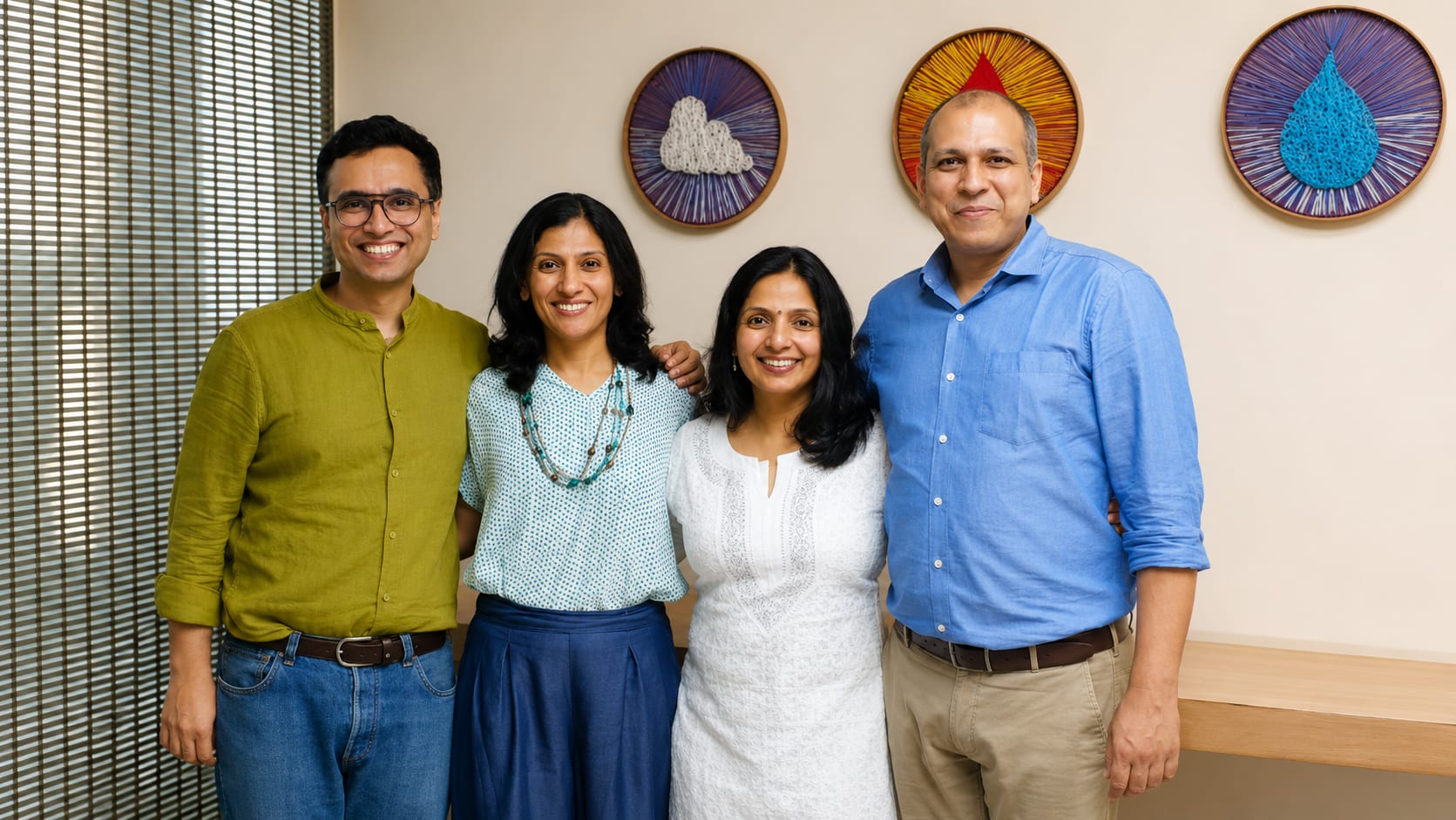
Founded in 2017 in Chennai by Sucharita Mukherjee and Puneet Gupta, Kaleidofin builds credit assessment tools designed specifically for the informal economy. Mukherjee previously served as Vice President at Morgan Stanley and Deutsche Bank, founded IFMR Capital, and led IFMR Holdings as CEO. Gupta, a former Chief Manager at ICICI Bank, co-founded the IFMR Trust Group and held senior roles including CEO of IFMR Mezzanine Finance and CFO of IFMR Holdings. They are joined by Natasha Jethanandani (co-founder and CTO), who brings experience from Microsoft and Google and a Stanford degree, and Vipul Sekhsaria (co-founder and COO), who previously headed new business initiatives at IFMR Holdings.
Kaleidofin began as a savings platform. Informal workers could access loans but had few safe places to save. Customers set aside small monthly amounts toward goals such as children’s education; Kaleidofin invested these in mutual funds with insurance cover, working through microfinance partners whose agents collected savings during loan visits.
COVID-19 disrupted the model. When repayments stalled, agents pressured customers to withdraw Kaleidofin savings to clear overdue loans, damaging the distribution channel. Separately, SEBI banned the pooling of customer funds into a single account before investment, a rule that took effect in 2022.
Yet the data models Kaleidofin had built to understand household income and stability proved unexpectedly valuable. When lenders struggled to identify who could still repay, the company already possessed tools that could answer the question. Those models were repurposed into credit scores at the exact moment banks needed better risk assessment.
The “ki score” and Localised Intelligence
Today Kaleidofin’s core product is the “ki score.” It draws on a far wider data set than traditional bureaus: demographics, geography, payment patterns, savings behaviour, and alternative sources including satellite imagery, rainfall patterns, crop types, and livestock counts for agricultural customers.
“Credit assessments need to happen in fractions of a second for real-time lending decisions,” Gupta notes. This required a data warehousing system capable of retrieving information instantly from multiple sources.
The decisive difference is a multi-model approach. Instead of one national model, the platform runs hundreds of localised versions. A rain-fed farmer in a remote Bihar village is scored differently from an irrigated farmer near Patna. “If you use the same model to appraise all farmers, a rain-fed farmer might always get eliminated,” Gupta explains.
When a bank or NBFC receives an application, Kaleidofin’s API returns a credit decision in real time—within seconds. The company also offers “ki view,” a risk-management dashboard that helps lenders monitor portfolio health and detect early warning signals. It facilitates co-lending arrangements among banks, NBFCs, and microfinance institutions.
On the compliance side, Kaleidofin adheres to the Digital Personal Data Protection Act, holds SOC 2 Type 2 compliance, and maintains ISO 27001 certification. KPMG conducts audits four times a year. Customer data flows in masked form; recommendations return in roughly 0.03 seconds. Banks retain final approval authority, and Kaleidofin continuously refines its models using actual loan performance data.
The Chennai-based B2B company works with more than 57 partners, including banks, NBFCs, and microfinance institutions. Models have already been taken to Bangladesh and parts of Africa.
Scale and Performance
In seven years, the platform has enabled loans to over 10.6 million unique customers and supported disbursements totalling $9.12 billion. It currently evaluates more than 350,000 customer loans each month across categories that include women entrepreneurs, agriculture, dairy, loans against property, and small business finance. Monthly volumes run around $215 million.
Credit risk on loans underwritten with Kaleidofin’s models has stayed under 3 percent even during periods of elevated industry stress. Many customers who previously could access only group loans now receive individual credit. The company employs about 100 people and is approaching operational break-even.
Looking Ahead
Gupta frames the long-term vision simply: making high-quality financial products available to low-income households so they can build livelihoods on firmer ground. In India, the priority remains expanding partnerships and continuously incorporating new data sources while proving model performance to lenders.
The challenges of other developing markets resemble India’s, though few countries have as mature a financial services infrastructure. Kaleidofin has begun operations in East Africa and plans gradual expansion across the region and, later, into Southeast Asia.
India’s informal economy is not uncreditworthy. It has simply been underserved by tools built for a different kind of borrower. By combining alternative data, including satellite imagery, with localised AI models, Kaleidofin is giving banks a practical way to see, score, and serve the customers the traditional system has long rejected.