How MyWonder’s Screen-Free AI Toy is Helping Kids Talk, Think, and Dream Again
In most Indian homes today, the sight of a child glued to a screen has become painfully common. Between online classes, cartoons, and endless YouTube videos, young minds are increasingly shaped by glowing rectangles rather than real-world wonder.
Bengaluru-based MyWonder is on a mission to change that.
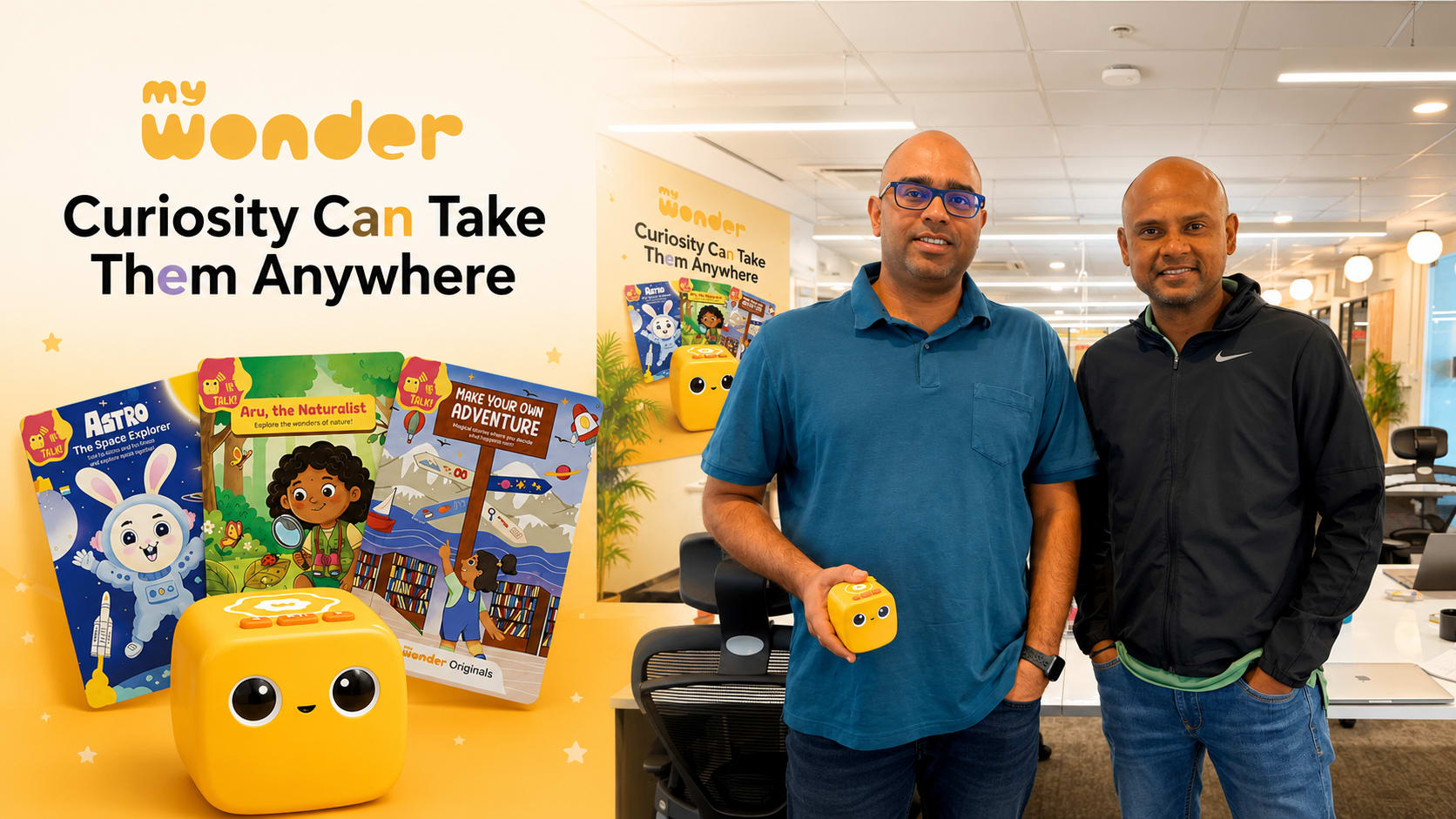
Founded in 2024 by Chandramouli K and Venkat Potluri, the startup has created MyWonder, a palm-sized, screen-free, AI-powered device designed for children aged 3 to 10. Instead of passive scrolling, Wonder encourages active conversation, storytelling, and imaginative play through voice interaction.
Launched from stealth in October 2025, MyWonder is redefining what “edtech hardware” can look like in Indian homes: fun, safe, and deeply human.
The Problem MyWonder Solves
Modern childhood is under siege from excessive screen time. Parents worry about attention spans, language development, social skills, and creativity all impacted by constant digital stimulation.
Chandramouli explains the core motivation: “We want to bring back the wonder years that magical phase where curiosity, storytelling, and unstructured play come naturally to children. Our mission is to make technology that talks with children, not at them.”
How Wonder Actually Works
At first glance, Wonder looks like a charming, colourful toy. But switch it on, tap one of its interactive Wonder Cards on the Pod, and an entire world of adventures comes alive.
The device features several engaging characters:
Astro — an explorer guiding kids through space adventures
Riddles — a wise owl that challenges them with puzzles
Mind Reader — for voice-based 20-questions games
Make Your Adventure — where children co-create stories and decide how they unfold
Each card instantly activates a specific AI character. Kids don’t just listen — they talk back, ask questions, and shape the experience. The conversations feel natural and responsive.
A starter pack includes 10 interactive cards. Additional cards are available across themes like science, nature, math, stories, and music. Parents can even create custom cards featuring family voices or personal stories.
Smart AI Built for Real Indian Homes
The technology behind Wonder is impressive. MyWonder developed a proprietary conversational AI engine optimised for real-time voice interactions on low-cost hardware.
“We re-engineered the entire AI pipeline,” says Chandramouli. “We made it possible to deliver rich conversations without heavy cloud dependency.”
Each character is a tightly defined AI entity. Astro stays in the realm of space exploration. Riddles focuses on puzzles. This design keeps interactions safe, relevant, and age-appropriate.
Wonder is also engineered for noisy Indian households. After multiple iterations, the team implemented a dual-microphone setup with active noise cancellation, placing the mic near the toy’s “beak” for better voice capture.
The device is priced at ₹4,999 (including 10 cards). Extra cards range from ₹399 to ₹999. The startup has partnered with publishers like Hachette India and Pratham Books, with Sudha Murty’s stories also coming soon in immersive audio format.
Adaptive Learning That Grows With the Child
Wonder doesn’t just entertain it subtly educates. The AI monitors how children interact and gently adjusts difficulty through “micro-challenges” never too easy, never too hard.
Parents get a companion app with usage summaries (“Your child spent 20 minutes exploring space with Astro”) and insights into interests and learning patterns. The system can even flag signs of stress or discomfort.
Strong Early Momentum
MyWonder has already raised $300,000 in pre-seed funding from Antler India and was selected for Google’s AI for Startups programme. The company is now planning to raise around ₹20 crore for the next phase of growth.
Wonder is currently available on the company website, with deliveries beginning in December 2025. Listings on Amazon and Flipkart are also in the works. The startup is piloting partnerships with schools and early learning centres.
Why Screen-Free AI Matters
The global edtech hardware market is booming, projected to grow from $46.7 billion in 2023 to over $106 billion by 2030. MyWonder aims to capture a meaningful share by offering something different: technology that enhances imagination rather than replacing it.
In a world overflowing with visual noise, MyWonder bets on the most natural interface children have: voice and conversation.
“Children learn best through dialogue, curiosity, and play,” says Chandramouli. “Not by scrolling.”
The Bigger Vision
MyWonder isn’t building just another gadget. It is creating a new language for childhood, one where technology augments human connection instead of replacing it.
The founders dream of every child in India having access to their own Wonder, a companion that listens, responds, teaches, and most importantly, sparks joy and imagination.
As AI becomes part of everyday life, tools like Wonder show how it can be designed with empathy, safety, and child development at the centre.
For parents tired of screen addiction battles, MyWonder offers a refreshing alternative: a smart toy that encourages kids to talk, think, ask questions, and dream bigger.
In the noisy digital age, sometimes the most powerful innovation is the one that brings us back to simple, meaningful interaction.
Wonder isn’t replacing imagination. It’s helping bring it back to life.