How Scotch-Brite Built a ₹2.5 Lakh Crore Global Business: The Scotch-Brite Success Story
When Every Kitchen Had a Problem
Every kitchen in the world shared one common frustration. Washing vessels meant scrubbing. Scrubbing meant rough hands, worn-out jute scraps, or steel wool that rusted and scratched. Nobody had a good answer. Greasy pans, burnt residue, and baked-on food were simply part of the daily reality of cooking. You scrubbed harder, or you gave up.
Nobody had thought to engineer a better tool for this. Not until a quiet 3M lab technician spent a summer alone in a university library trying to understand how fibres worked.
The scrubber in your kitchen today is the result of that summer.
How a Struggling Company Built a Global Giant
To understand Scotch-Brite, you first have to understand 3M, because nothing about this brand's story begins where you would expect it to.
In 1902, five businessmen in Two Harbors, Minnesota, formed the Minnesota Mining and Manufacturing Company to mine a mineral deposit they believed would make excellent grinding wheel abrasives. The deposit turned out to be nearly worthless. The company had no product, no revenue, and no real reason to continue existing. Most early investors walked away.
The few who stayed moved the company to Duluth, abandoned mining, and pivoted to manufacturing sandpaper using purchased abrasive minerals instead. The sandpaper was inconsistent, customers complained constantly, and the company remained one bad quarter away from collapse for years.
Then a 20-year-old showed up and changed everything.
The Man Who Saved the Company
William L. McKnight was born in 1887 in White, South Dakota, in a sod home on his parents' homestead. In 1907, four months into a six-month business college programme, he dropped out and applied for a job at the struggling 3M as an assistant bookkeeper. He was rejected the first time because his handwriting was illegible from nerves. He came back, applied again, and was hired on May 13, 1907, at a salary of ₹960 a month in today's equivalent terms, which was $11.55 per week at the time.
McKnight was 20 years old, joining a company that was bleeding cash and producing products that literally fell apart in customers' hands. He did not panic. He observed. He studied the company's financial position line by line and began identifying where costs could be cut and where quality was failing. His first major insight was that the company's sandpaper was contaminated with olive oil absorbed from shipping crates, a detail nobody had thought to investigate before.
That kind of thinking, patient, curious, and unwilling to blame customers for problems caused by the company itself, defined everything McKnight built over the next 65 years.
By 1914, just seven years after joining as a bookkeeper, McKnight was named General Manager. By 1916, at 29, he was Vice-President. By 1929, he was President. He held leadership positions at 3M until 1972, overseeing a company that grew from near-bankruptcy to one of the world's most respected manufacturing corporations.
The Management Philosophy That Made Everything Possible
McKnight did not just save 3M financially. He built a culture that made every great product that followed, including Scotch-Brite, possible.
His core management belief was radical for the early 20th century. He argued that as a business grows, it must delegate responsibility and encourage people to exercise their own initiative. He famously created the 15% Rule, allowing 3M scientists to spend 15% of their working hours on any project of personal interest, with no approval required. Decades before Google's 20% time became famous, McKnight had already institutionalised creative freedom at a sandpaper company in Minnesota.
"If you put fences around people, you get sheep," he said.
That philosophy is the direct reason Scotch-Brite exists.
The Mail Boy Who Invented the Scrubber
In 1925, a young man named Al Boese dropped out of high school and worked as a bellhop and drug store clerk before joining 3M as an office boy in 1930. He had no degree. He had no scientific credentials. He had curiosity and the freedom that McKnight's culture had created.
By 1933, Boese had moved into the laboratory as a helper. By 1938, his boss told him bluntly that he might not be cut out for technical work. Rather than look for another job, Boese went to the University of Minnesota's Home Economics Department, which had the best available library on fibre science, and spent an entire summer there alone, studying how fibres could be bound together without weaving them.
One day, he placed a small tuft of fibre in a colander, heated the surface, and watched the fibres bond together without weaving. That was the beginning of non-woven material. In 1950, Boese married this non-woven technology with abrasive compounds, binding aluminium oxide and titanium oxide into the fibre structure to create a scrubbing pad that could clean without weaving, without rusting, and without scratching the way steel wool did.
The Scotch-Brite scrubbing pad was born. By 1958, it was being marketed for industrial use. By 1960, it had entered consumer homes.
How Scotch-Brite Reached Every Indian Kitchen
3M established its India operations in 1987 and listed on the Indian stock exchanges in 1995. Scotch-Brite entered Indian kitchens as a premium product at a time when most Indian homes used wire scrubbers, coconut husk, or rough jute to clean vessels.
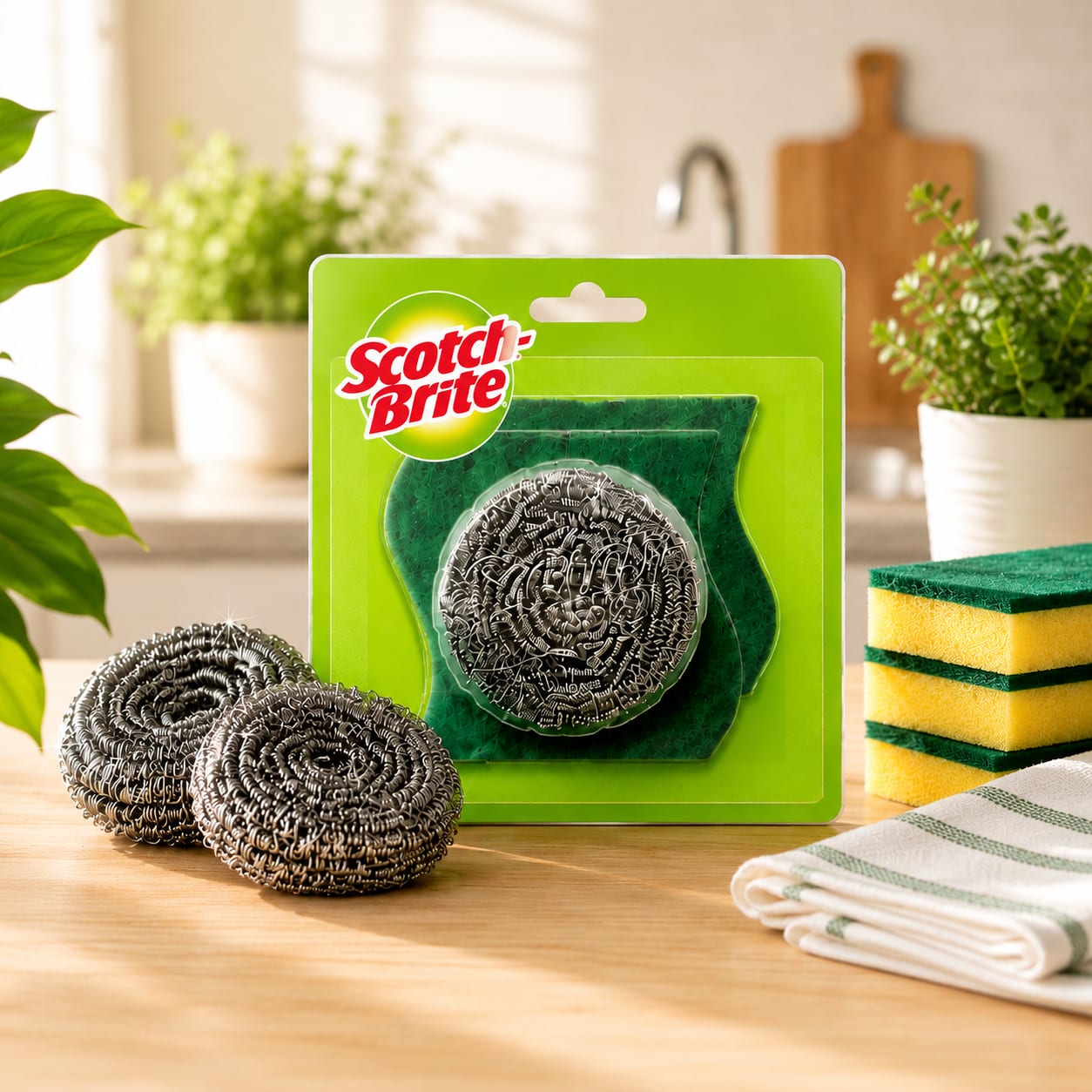
The green scrubber pad with its distinctive rough surface and soft sponge layer was immediately different from anything available in the market. It did not rust like metal scrubbers. It did not leave fibres behind like jute. It cleaned grease efficiently, lasted longer than alternatives, and felt good to hold. Indian homemakers took to it quickly.
3M India built distribution into every tier of Indian retail, from large modern grocery stores to neighbourhood kirana shops. The product's distinctive green and yellow packaging became one of the most recognised product identities in Indian kitchen cleaning, to the point where many Indian consumers now call any scrubber a Scotch-Brite, regardless of the brand, the same way people say Xerox for any photocopy.
Where Scotch-Brite and 3M Stand Today
3M India reported revenue of ₹5,090 crore in FY25 and carries a market capitalisation of ₹37,445 crore on Indian exchanges, with 3M Company holding a 75% promoter stake. The consumer segment, which includes Scotch-Brite, Post-it, Scotch tape, and Command products, reported ₹464 crore in revenue for FY25.
Globally, 3M Company reported revenue of approximately ₹2.3 lakh crore in the most recent trailing twelve months. The parent company's market capitalisation has historically touched and exceeded ₹2.6 lakh crore, the figure referenced in the brand's image. Scotch-Brite is manufactured in over 70 countries today and is available in more than 100, with a product range spanning kitchen scrubbers, bathroom cleaners, floor maintenance pads, industrial polishing materials, and a growing line of sustainable, plant-based cleaning tools launched in 2024.
More Than Just a Scrubber
Scotch-Brite did not get into your kitchen because of a marketing campaign. It got there because a high school dropout spent a summer alone in a library. After all, a 20-year-old bookkeeper refused to blame customers for problems he could fix, and because a management philosophy built in 1907 gave curious people the freedom to pursue ideas that nobody had asked for.
William McKnight joined a failing company at 20, earned less than ₹1,000 a month, and built it into one of the world's most innovative corporations. Al Boese was told he was not cut out for technical work and went on to invent the non-woven material that your kitchen could not live without.
Some things in your home are there because of smart marketing. The Scotch-Brite scrubber is there because of two people who refused to accept that the obvious answer was good enough.