How Seven Women Built Lijjat Papad Into a ₹2,000 Crore Women-Led Empire
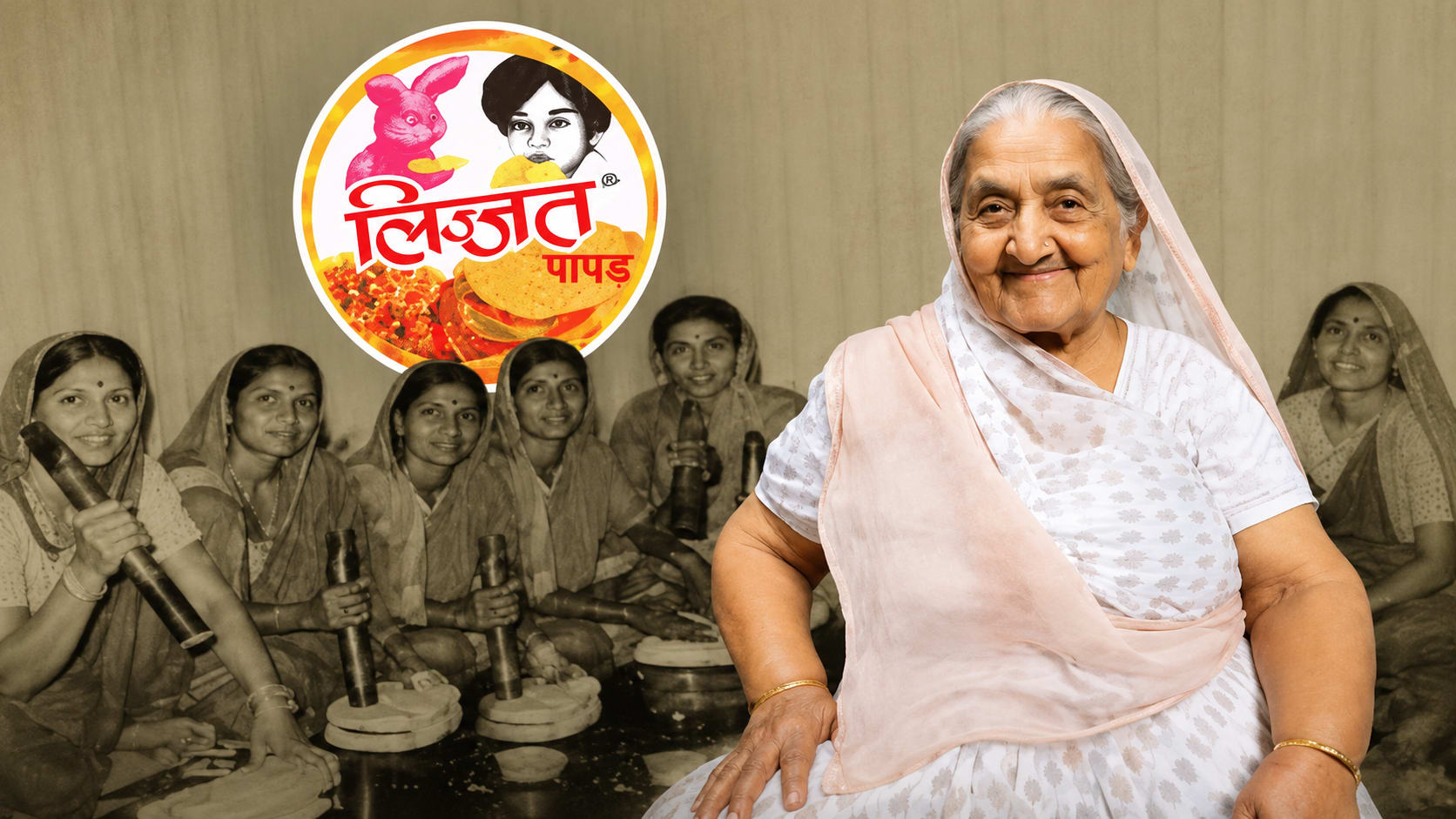
For most of the last forty years, Indian business writing has treated Lijjat Papad as a heartwarming Mumbai story rather than a serious case study. That is a mistake. Lijjat is the longest-running working example in India of a different industrial structure: a women-only co-operative that has scaled into a multi-thousand-crore turnover, distributed manufacturing across the country, exported its product internationally, and done all of it without a single rupee of external capital.
Everything modern Indian D2C has been trying to learn about community ownership, distributed production, and patient compounding, Lijjat has been practising for more than six decades.
The Founding Moment: 15 March 1959
The story begins on the terrace of a chawl building in Girgaum, Mumbai, on 15 March 1959. Seven women Jaswantiben Jamnadas Popat, Parvatiben Ramdas Thodani, Ujamben Narandas Kundalia, Banuben N. Tanna, Laguben Amritlal Gokani, Jayaben V. Vithalani, and Diwaliben Lukka began rolling papads. Their intention was modest: to supplement household income.
The seed capital was ₹80, borrowed from social worker Chhaganlal Karamsi Parekh, who became a long-term mentor. The first batch was sold to a local merchant in Bhuleshwar. Parekh’s most consequential suggestion came almost immediately: rather than expand by hiring employees, the women should expand by adding more members. Every new participant would be an owner, not a worker.
The Co-operative Structure
That single decision explains Lijjat’s longevity. New women who join do not receive a salary. They are paid for the output they roll. Profits at the end of each year are distributed proportionally based on participation, in addition to the per-piece earnings collected during the year. Members can vote on the governance of their branch, and senior committees are elected from within the membership.
The legal form is Shri Mahila Griha Udyog Lijjat Papad, registered under the Societies Registration Act and operating under the Khadi and Village Industries Commission (KVIC). There are no external shareholders. There is no conventional chief executive; senior leadership is held by long-tenured members who rotate through roles. By membership count, Lijjat is one of the largest women-only co-operatives in the world.
How Production Actually Works
Lijjat does not run a conventional papad factory. It operates a network of branches. Every morning, a central team at each branch prepares dough to a standardised recipe. Member sisters collect a pre-weighed quantity, take it home, roll the papads, and return the dried finished product the same evening. Output is quality-checked, weighed, and recorded.
Members are paid per standard unit of acceptable papads. This model carries major operational advantages. Lijjat avoids the fixed costs of large factory floors and does not need to relocate workers to industrial estates. Capacity scales almost linearly with membership. New towns can be added with relatively little capital expenditure on plant.
Quality Control Across Thousands of Homes
The non-obvious challenge is quality. A centralised factory can enforce standards with supervisors and machines. A distributed, home-based system involving tens of thousands of women has every theoretical reason to drift.
Lijjat manages this with three layers. First, dough preparation is centralised, so inputs are consistent. Second, every batch of returned papads is checked at the branch for thickness, uniformity and dryness; substandard output is rejected. Third, quality is peer-enforced. Because members are owners, a papad that fails the standard hurts the collective brand and, ultimately, the collective payout.
Distribution, Exports and Product Expansion
Lijjat’s products reach across India through general trade (kirana stores and grocers), modern trade (supermarket chains) and export markets. The brand is available in Indian diaspora-heavy geographies including the UK, the Gulf, the US and Singapore through importer partnerships rather than owned international operations.
The company has kept distribution deliberately simple: essentially one papad SKU at one price point per variant. That simplicity is unusual for a multi-thousand-crore consumer brand and is one reason retailers are willing to stock it consistently.
Over time the portfolio has expanded beyond papads to include masala spices, vermicelli, atta and the SASA detergent line. Each new category has been launched under the same co-operative production model. The detergent business is particularly instructive: it involves chemical formulation, machine-assisted production and mainstream FMCG competition, yet Lijjat has operated it profitably under the same internal economics.
Recognition
Recognition has come slowly. Lijjat received the Best Village Industry Institution award from KVIC repeatedly through the late twentieth century. The most public honour arrived in 2021, when founding member Jaswantiben Jamnadas Popat was awarded the Padma Shri in the trade and industry category. The citation referenced her decades-long role in building Lijjat and the co-operative’s contribution to women’s economic participation.
What Modern D2C Still Hasn’t Learned
Community ownership beats community marketing. Much contemporary D2C strategy treats “community” as a marketing tactic — loyalty programmes, ambassadors, referrals. Lijjat has spent six decades showing that the most durable community is the one that owns the equity. Members care about quality because they are owners, not merely stakeholders.
Distributed manufacturing can be a feature. Indian D2C has often been obsessed with centralised manufacturing and “owning the factory.” Lijjat demonstrates an alternative: distributed home production with central quality control and central IP, anchored by a strong branch network. The model carries higher quality-control overhead but dramatically lowers fixed costs and increases social licence to operate in towns where employment matters.
Patience compounds. Lijjat reached multi-thousand-crore scale over more than sixty years without external capital, without acquisitions and without aggressive product diversification. The trajectory is the opposite of venture-style hockey-stick growth. For founders who cannot or will not take the venture path, it remains the clearest Indian counter-example of long, slow, owned compounding.
Operational simplicity is strategic. Lijjat sells essentially one core product through essentially one distribution model at essentially one price point. Institutional complexity sits inside the co-operative structure, not in the SKU portfolio. That discipline is deliberate and worth studying.
Timeline Snapshot
- 15 March 1959: Founded on a Girgaum terrace by seven women with ₹80 in borrowed capital.
- 1960s–70s: Membership expands across Maharashtra and other states; co-operative structure formalised; KVIC relationship established.
- 1980s: National distribution scales; exports begin in earnest; product line expands.
- 1988: SASA detergent and soap line launched.
- 2010s: Membership widely reported in the tens of thousands; turnover in the high hundreds to low thousands of crores.
- 2021: Founding member Jaswantiben Jamnadas Popat was awarded the Padma Shri.
What Remains Opaque
Lijjat is a co-operative, not a listed company. Its accounts are not disclosed in the form of audited financial statements that would be treated as fully authoritative. Publicly reported turnover and membership figures vary by year and source. Exact profit distribution among members, per-piece economics at branch level, and the precise export-revenue split sit outside the verified public record.
What is well documented — and what founders can actually learn from — is the structure, the founding history, and the trajectory across six decades. Those elements remain the most valuable part of the Lijjat case, independent of any single year’s exact revenue number.
Lijjat Papad is not merely a heartwarming story of seven women on a Mumbai terrace. It is one of the most durable alternative industrial models India has produced: community-owned, distributed in production, patient in growth, and relentlessly simple in its market face.