How this Fast-Fashion Startup Uses Tech to Design Gen Z Styles and become India’s Answer to Shein?
Fashion trends have long been dictated by runways and the instincts of a handful of designers. Sumit Jasoria believes the earliest signals of change now come from somewhere else: popular culture and the content people consume.
“From 2021, Korean dramas started dominating major OTT platforms. And as content consumption evolves, fashion and beauty trends change accordingly,” says Jasoria, Co-founder and CEO of NEWME.
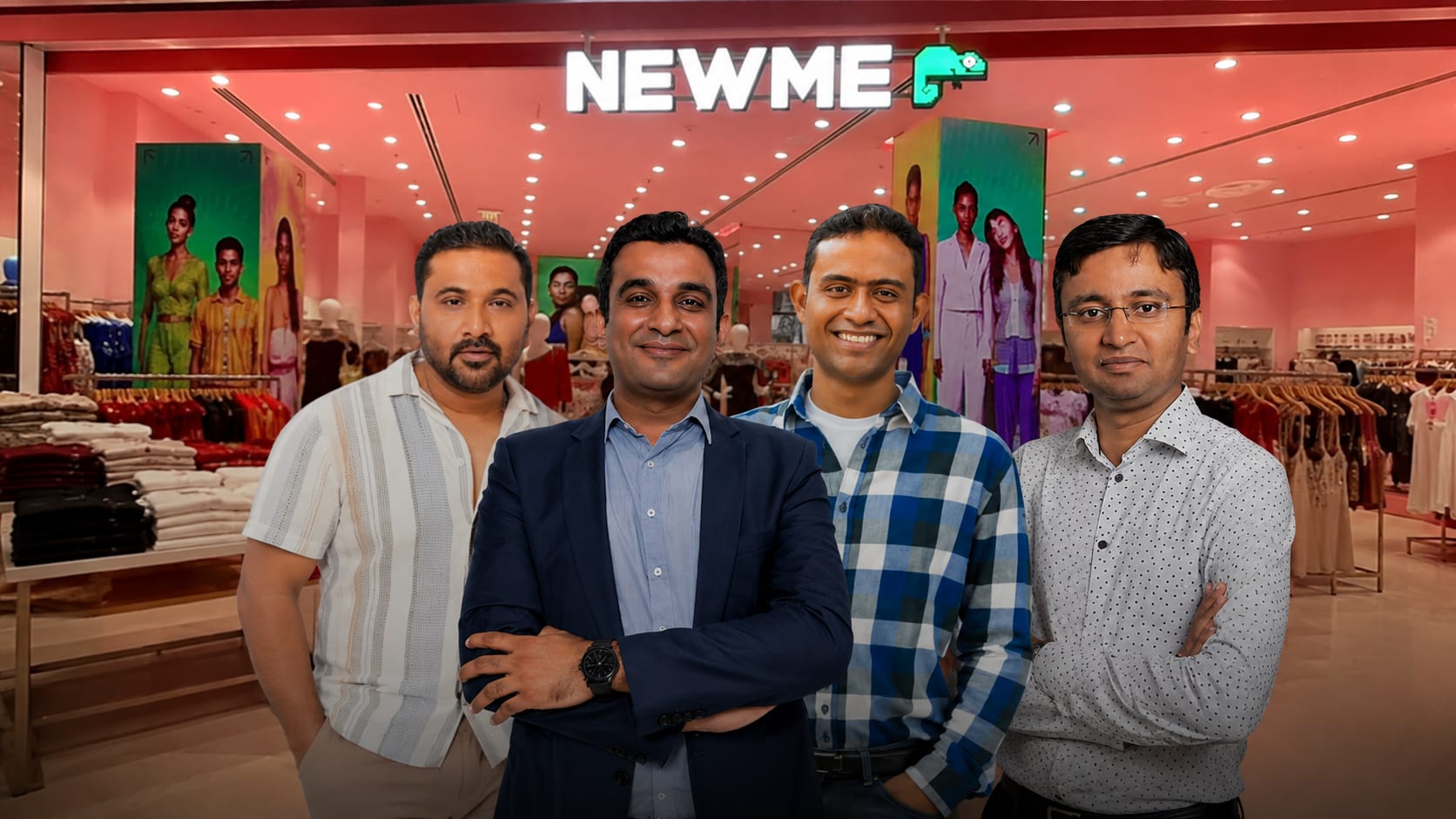
Spotting this shift, Jasoria founded the Bengaluru-based fast-fashion brand in 2022 along with Himanshu Chaudhary, Vinod Naik, and Shivam Tripathi (Co-founder and CTO). Their approach was deliberate: put data and technology ahead of creative gut feel.
“Most new designs were not data-led; they were based on gut instincts of a few creative people. We decided to flip that model by putting data and technology before aspirations,” Jasoria explains.
Today NEWME employs around 200 people across offices in Bengaluru, Mumbai, and Guangzhou, China. The company focuses exclusively on Gen Z, aiming to identify emerging trends before global players like Zara while deliberately avoiding the industry’s biggest pitfall—overproduction.
A Tech-Textile Hybrid Model
Before launching any new line, NEWME follows a structured process. Its trend team scans fashion magazines, social media, and cultural signals to create weekly mood boards. The technology and manufacturing teams then analyse these boards to determine which styles can be produced quickly and profitably.
“That is where the data-led tech team takes over, using AI tools from global giants like Adobe to smaller startups, to ensure our supply chain stays agile and nimble,” Jasoria says.
The company operates on a “zero-inventory” principle. New designs are launched every Friday—not as physical products, but as images of ideas. Customer engagement with these images feeds a demand-prediction model. Only when signals indicate sufficient interest does production begin. If demand remains strong, more units follow.
NEWME currently lists about 13,000 styles on its website and app, priced between Rs 199 and Rs 2,199. New styles are added weekly while underperforming ones are discontinued. “In fashion, relevance is everything. Most brands lose out because they don’t change their inventory. Customers move on. We innovate constantly to avoid that trap,” Jasoria notes.
Serving Gen Z at Scale
In three years, NEWME has reached nearly 1.7 million customers, almost all Gen Z, with a 50% retention rate. While global giant Shein (founded in 2008) reported around 88 million customers in 2024, Jasoria argues that NEWME’s hyperlocal designs, community engagement, college ambassador programmes, and content workshops give it a distinct advantage in India.
“It’s a fast generation that wears fast fashion. We are investing heavily in enhancing our technology and supply chain to solve their needs. This generation is expressive, aspirational, and soon to be 400 million strong in India’s workforce,” he says. The brand currently focuses on Gen Z women and plans to introduce menswear within the next two years.
Production has also shifted closer to home. Initially, manufacturing was based in China; today 40% of output comes from India, with a target of 50% by the end of FY26.
Beyond its digital channels, NEWME operates 14 physical stores across India, including four in Bengaluru and three in Delhi, with additional locations in Mumbai, Indore, Chandigarh, Hyderabad, Pune, Surat, and Dehradun. The company plans to open 12 more stores by the end of the year, beginning with the Northeast, and is exploring expansion into Southeast Asia and the Middle East. Notably, it does not sell through major marketplaces such as Amazon India or Flipkart.
Growth, Funding, and Differentiation
NEWME has raised approximately $29 million to date, including a Series A round in 2024. Revenue has grown rapidly: from about Rs 8 crore in the first year to Rs 65–70 crore in the second and Rs 180 crore in the third. Jasoria expects the business to roughly double this year.
Competition comes from players such as Bengaluru-based KOOVS and numerous unbranded fast-fashion sellers. NEWME differentiates itself through a tightly focused distribution strategy and a consumer-centric, data-first model that keeps inventory levels among the lowest in the industry.
“The idea is to always remain an aspirational brand for Gen Z without being expensive. We have to keep inventory at the industry’s lowest levels. This helps us continually innovate whilst protecting business risks,” Jasoria says.
By combining cultural signal detection, AI-assisted design, and demand-driven production, NEWME is attempting to offer the speed and variety of global fast fashion while remaining more responsive and less wasteful than traditional models. For a generation that moves quickly and expects brands to keep up, that combination may prove decisive.