How Varthana Finance Helps Indian Schools Expand Access to Affordable Education
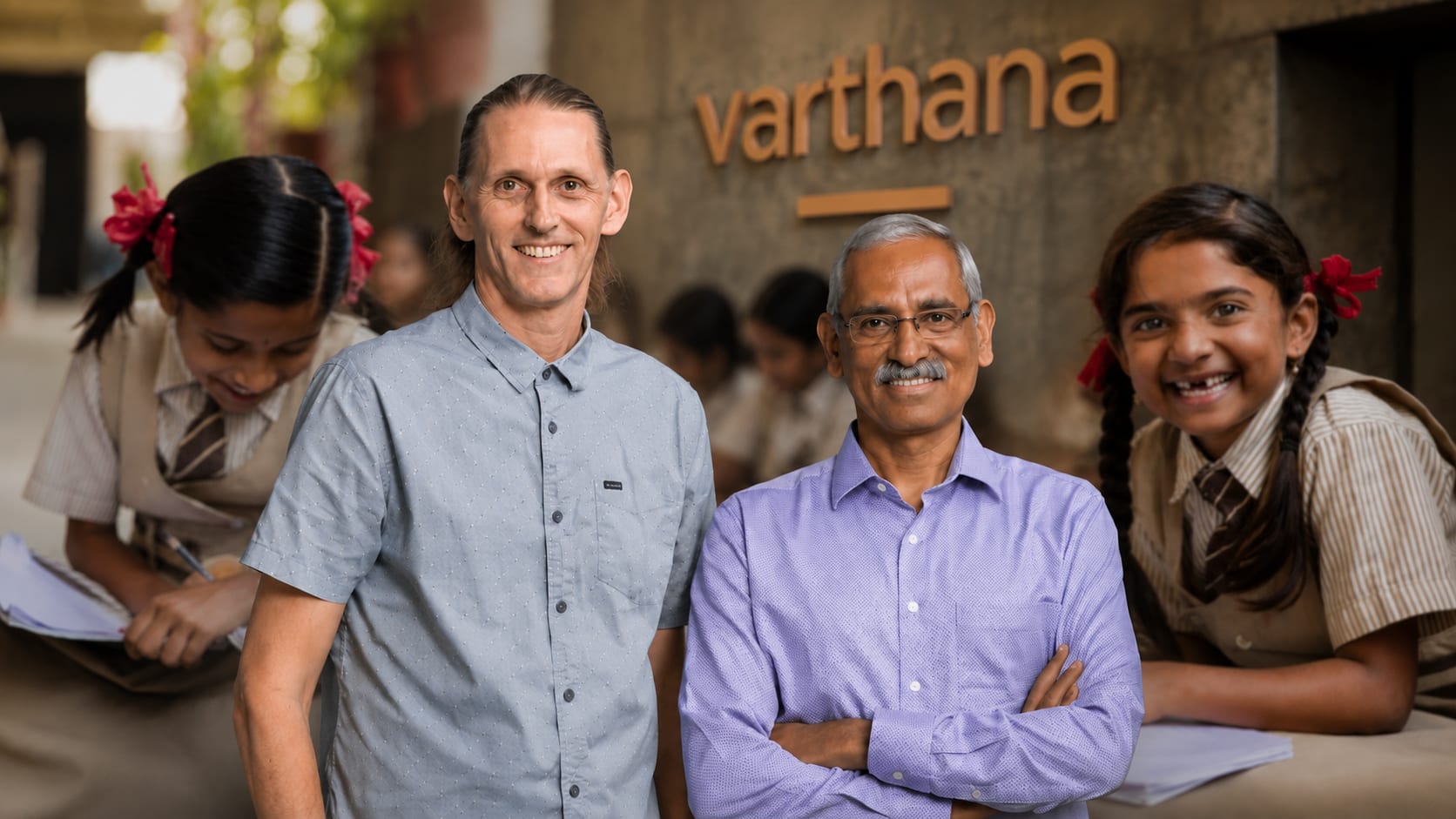
Born and raised in Southern California, Steve Hardgrave might appear an unlikely person to run a non-banking financial company focused on schools in India. Yet for the past 13 years, he has dedicated himself to that mission through Bengaluru-based Varthana Finance.
Varthana provides loans to small private schools that often lack formal banking relationships. These schools use the capital to expand classrooms, upgrade laboratories, purchase school buses, or make other improvements that allow them to serve more students.
Hardgrave grew up viewing private schools as expensive and inaccessible to most families. In the United States, public schools are funded by local, state and federal governments and are generally available to all students within a district. His perspective shifted while working at Atlanta-based impact investor Grey Ghost Ventures in 2007. The firm was exploring education as a lever to reduce poverty.
While travelling to monitor microfinance investments, Hardgrave began asking women borrowers a simple question: where do you send your children to school? Roughly half answered “private school.” The response surprised him. Those conversations eventually led to the creation of Indian School Finance Company (ISFC) in 2008, with Grey Ghost’s backing, to offer small-enterprise loans to affordable private schools.
Disagreements over strategy prompted Hardgrave to leave ISFC. Together with former colleague Brajesh Mishra, he obtained an NBFC licence in 2012 and launched Varthana Finance. In March 2024, Varthana acquired ISFC’s school-loan portfolio for Rs 126 crore, bringing the two entities full circle.
Why Affordable Schools Struggle to Access Capital
Hardgrave discovered that many private schools in India charge as little as $5 per month. Despite low fees, these institutions often strive to maintain standards by adopting modern teaching methods, introducing technology in classrooms, and offering extracurricular activities.
Most school owners had established their institutions with personal resources and property. Expansion, however, required external finance that banks were reluctant to provide. “Most banks avoid underwriting loans for such schools due to preconceived notions about their creditworthiness and the challenges involved in the underwriting process,” Hardgrave explains.
Indian schools are frequently structured as trusts or societies rather than companies, resulting in less conventional governance. Banks and financial institutions often prefer to avoid the sector altogether.
Varthana addresses governance concerns by making the key entrepreneur a co-applicant on the loan, often alongside trustees or society members. Underwriting cannot rely solely on bank statements, CIBIL records or income-tax returns, as these institutions typically do not maintain audited financials or file tax returns in the same way companies do.
Instead, the team visits schools in person, examines fee-receipt books, ledgers and other operational records kept in spiral notebooks, and verifies student enrolment. “This is where a lot of the secret sauce comes in: you know how to correctly underwrite the schools. As you do more and more, you learn all these little lessons and get better at it,” Hardgrave says.
Scale and Real-World Impact
Many of the schools Varthana finances serve children of farmers, daily-wage labourers, auto-rickshaw drivers and other low-income families. Low-cost private schools account for 70–85% of student enrolment in India’s most populous states, according to UNESCO.
Varthana’s portfolio spans more than 11,000 schools across 14 states. It typically engages with institutions that have operated for about five years and enrol 300–400 students. Average loan size is Rs 35 lakh, ranging from Rs 5 lakh for smaller needs to as high as Rs 10 crore for larger, more mature schools.
One example is Sristi Global School, which began as a preschool 13 years ago and now offers classes from Nursery to Grade 7. It follows the state board syllabus and plans to adopt CBSE. Varthana has supported the school since 2014, starting with an unsecured loan of Rs 5 lakh, followed by Rs 10 lakh in 2022 and Rs 1.73 crore in 2023 for infrastructure. The funding enabled additional classrooms and expansion to three campuses in Bengaluru.
Over more than a decade, Varthana has frequently provided successive loans to the same schools, helping some grow from a few hundred students to 2,000–3,000. During the COVID-19 pandemic, the company went beyond financing: its education team supplied learning packets to schools unable to shift online and offered digital content access to customers.
Funding and Future Direction
Varthana’s focus on expanding educational access has attracted impact investors. In 2018, it raised a $55 million Series C led by ChrysCapital, with participation from Omidyar Network and Kaizenvest. In 2024 it secured $10 million from BlueOrchard Finance and $14 million from Blue Earth Capital.
Beyond primary and secondary schools, Varthana has entered the student-loan segment. The new product targets students who have completed Class 10 or 12 and need support for higher education or vocational training. The goal is to improve earning potential and reduce dropout rates driven by financial pressure or the need to enter the workforce early.
By specialising in a segment that conventional banks have largely avoided, Varthana has built both a viable lending business and a meaningful education-impact platform. For thousands of affordable private schools and the low-income families they serve, access to capital is no longer the barrier it once was—opening the door to better classrooms, more students and stronger educational outcomes.