IIT Delhi’s India’s First Indigenous Micro-GPU: How It Cuts Import Dependence and Powers Affordable Tech
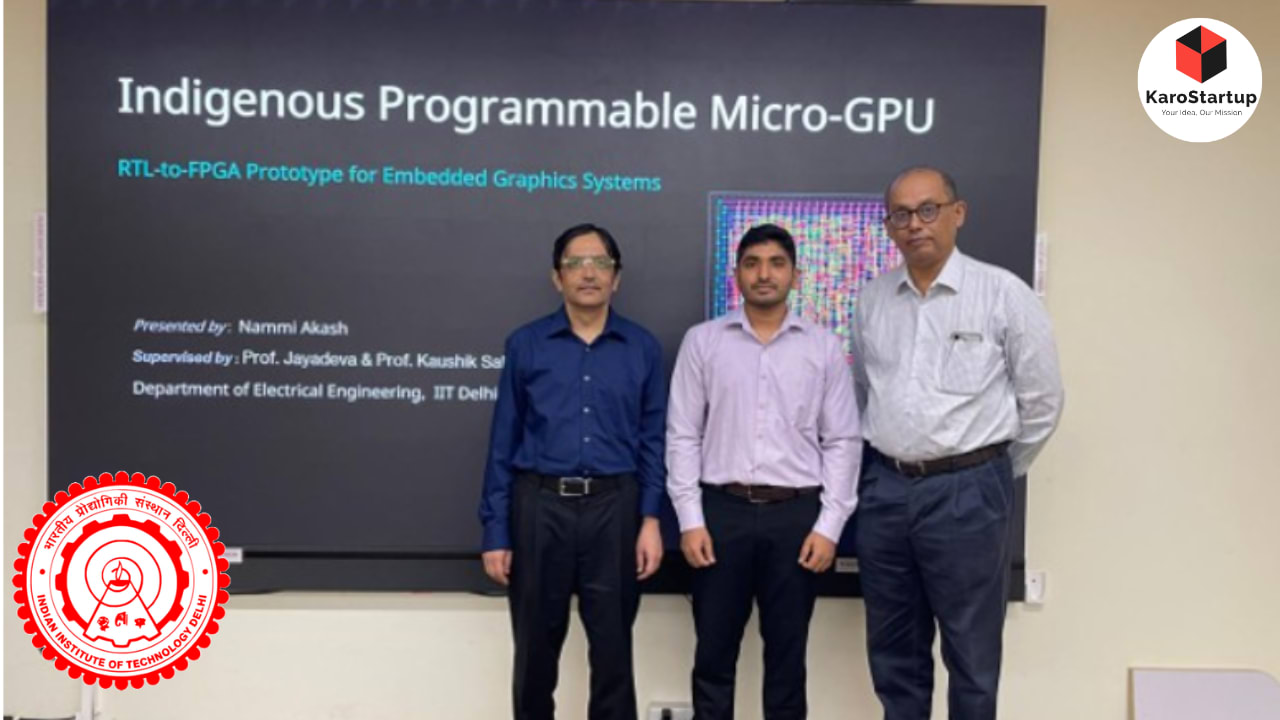
Researchers at IIT Delhi have developed India’s first working, demonstrable indigenous micro-Graphics Processing Unit (micro-GPU). According to IIT Delhi's official announcement, this breakthrough marks a significant step toward reducing India’s heavy reliance on imported GPUs and supporting self-reliance in semiconductors and embedded systems.
Graphics Processing Units are widely used in modern hardware, including AI and machine learning engines. Currently, all GPUs are imported. The new micro-GPU offers a compact, programmable alternative designed for practical, low-cost applications rather than high-end computing.
Micro-GPU was developed by MTech students Nammi Akash and M. Ravi Teja under the guidance of Professors Jayadeva and Kaushik Saha.
What Is a Micro-GPU and Why Does India Need One?
A Graphics Processing Unit (GPU) handles visual and parallel computing tasks much faster than a regular processor for graphics, displays, and certain AI workloads. A “micro-GPU” is a smaller, more efficient version optimized for embedded systems, devices that need basic graphics without high power or cost.
India’s dependence on foreign GPUs creates supply risks, higher costs, and limited customization for local needs. An indigenous design helps build self-reliance in critical technology, supports affordable digital tools, and contributes to bridging the digital divide. The IIT Delhi team states that this is the first working, demonstrable indigenously designed micro-GPU from an Indian university.
How Did IIT Delhi Develop the Micro-GPU?
The team built a custom floating-point GPU engine entirely in RTL. They mapped and tested it on a Spartan-7 FPGA platform, successfully demonstrating programmable graphics rendering.
This approach proves the design works in hardware and can later move to silicon chips (ASICs) or other programmable platforms. The architecture is scalable and functions as a programmable graphics processor intellectual property (IP) block that others can reuse or adapt.
In a joint statement, the students explained their goal: to create a compact yet genuinely programmable graphics-processing architecture suitable for FPGA implementation and future ASIC realization. They hope it will support affordable digital-access platforms.
Key Features of IIT Delhi’s Indigenous Micro-GPU
Fully indigenous design developed in India
Programmable graphics rendering with custom floating-point engine
Implemented in RTL and successfully tested on Spartan-7 FPGA
Scalable architecture suitable for embedded systems
Can be mapped to silicon ASIC or FPGAs
Focused on practical performance for real-world applications
These features prioritize affordability and usability over peak gaming or data-center performance.
Potential Applications of the Micro-GPU
The hardware architecture is designed for affordable embedded visualization systems. Specific uses listed in the official announcement include:
Industrial control displays
Low-cost human-machine interfaces
E-rickshaw dashboard navigators
Inland-water navigation terminals for small fishing boats
Educational e-book readers
Other low-cost digital display and interface systems
These applications target everyday needs in industry, transport, education, and rural settings where expensive imported GPUs are unnecessary.
Why This Matters for India’s Semiconductor Push
GPUs play a growing role in AI, machine learning, and modern computing. Full import dependence leaves India exposed to global supply issues. An indigenous micro-GPU supports national efforts under Make in India and Atmanirbhar Bharat by building domestic design capability.
Prof. Jayadeva noted that the work demonstrates the educational and research potential of indigenous programmable graphics hardware for affordable and socially useful computing platforms. Many innovations were needed to realize the design on a standard FPGA board. Prof. Kaushik Saha added that the project encourages students to integrate arithmetic hardware, programmable architectures, compilers, and embedded systems thinking while addressing wider societal accessibility challenges.
Future Roadmap: What’s Next?
The team is already planning the next stages:
Scaling to an 8-16 core vector-style graphics processor architecture
Developing an optimized compiler and full graphics software toolchain
Creating a proof-of-concept on a 65nm ASIC process node
Researchers believe mature nodes like 65nm can enable practical and commercially useful indigenous graphics silicon for embedded systems.
The team also plans to seek funding support for ASIC development, system integration, and eventual commercialization of the technology, as confirmed in the official IIT Delhi announcement.
How Does This Help Bridge the Digital Divide?
Affordable indigenous hardware can lower the cost of digital tools used in education, small businesses, transport, and rural services.
In a joint statement, Akash and Ravi Teja said: “Our objective was to create a compact but genuinely programmable graphics-processing architecture suitable for FPGA implementation and future ASIC realization. We hope such indigenous hardware systems can support affordable digital-access platforms and contribute meaningfully toward bridging the digital divide. We are grateful to our institute, IIT Delhi, for providing the academic environment and the technical platform that enabled this work.”