India Builds Drones. But Imports Their Batteries. Dreamfly Innovations wants to change that
A drone is only as useful as its battery. Most Indian drones fly for 20 to 30 minutes at a stretch. Operators work around this by carrying spare packs into the field, sometimes half a dozen of them, and swapping them out between flights. The batteries themselves are mostly imported. India has built a large drone industry without building the component supply chain underneath it.
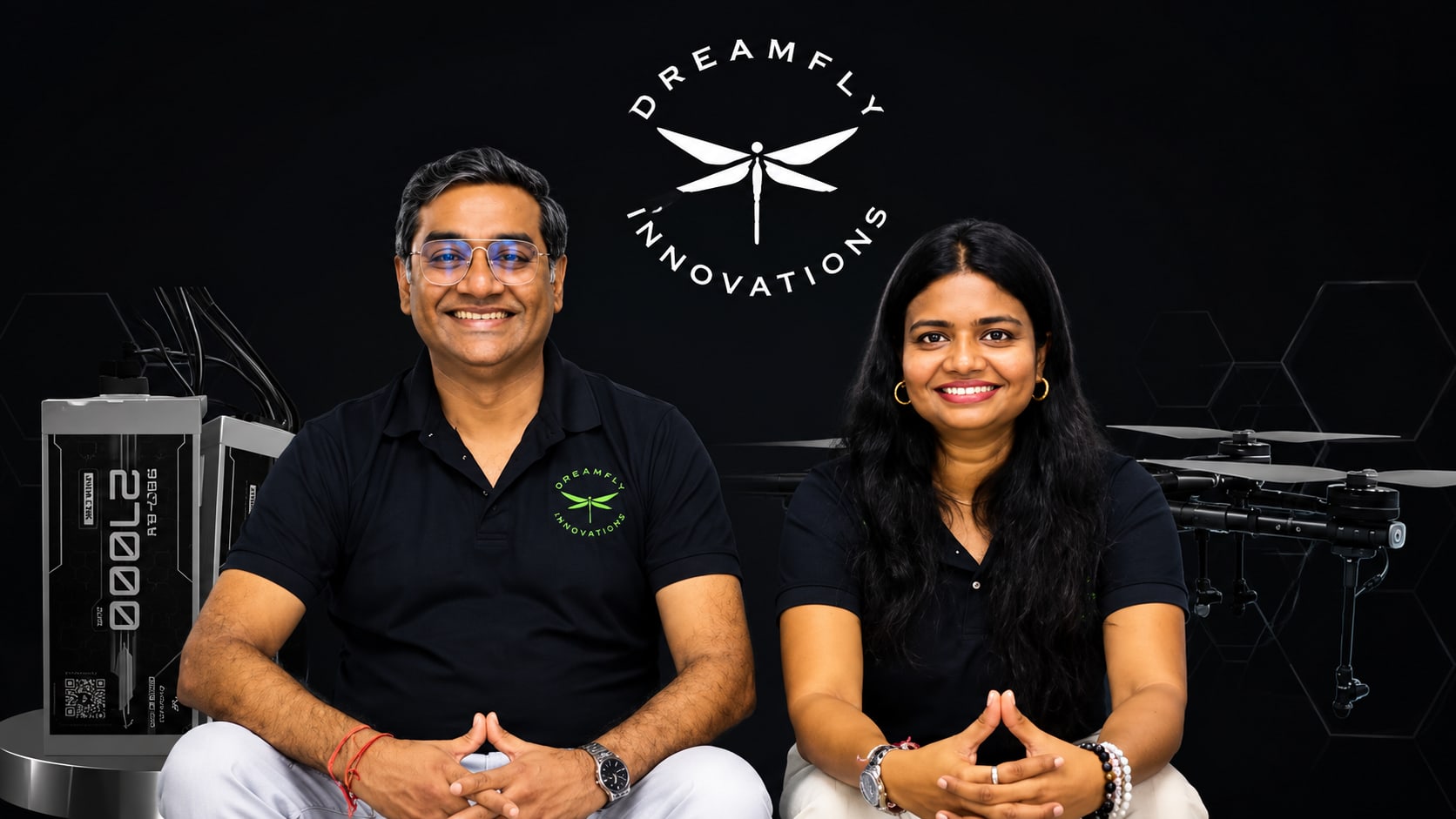
Dreamfly Innovations, a Bengaluru startup, makes those batteries in India. It was founded in 2021 by Kajal Shah, its chief executive, and Dr Saurabh Markandeya. Both had built companies before, and both had worked in clean energy and mobility. Their reading of the market is that the gap is not in drones. It is in the parts that go inside them.
Why the Gap Matters Most in Agriculture
The problem is most acute in agriculture. A spraying drone works in long shifts over open fields. Every battery swap costs time, and every spare pack is weight and cost the operator has to carry. In the middle of a spraying window, when weather and crop conditions align, downtime becomes expensive. Farmers and service providers cannot afford long gaps between flights. A reliable drone battery that lasts longer, weighs less, or can be swapped faster directly improves utilisation and economics.
Beyond agriculture, the same constraint appears in surveying, inspection, logistics trials and defence applications. Short flight times force operators to plan around battery limits rather than around the work itself. India’s drone makers have focused on airframes, flight controllers and applications. The energy source that actually keeps the machine in the air has largely remained an import.
Batteries Built for Indian Conditions
Dreamfly designs and manufactures high-power-density battery packs for drones, aviation and aerospace. It works across several cell chemistries, including lithium, graphene and supercapacitors. The engineering focuses on heat and safety. Its thermal case design lowers operating temperature by up to 20 degrees Celsius, lowering fire risk. Lighter cell stacks cut the weight a drone has to carry. The company has filed two patents on this work.
Heat is a bigger factor than it appears to be. A hot battery loses power faster, ages sooner, and carries a higher fire risk. In a drone, weight and heat pull against each other. A bigger battery flies longer, but it also weighs more and eats into the payload the drone can carry. Designing around both constraints at once is harder than simply increasing capacity.
The company also builds for specific Indian use cases. One battery is designed for high-altitude flying and works at temperatures as low as minus 30 degrees Celsius. Another is a non-explosive graphene pack aimed at agricultural drones, which spray fields and need to be safe around crops and people. A drone battery that fails safely in an open field is not a luxury; it is a practical requirement when the machine flies low over cultivated land and near people.
Selling into Demanding Customers
Dreamfly sells to drone and aerospace manufacturers rather than to end users. Its customers include Tata Advanced Systems, the Tata Group’s aerospace arm, and Larsen & Toubro. It also supplies General Aeronautics, which builds agricultural spraying drones, and Neosky India, a subsidiary of RattanIndia Enterprises.
Large defence and engineering firms test components slowly, and once a supplier clears those standards, it is hard to displace. Getting onto those approved lists is therefore both difficult and valuable. For a young battery company, clearing the qualification processes of Tata and L&T signals that the product meets requirements beyond ordinary commercial use.
Building batteries in India also reduces a dependency common in the sector: cells and packs are among the components that Indian drone makers most often import, leaving them exposed to shipping delays and price swings they cannot control. A domestic drone battery supplier reduces that exposure and shortens the feedback loop between user problems and engineering improvements.
Funding the Next Stage of Growth
In February 2025, the company raised Rs 12 crore in a seed round led by Avaana Capital, with Sunicon Ventures and existing backers. It had raised Rs 4.9 crore in an angel round in 2023, supported by the Rebalance Angel Community. The money is going into a manufacturing facility, a larger team and further research. The company employs about 27 people.
Scaling manufacturing is the practical challenge that follows technical validation. Producing consistent, high-quality packs at volume while meeting the safety and performance standards of aerospace and defence customers requires process discipline and capital. The seed funding is intended to support that transition from smaller-batch production toward a more industrial capability.
Dreamfly also works beyond drones, on batteries for electric aviation and other aerospace uses. The underlying engineering is similar, and the certification standards are equally demanding. Progress in one domain can strengthen the company’s position in the other.
The Larger Market Opportunity
India’s drone market is expected to grow quickly over the rest of the decade. Policy support, expanding agricultural applications, infrastructure inspection needs and defence modernisation all point toward higher demand. That growth will require more than airframes and software. It will need a domestic component industry that can supply critical parts at competitive cost and with reliable delivery.
Dreamfly’s position is that the growth will need a domestic component industry to support it, and that batteries are the place to start. A high-performance drone battery designed for Indian heat, altitude and operational patterns is not a peripheral product. It is a constraint that currently limits how useful the rest of the system can be.
The company’s approach, focusing on thermal management, weight reduction, safety and application-specific designs, addresses the practical limits operators face every day. If those designs prove reliable at scale and under the scrutiny of large industrial customers, Dreamfly will have built more than a product. It will have closed one of the more important gaps in India’s emerging drone supply chain.
For operators in the field, the difference will be measured in fewer swaps, longer effective flight windows and lower risk. For the industry, the difference will be a reduced dependence on imported energy packs and a stronger foundation for the next phase of growth. In a market where every extra minute of flight time and every kilogram of payload matter, the quality of the drone battery is no longer a secondary detail. It is central to whether the entire system delivers value.