MARKETS
India Must Move from ‘Made in India’ to ‘Imagined in India’: Finance Minister Nirmala Sitharaman’s Call for Innovation-Led Growth
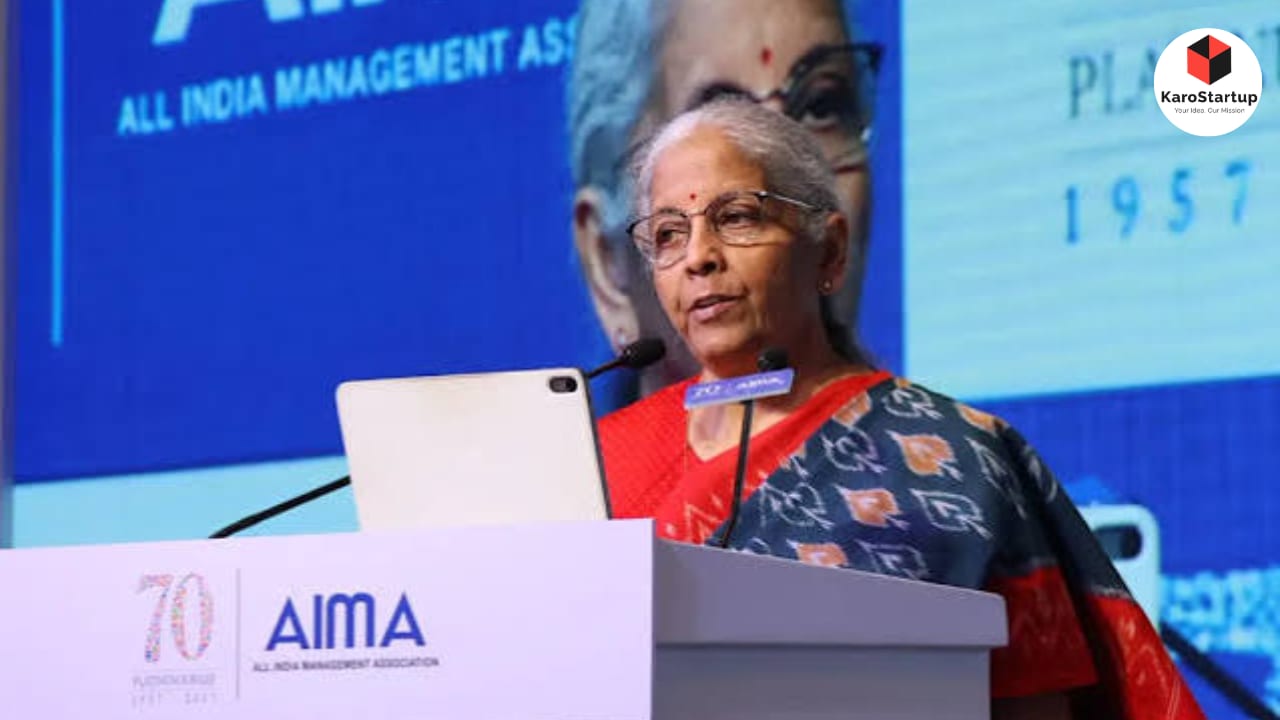
Finance Minister Nirmala Sitharaman has urged Indian businesses to shift from being primarily a manufacturing base to becoming a global source of original ideas, design, patents, and technology.
Speaking at the 53rd National Management Convention of the All India Management Association (AIMA) on September 22, 2026, themed “Transforming for Tomorrow: Growth with Resilience,” she declared that India’s ambition must evolve from “Made in India” to “Imagined in India.”
This means products should not only be manufactured in India but conceived, designed, engineered, and technologically developed domestically before being taken to world markets. The statement marks a strategic pivot for India’s economy as it aims for sustained high growth toward Viksit Bharat 2047.
Why “Imagined in India” Matters Now
Sitharaman described India as standing at a “structural inflection point.” Rising incomes and upward mobility are reshaping consumption patterns. Demand is no longer limited to affluent urban consumers. Working families in rural and semi-urban India form a large and growing market across agriculture, construction, transport, and informal enterprises.
She warned: “If corporate India pursues premiumisation for the urban tier alone, growth will lose its structural durability.” Companies must design products and services that serve this broader consumption base while building global competitiveness through intellectual property and higher value addition.
Manufacturing scale remains important, but the next stage is capturing more value from design, engineering, patents, software, technology, and specialised know-how. This aligns with broader efforts to deepen India’s role in global value chains and move beyond assembly toward original innovation.
The R&D Gap India Must Close
A central pillar of Sitharaman’s message was the need for significantly higher research and development (R&D) investment. India’s gross expenditure on R&D stands at around 0.83-0.84% of GDP (latest available figures around 2023-24 data, with projections higher for subsequent years). This compares with approximately 2.7% for the OECD average, 2.6% for China, and 3.5% for the United States.
The private sector’s contribution in India has historically been lower (around 36% in earlier data, though recent figures show improvement toward 45-50%+ in some years). In leading economies, private industry typically accounts for over 70% of R&D spending. Sitharaman called on companies to increase R&D spending either through in-house capabilities or collaborations with academia. Higher spending should translate into more intellectual property created, developed, and commercialised in India.
This push supports quality improvement, product innovation, and the creation of globally competitive technologies. Parallel industry voices, including in the automotive sector, have echoed similar calls to move from “Make in India” to “Create in India” or “Design in India.”
Supporting India’s Strong Macro Backdrop
Sitharaman highlighted India’s robust economic performance amid global challenges. While global growth has slowed below 3%, India’s GDP growth is approaching 8%, with the latest quarter (Q1 FY27) recording 7.8% real GDP growth. Gross fixed capital formation rose above 34% of GDP and grew about 12% in real terms. Manufacturing capacity utilisation reached 75%.
The government has scaled capital expenditure to more than ₹12 lakh crore in FY27, with effective capital expenditure (including grants to states for capital assets) exceeding ₹17 lakh crore. Japan Credit Rating Agency (JCR) upgraded India’s long-term foreign and local-currency issuer ratings from BBB+ to A- with a stable outlook in early September 2026, also raising the country ceiling to A. This reflects sustained growth, policy effectiveness, and improved financial system soundness.
Resilience, she stressed, does not mean economic isolationism. It means building sufficient domestic capacity, fiscal strength, and industrial scale so that global shocks can be absorbed without disrupting national development.
Building Scalable, Enduring Enterprises
India has more than 2.3 lakh DPIIT-recognised startups, with over 120 having crossed the $1 billion valuation mark. Sitharaman noted that the challenge is not merely creating more companies but building enterprises that can scale, institutionalise, and endure. She called for greater professionalisation of startups and family-owned businesses.
Management education has a key role. Practical training for founders and early teams on hiring, delegation, financial discipline, customer management, compliance, and systems building is essential. Short courses focused on governance, succession planning, and conflict management for family businesses can help sustain growth across generations.
She also urged stronger corporate governance, building trust with regulators, and developing capabilities in geopolitical risks, supply chains, climate, data, regulation, and technology. Engagement with government and regulators should be constructive; not every disagreement needs to begin as litigation.