STARTUPS
India’s Instant Househelp Startups Are Growing Fast, But Can the Economics Work?
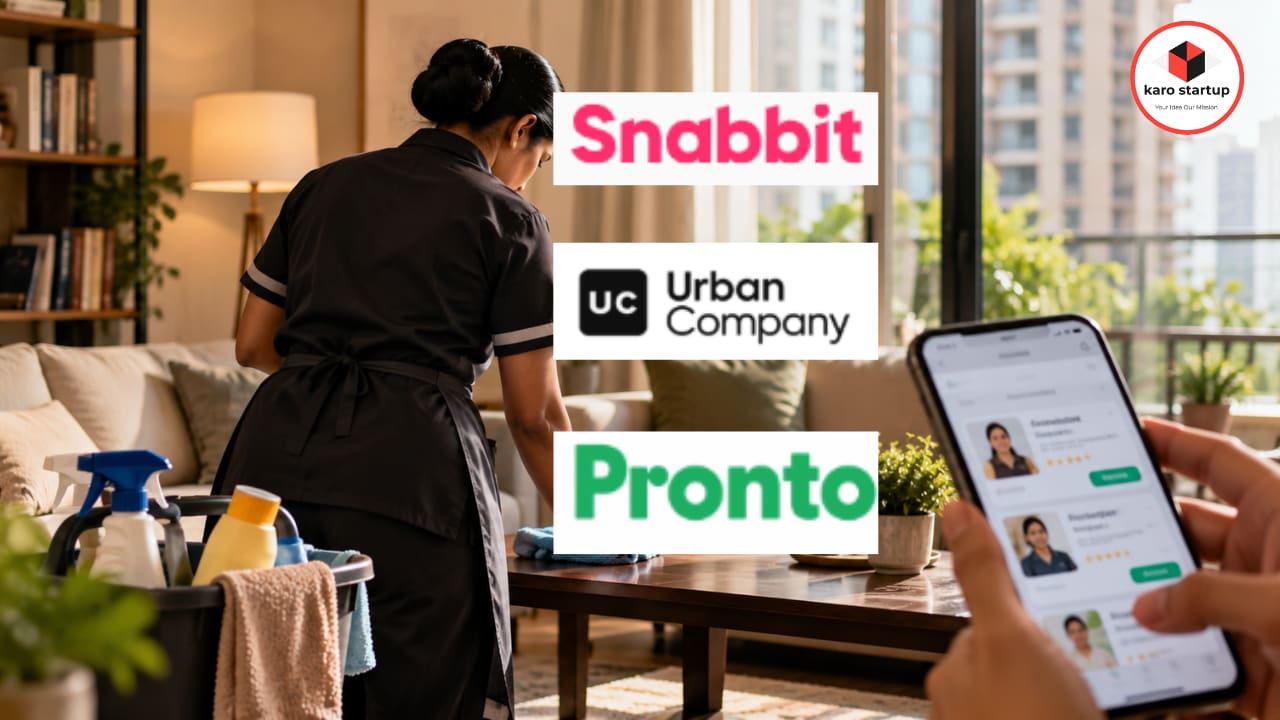
India’s instant househelp startups are growing rapidly by offering on-demand domestic help for cleaning, dishes, laundry and other household tasks, often at very low introductory prices. Companies such as Snabbit, Urban Company’s InstaHelp and Pronto are betting that customers will turn instant househelp into a regular habit.
But the business model remains under pressure. Low prices, high marketing costs, worker recruitment expenses and heavy cash burn mean that growth has not yet translated into profitability. The next phase will depend on whether these platforms can raise average order values, improve worker utilisation and retain customers once discounts reduce.
What Are Instant Househelp Startups?
Instant househelp startups are app-based platforms that allow customers to book domestic workers quickly, often within minutes, for household tasks such as:
- Dishwashing
- Floor cleaning
- Laundry support
- Bathroom cleaning
- Kitchen cleaning
- Backup domestic help when regular workers are unavailable
The appeal is simple: instead of relying only on a fixed housekeeper, households can book help on demand. But the economics are far more complicated than the convenience suggests.
The Promise Is Clear: Cheap, Quick Domestic Help
India’s instant househelp platforms have grown by offering services at around ₹100, and in some cases at even lower effective prices after discounts.
That pricing has helped attract customers quickly. It has also helped create a new consumer habit: booking domestic help at short notice through an app.
But there is a difficult question at the centre of the business model:
Who pays the difference between what customers are willing to pay and what it costs to provide the service?
For now, much of that gap is being covered by startup capital, discounts and aggressive expansion spending.
Snabbit’s FY26 Numbers Show the Cost of Growth
Snabbit’s financials show how expensive this category can be.
In FY26, Snabbit spent ₹195 crore to generate just ₹12.2 crore in operating revenue. Its net loss stood at ₹168 crore, almost 14 times its operating revenue.
A large part of this spending went into building the marketplace:
- Expert service costs: ₹63.1 crore
- Marketing costs: ₹48.7 crore
- Employee benefit expenses: ₹46 crore
- Total expenses: ₹195 crore
The company expanded rapidly during the year. Snabbit said it grew from around 500 daily jobs across eight micro-markets at the start of FY26 to a run rate of 35,000 jobs across more than 100 micro-markets by year-end.
That expansion is significant. But the next test is whether each new micro-market becomes more efficient as it grows.
If every new neighbourhood requires heavy spending on worker recruitment, supply building and customer acquisition, then scale alone may not solve the profitability problem.
Urban Company’s InstaHelp Faces a Pricing Gap
Urban Company’s InstaHelp shows a similar challenge from a different angle.
The company’s post-discount average order value for InstaHelp fell to ₹118 in the September quarter from ₹134 in the June quarter. Urban Company attributed the decline to lower introductory prices as it pushed to acquire more users.
The company expects average order value to improve over time, but it has also acknowledged that the increase could be gradual and influenced by competitive intensity.
This is the central pricing problem for instant househelp platforms:
- Raising prices can improve revenue per booking.
- But higher prices may reduce demand from customers who use the service mainly because it is affordable.
- If one platform reduces discounts too quickly, customers may shift to a rival still offering subsidised prices.
Earlier, Urban Company had said InstaHelp would need an average order value of around ₹300 to break even, compared with about ₹138 at the time. CEO Abhiraj Singh Bhal indicated that reaching that level could take as long as five years.
That is a long runway for a business whose customer promise depends heavily on low prices.
The Real Prize Is Density
The economics of instant househelp depend heavily on neighbourhood density.
A platform cannot simply recruit workers and wait for orders. It needs enough demand in a small geographic area to keep workers busy throughout the day while still delivering quick service.
That makes the model operationally demanding.
A worker who spends too much time travelling between jobs, or waiting for the next booking, creates cost without generating revenue. Similarly, launching in a new area requires investment in local worker supply before demand is predictable.
The strongest economics are likely to come from dense urban catchments where:
- Orders are frequent
- Travel time is low
- Workers can complete more jobs per day
- Customer acquisition costs fall over time
- Repeat usage improves predictability
Lower-density neighbourhoods are much harder to serve profitably.
For companies such as Snabbit and InstaHelp, the question is not only whether they can generate demand. It is whether they can generate enough demand within tight local clusters to improve worker utilisation.
Growth Is Real, But Spending Is Still Rising
There are signs that the market is growing quickly.
According to an Economic Times (ET) report, the three major instant househelp platforms together handled 3.97 million orders in June, up 20% from May.
But the same growth came with higher spending. Their combined monthly cash burn rose 14% to about $16 million-$17 million, compared with $14 million-$15 million in May.
That means demand is expanding, but the sector has not yet proved that growth automatically reduces losses.
The key issue is whether higher order volumes eventually lead to:
- Lower loss per booking
- Better worker utilisation
- Higher average order value
- Lower customer acquisition cost
- Stronger retention without discounts
Until then, rapid growth may continue to require heavy funding.
Is Instant Househelp a Daily Habit or an Emergency Backup?
A major unknown is how often customers will use instant househelp once introductory pricing disappears.
The category has obvious appeal. Customers may book a worker when:
- Their regular domestic help is absent
- They need urgent cleaning
- Guests are coming over
- They need extra help after a busy day
- They want one-time cleaning support
But occasional backup use may not be enough to support a large dedicated network of workers.
For the model to become sustainable, platforms need customers to move beyond emergency or occasional usage. They need instant househelp to become part of a regular household routine.
That is a much harder consumer habit to build.
The June data offers some encouragement. The three major platforms recorded nearly 4 million orders in a single month. Snabbit reportedly overtook Urban Company’s InstaHelp in booking volumes, while Urban Company retained the lead in transaction value because of its higher average order value.
This difference matters. Order volume alone may not determine the strongest business. A platform with fewer orders but higher revenue per booking may have better long-term economics than a platform chasing volume through deeper discounts.
Pronto’s Fundraising Shows Investor Appetite
Pronto’s recent fundraising also points to strong investor interest in the category.
The startup raised an additional $20 million, reportedly doubling its valuation to $200 million within two months of an earlier funding round.
Pronto said its bookings had risen from 3,000 per day to more than 26,000 per day since December. It also said it had reduced burn per booking by 55% while maintaining worker payouts.
Those numbers suggest there is real demand for fast domestic help. They also suggest that unit economics can improve as platforms scale.
But the broader question remains unanswered: can these improvements continue as companies enter more neighbourhoods, face more competition and reduce customer subsidies?
Urban Company Has a Funding Advantage
Urban Company has one clear advantage over younger startups: it already has established home-services businesses that generate profits.
In its latest shareholder communication, Urban Company said its businesses outside InstaHelp generated ₹119 crore in adjusted EBITDA over the first nine months of the financial year. It also reported ₹1,901 crore in cash as of September 30,2026.
The company has approved a plan to raise ₹2,500 crore through a qualified institutional placement.
That capital gives Urban Company more room to compete aggressively in instant househelp. Bhal has also said that losses in InstaHelp will remain elevated for several quarters as the company prioritises scale over near-term profitability.
But having more capital does not automatically make InstaHelp profitable. It only gives the company more time to try to improve the model.
Snabbit’s Challenge Is Proving Recent Progress Can Sustain
Snabbit faces a different kind of test.
Its FY26 financials show a large gap between revenue and spending. However, founder Aayush Agarwal has argued that the annual accounts do not fully reflect the company’s more recent operating progress.
According to the company, loss per job fell below ₹200 in September, compared with roughly ₹1,500 at the start of FY26.
That is an encouraging company-reported metric. But the key question is whether Snabbit can sustain that improvement while continuing to expand into new micro-markets.
If loss per job keeps falling as density improves, the company’s model becomes more credible. If losses rise again in new locations, the business may remain dependent on funding.
The Risk: A Long Price War
There is a plausible argument for spending heavily while a new category is being created. Startups often subsidise early usage to build behaviour, improve density and establish market leadership.
But instant househelp also carries the risk of a prolonged price war.
If multiple companies keep offering low prices to prevent rivals from gaining share, fresh capital may end up funding discounts rather than building a profitable service.
The sector’s rising cash burn is a warning sign. Combined monthly burn increased from $14 million-$15 million in May to $16 million-$17 million in June.
That does not mean the model cannot work. But it does mean investors will eventually look for stronger evidence that growth is improving the economics.
What Needs to Happen for Instant Househelp to Become Profitable?
For instant househelp startups in India to build sustainable businesses, several things need to improve at the same time.
1. Average Order Value Must Rise
Customers may eventually need to pay more than today’s introductory prices. Urban Company’s earlier indication that InstaHelp may need around ₹300 average order value to break even highlights the size of the pricing gap.
2. Worker Utilisation Must Improve
Workers need to spend more time completing paid jobs and less time travelling or waiting. This requires strong local density.
3. Customer Retention Must Hold Without Discounts
The category will become more credible if customers continue booking at normal prices instead of relying on offers.
4. Expansion Must Become Cheaper
If every new neighbourhood requires heavy upfront spending, national scale may remain expensive.
5. Platforms Must Avoid a Subsidy Trap
Discounts can help build a market, but long-term dependence on subsidies can weaken the business model.
The Bottom Line
India’s instant househelp startups have found real demand. Customers clearly value the convenience of booking domestic help quickly for cleaning, dishes, laundry and other household tasks.
But demand is not the same as profitability.
Snabbit, Urban Company’s InstaHelp and Pronto are all betting that instant househelp can become a daily or weekly household habit. For that bet to work, they need dense local demand, higher revenue per order, better worker utilisation and strong retention without heavy discounts.
Urban Company has the advantage of a profitable core business and a large cash position. Snabbit is betting that micro-market density will improve its unit economics. Pronto’s rapid booking growth and fresh funding show that investors still believe in the opportunity.
But none of the major players has yet fully proved that rapid, low-cost househelp can deliver sustainable profits at scale.
The category does not need to abandon the 10-minute promise. It needs to prove that customers will pay enough for it.
FAQs
What are instant househelp startups?
Instant househelp startups are app-based platforms that let customers book domestic workers quickly for household tasks such as cleaning, dishwashing, laundry and kitchen work.
Which companies are competing in India’s instant househelp market?
Major companies in the space include Snabbit, Urban Company’s InstaHelp and Pronto.
Why are instant househelp startups losing money?
They are spending heavily on worker recruitment, customer acquisition, marketing, discounts and local expansion. Low introductory prices also mean revenue per order is often not enough to cover costs.
Why is density important in the instant househelp business?
Density helps workers complete more jobs in a smaller area with less travel and waiting time. Higher density can improve worker utilisation and reduce cost per booking.
Can instant househelp become profitable in India?
It can become profitable only if platforms raise average order values, retain customers without discounts, improve worker utilisation and reduce the cost of entering new neighbourhoods.
What is the biggest challenge for instant househelp apps?
The biggest challenge is proving that customers will pay sustainable prices for fast domestic help while platforms continue to provide reliable service and fair worker payouts.