India’s Skilled Welder Shortage Is Real. Terafac Is Teaching Machines to Close the Gap
India is short of skilled welders, and Terafac is teaching robots to fill that gap. An industrial robot is precise but rigid. A robot arm on a factory floor repeats the same movement down to the millimetre, which works well when every part coming down the line is identical. Indian manufacturing often does not work that way. Smaller factories handle short runs and frequent changes, and each change means reprogramming the robot. That takes a specialist, and it takes an amount of time the factory does not have the privilege to provide. The result is that most small and mid-sized Indian manufacturers do not automate at all. They rely on skilled workers instead, in trades where those workers are increasingly hard to find.
Software That Watches the Part
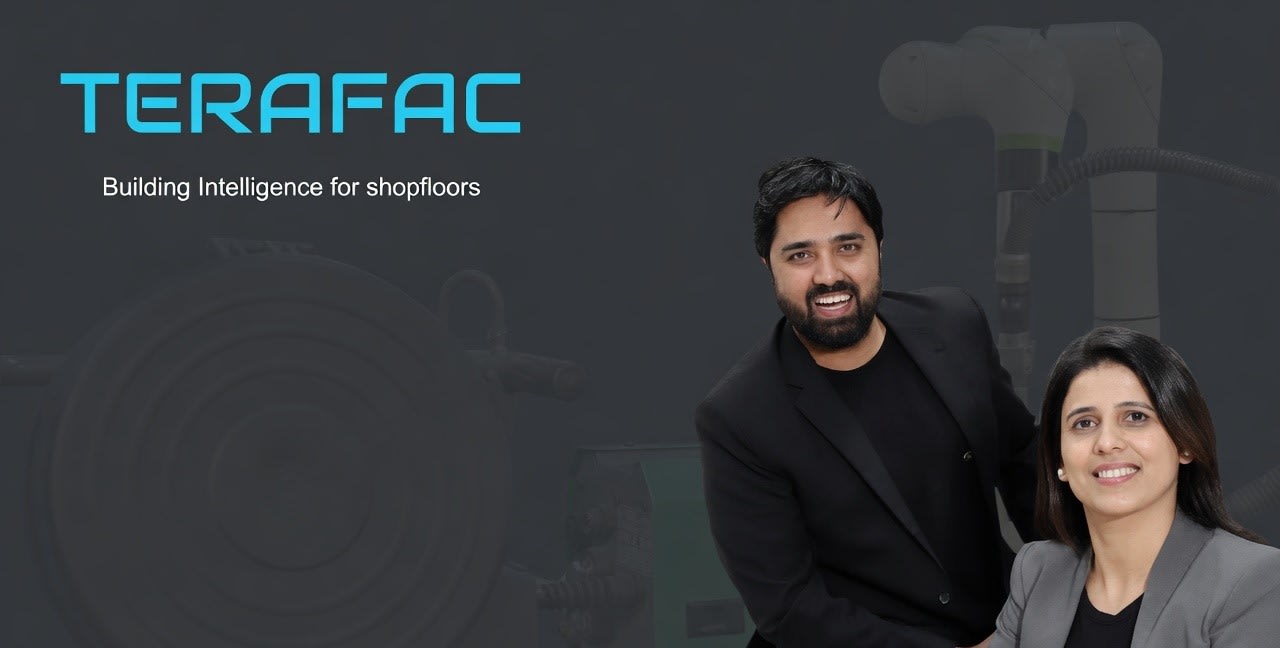
Terafac, a Chandigarh-based startup, sells software that aims to remove the reprogramming step. It was founded in 2021 by Anubhi Khandelwal, its CEO, and later in 2023 Amrit Singh joined as the co-founder and CTO. Building it from Chandigarh rather than a metro puts the company close to the manufacturing clusters of Punjab and Haryana, where the customers it is aiming at actually operate.
Terafac’s platform uses computer vision to give an ordinary industrial robot a way to see what is in front of it. The robot scans the part, works out what needs doing, and adjusts its own movement. No one writes new instructions for each variation. Its first product, WeldT, applies this to welding. Welding is a good starting point because it is a skilled, repetitive and physically demanding task, and India has a severe shortage of trained welders.
The company calls its approach “Software as a Skill.” Rather than selling a robot, it sells a capability that runs on machines a factory may already own. That keeps the cost of adopting it much lower than buying new hardware. Terafac plans to extend the same platform to painting, glueing, inspection and assembly, which are variations of the same underlying problem. Each of those tasks involves a robot doing skilled physical work on a part that is not always identical. If the vision layer can handle one, the argument goes, it can be adapted to the others without starting again.
Why Smaller Factories Have Stayed Away from Automation
The company sells to original equipment manufacturers and to factories directly, with system integrators as partners. Its stated target market is India’s small and mid-sized manufacturing base, which has largely been priced out of automation. Working through integrators matters for reach. Those firms already install and service equipment for hundreds of factories, and they are the route through which a small software company can get in front of buyers it could never call on directly.
Traditional automation assumes long production runs of identical components. In that world, the cost and time of programming an industrial robot can be amortised over thousands of identical cycles. In India’s SME-heavy manufacturing landscape, the opposite is true. Job shops and mid-sized plants switch between components frequently. Every new batch risks becoming a programming project, and the specialist who can do that programming is scarce and expensive. The result has been a stubborn preference for manual labour even when the physical work is dangerous, inconsistent or simply hard to staff.
Terafac’s bet is that if the software layer can absorb the variability, the existing installed base of machines becomes far more useful. Factories do not need to scrap what they already own. They need a way to make those machines responsive to the next part that appears in front of them.
Funding, Ambition and the Road Ahead
Terafac raised Rs 6.5 crore in a pre-seed round led by Inuka Capital, with DeVC, Bharat Founders Fund, Innovation Mission Punjab and several angel investors. The money is going into product development, hiring and market expansion. Raj Sheth, founding partner at Inuka Capital, said the company was making automation accessible for factories of all sizes by upgrading machines they already have, starting with welding, where the shortage of skilled workers is most acute.
The company has said it aims for 80 deployments across more than 20 customers within a year of the round. Whether it reaches that would be the test of whether the model works outside a pilot. Early traction will matter because the technology has to prove itself on real shop floors, under real production pressure, with real variation in part geometry and surface condition.
Terafac is competing against established industrial automation suppliers, most of them selling hardware. Its position is that a factory should not have to replace its machines to make them adaptable, which is a different proposition from the one those suppliers offer. An industrial robot that can only repeat a fixed program remains a high-cost tool for high-volume, low-variety work. An industrial robot that can perceive and adapt becomes something closer to a flexible skilled worker that never tires and never leaves for another job.
Closing the Skills Gap Without Replacing the Machines
The broader context is straightforward. India wants to expand manufacturing output and improve quality and consistency. At the same time, the pipeline of young people entering traditional skilled trades is under pressure. Welding is only the most visible example. Painting, adhesive application, inspection and certain assembly steps face similar constraints. If software can reliably turn a standard industrial robot into a system that handles natural variation, the economics of automation for smaller plants change.
Success will depend on more than clever computer vision. The software must integrate cleanly with existing controllers, survive the dust and vibration of a factory, and produce welds or coatings that meet customer specifications without constant human oversight. Integrators will need training and support so they can sell and service the solution with confidence. Customers will need clear evidence that the reduction in reprogramming time and the improvement in consistency outweigh any residual process risk.
Terafac’s location in Chandigarh is not accidental. Proximity to the industrial belts of north India means shorter feedback loops with early users and a clearer view of the constraints those users actually face. For a company trying to make automation practical rather than theoretical, that closeness is an advantage.