MakeMyShoe: How One Founder Built India’s Answer To High MOQ Footwear Manufacturing
The Problem No One Talks About In The Footwear Industry
Every year, hundreds of aspiring entrepreneurs in India dream of building their own footwear brand. They design a sneaker, sketch out a logo, imagine the packaging. Then they go looking for a factory to actually make the shoes, and that is where most of these dreams quietly die.
The footwear manufacturing industry, in both India and China, has traditionally been built for scale. Factories are set up to produce thousands of pairs at once, and most of them have little patience for a new brand asking for a few hundred units to test the market. Minimum order quantities, commonly known as MOQ, have long been the invisible wall between a good idea and an actual product on shelves.
This was exactly the wall that a close friend of Abhishek Singhal ran into a few years ago.
Where It All Started
Abhishek’s friend wanted to launch a good-quality footwear brand in India. He started researching factories, first within India, then in China, hoping one of the two markets would offer more flexibility. Instead, he found the same problem everywhere. Factories demanded high minimum orders that no new brand could realistically commit to. On top of that, new brand owners were rarely taken seriously by manufacturers used to dealing with large, established clients. The Chinese factories he visited added another layer of complexity, with import logistics and communication gaps making the process even harder.
Abhishek was closely involved during this research phase, watching his friend hit the same wall again and again. At the time, Abhishek was not a footwear industry insider. He held a B.Tech and an MBA, and had spent years working in the software and e-commerce industry. Shoes were not his world. But problems in scaling businesses were, and he recognised this one for what it was: a gap in the market that nobody with manufacturing expertise seemed interested in closing.
So he made a decision that changed the direction of his career. He moved to Agra, widely known as the footwear capital of India, and started a small factory of his own.
Building MakeMyShoe From Scratch
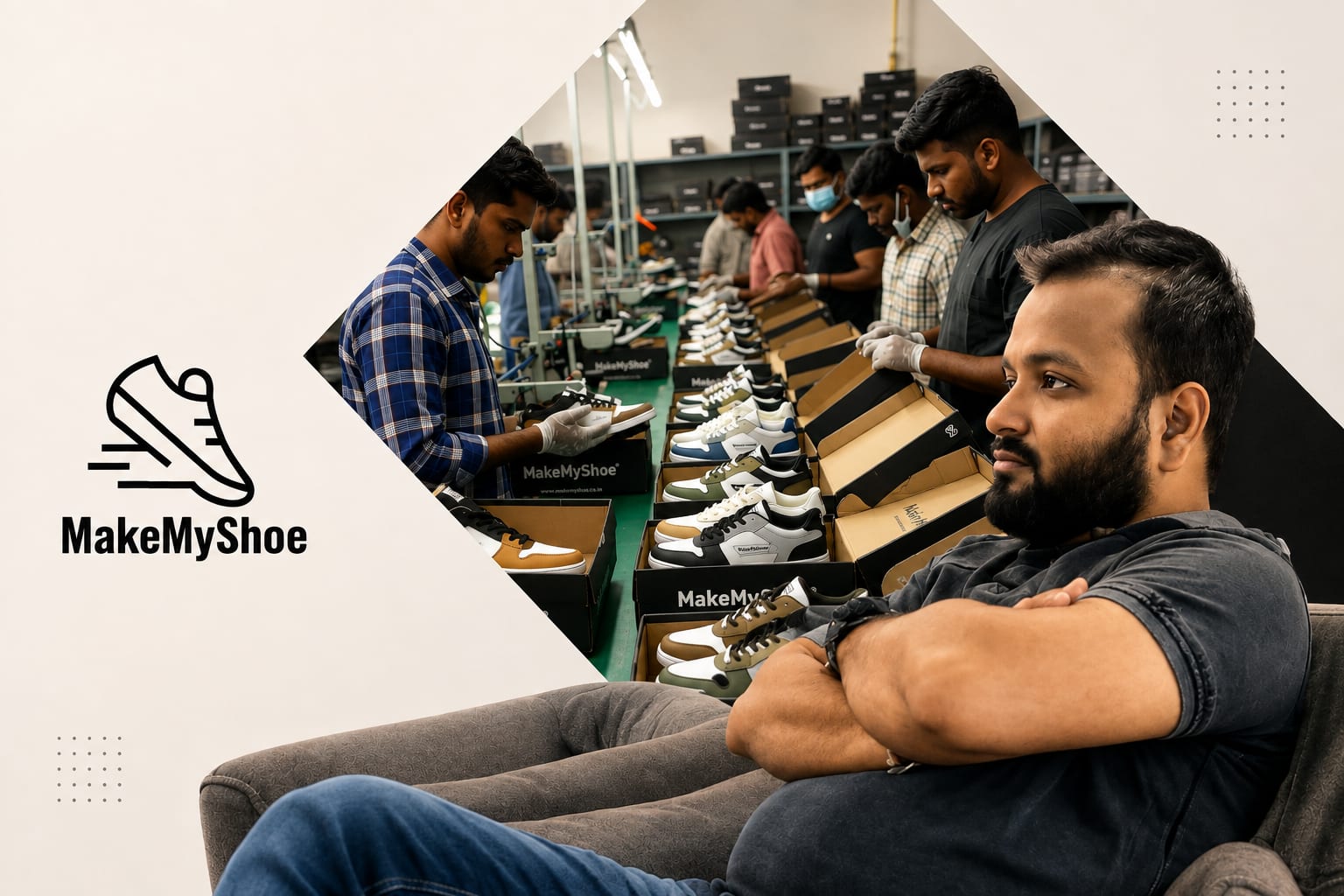
The early goal was simple. Work with new brand owners who were being turned away everywhere else and offer them a low-MOQ option without compromising on quality. That small factory eventually grew into MakeMyShoe, a private-label and white-label custom shoe manufacturing company now based in Agra.
The transition was far from smooth. High-quality materials come at a cost, and low MOQs are not something most suppliers are naturally excited about. In the initial phase, several suppliers were reluctant to work with MakeMyShoe because the order sizes did not match their usual volumes. It created a strange paradox for the young company. It wanted to do things better, at a time when the industry was built almost entirely around doing things bigger.
Over time, Abhishek and his growing team worked through these supply chain challenges. A major part of that success came from the people he brought on board. MakeMyShoe’s team includes professionals who have previously worked in large footwear factories across India, giving them a first-hand understanding of where new brands typically struggle. That experience now shapes how the company operates, guiding founders through every stage of the process instead of simply taking orders and shipping boxes.
What MakeMyShoe Actually Offers
Today, MakeMyShoe positions itself around one clear promise: global quality shoes with low MOQ. The company supports founders across the entire journey of building a footwear brand, including design and prototyping, material sourcing, sampling, production, quality control, private labelling, packaging, and final delivery.
Its manufacturing capabilities span multiple footwear categories, including custom sneakers, sports shoes, casual and formal footwear, leather shoes, and school shoes. This range allows MakeMyShoe to work with two very different kinds of customers. The first is the first-time founder who is building a D2C footwear brand from the ground up, often with no prior manufacturing experience. The second is the established D2C brand that already has a market presence and wants to launch a new sneaker line or expand into a new footwear category.
In just a few years, MakeMyShoe has worked with more than 300 Indian and international brands, a number that reflects both the demand for low MOQ manufacturing and the trust the company has built within that space.
Why MakeMyShoe Is Different From A Regular Factory
What sets MakeMyShoe apart is not just the low MOQ model, though that alone solves a major pain point for new founders. It is Abhishek’s background outside the footwear industry that shapes how the company operates.
Having spent years in software and ecommerce, and having worked closely with several ecommerce startups in India, Abhishek brings a founder’s perspective to manufacturing rather than a purely factory owner’s perspective. This means MakeMyShoe does not just produce shoes and hand them over. It actively guides founders on how to scale their brand, offering the kind of end-to-end support that a first-time entrepreneur genuinely needs but rarely finds at a traditional manufacturing unit.
This combination, a skilled team with big-factory experience paired with a founder who understands startup scaling, is what allows MakeMyShoe to sit in a category most Indian manufacturers have ignored: high-quality production at startup-friendly order sizes.
A Bootstrapped Bet On Small Brands
MakeMyShoe remains a bootstrapped company, built without external funding, growing purely on the back of the problem it solved and the trust it earned from founders who had nowhere else to turn. It continues to operate out of Agra, working with D2C brands, footwear startups, and new entrepreneurs who want to build their own footwear label from the ground up.
The story of MakeMyShoe is, in many ways, the story of a problem that hid in plain sight for years. Everyone in the footwear supply chain knew that high MOQs were shutting new brands out. It took someone from outside the industry, watching a friend struggle through the same wall, to finally build a way around it.