Metastable Materials: From battery waste to industrial metals
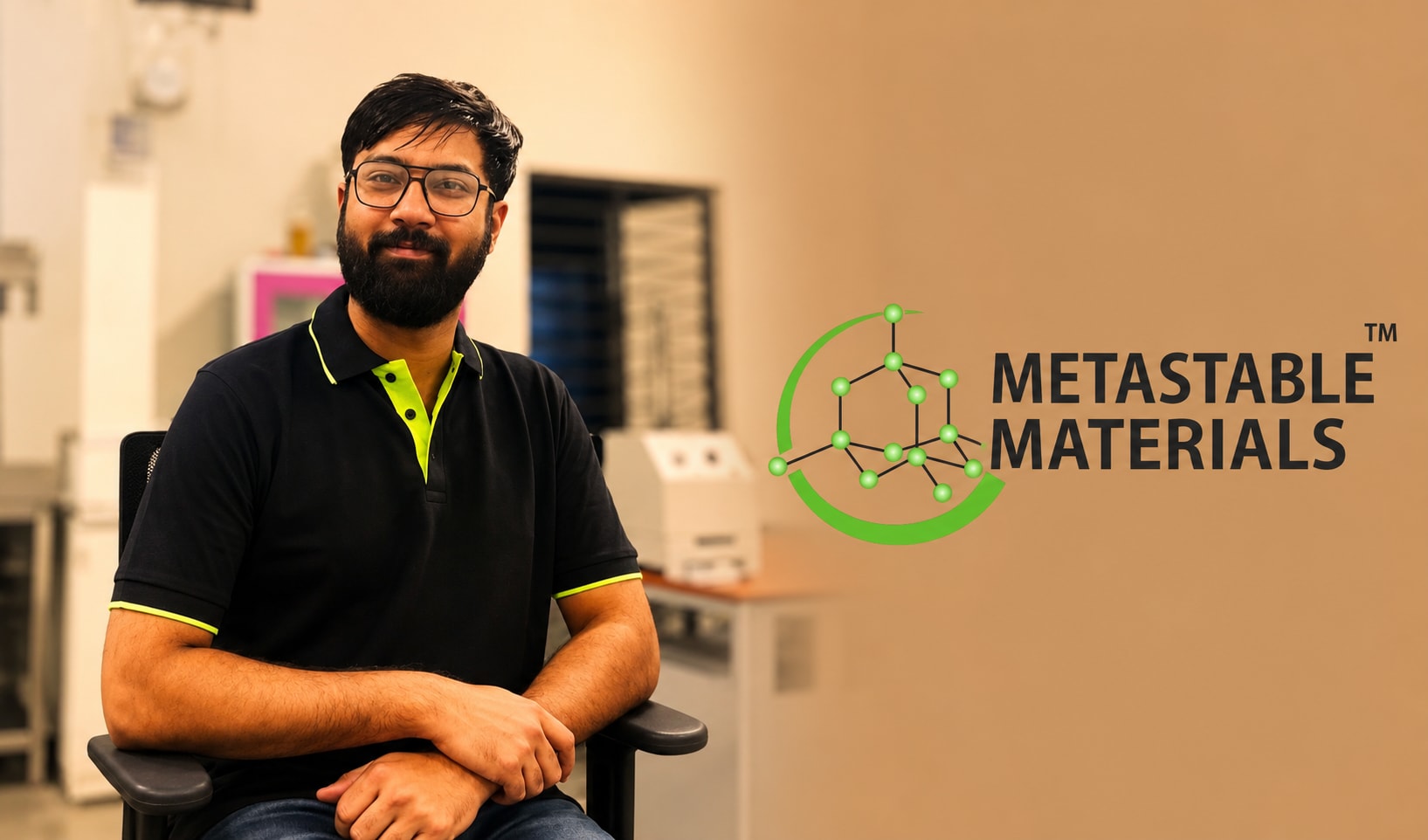
India imports most of the critical metals lithium, cobalt, nickel, copper, and more used in batteries for electric vehicles, consumer electronics, and renewable energy storage. At the same time, the volume of spent lithium-ion batteries is growing rapidly every year. These “dead” batteries are rich in the very materials the country desperately needs.
Bengaluru-based Metastable Materials was founded on a refreshingly simple yet powerful idea: spent batteries are not waste to be disposed of; they are ore to be refined.
The Founders and the Spark
Metastable Materials was founded in October 2021 by two IIT Roorkee graduates: Shubham Vishvakarma and Manikumar Uppala.
While in college, the duo began developing the core chemistry that would power their recycling process. Uppala studied mechanical and materials engineering, later specialising in machine design and manufacturing at NBC Bearings (CK Birla Group). Vishvakarma also gained experience in the company’s advanced materials division. Their technical grounding and shared vision for circular economy solutions led them to tackle one of the biggest challenges in India’s EV transition: battery waste and raw material dependence.
Turning Batteries into Metals Differently
Metastable buys spent lithium-ion batteries, dismantles them safely, and refines the materials into high-purity commodity metals: lithium, cobalt, nickel, copper, and aluminium.
“We are a sustainable raw material supplier,” says Vishvakarma. “And we just happen to be a really good refiner.”
The process is end-to-end: procurement, dismantling, refining, and recovery. A key innovation is dismantling batteries under water, which drastically reduces fire risk and toxic gas emissions compared to conventional dry crushing methods.
At the heart of their technology is a patented and trademarked reaction called Integrated Carbothermal Reduction. Unlike most recycling processes that rely on external chemicals to break metal bonds, Metastable’s method uses materials already inside the battery to react with each other.No added external reagents.
Once the reaction is complete, metals are separated using smart, physical-property-based techniques:
Copper recovered under pressure
Lithium dissolved in water
Nickel and cobalt separated via magnetism
“Simpler things, but effective,” Vishvakarma notes.
The team designs and builds much of its own equipment in-house magnetic separators, density separators, agitators, boilers, furnaces, mills, and shredders. They’ve also developed one of India’s most compact zero-liquid-discharge systems, recycling all process water on-site. The company holds five patents, including an international filing.
Who Buys These Recovered Metals?
Because Metastable produces refined commodity metals rather than battery-grade black mass or intermediates, its customer base is broad:
Lithium → Glass, ceramics, cement, and grease manufacturers
Nickel → Stainless steel industry (its largest global consumer)
Cobalt → Pigments and magnet production
Copper → Casting and bus bar manufacturing
Aluminium → Automotive casting
They work closely with customers to meet strict specifications on purity, contamination levels (e.g., manganese in cobalt for magnet makers), and particle size. On the supply side, batteries come from scrap dealers, large OEMs (two-wheelers and four-wheelers), and other recyclers. Logistics and safety for hazardous material transport are handled with care.
The business model is straightforward: buy spent batteries at market rates and sell refined metals benchmarked to exchanges like the London Metal Exchange (LME), Shanghai Metal Exchange, MCX India, and Bombay Metal Exchange. Pricing adjusts for purity, volume, and relationships.
Growth Trajectory
Revenue started flowing in 2025. Their Bengaluru facility has an installed capacity of 1,500 tonnes per year and has seen utilisation double every quarter in recent periods. The goal is to consistently operate at 80–90% utilisation.
The broader opportunity is massive. According to IMARC Group, the global battery recycling market was valued at ~$18 billion in 2025 and is projected to reach $32.9 billion by 2034. In India, Metastable competes with players like Attero Recycling, Lohum, BatX Energies, and Tata Chemicals — but differentiates through its chemistry and integrated approach.
Funding, Team, and Scaling Ambition
Metastable has raised two rounds:
Pre-seed (Jan 2022) led by Akshay Singhal and Kartik Hajela of Log9 Materials
Seed round (2023) from Surge (Peak XV Partners), Speciale Invest, Theia Ventures, and Climate9ers
The capital helped build two factories, file patents, and grow the team to over 50 employees.
Operations currently include an office and two factories: a half-acre facility in Bengaluru’s Harohalli Industrial Area and another in Delhi (chosen for proximity to feedstock). Site scouting is underway in Rajasthan and other locations for the next phase of expansion.
“Plants still take time to build; these are physical assets,” says Vishvakarma. The focus in 2026 and beyond is clear: scale as fast as possible while continuing process innovation.
Why This Matters for India
As India pushes aggressively toward EV adoption, securing domestic sources of critical metals is a strategic necessity. Metastable’s model reduces import dependence, minimises environmental harm from battery waste, and creates a circular supply chain.
By treating spent batteries as valuable ore rather than hazardous waste, the company is not just recycling; it is redefining resource security for the clean energy future.
In Vishvakarma’s words, they’ve proven the process works. Now it’s time to scale it nationwide.
The battery waste problem is growing. Metastable is turning it into India’s opportunity.