SEV Technologies: Measuring the Invisible Cost of Every Commute
As one of the world’s rapidly growing economies, India is also the third-largest emitter of greenhouse gases, responsible for 14% of global emissions. Vehicular pollution is believed to contribute to more than half of the air pollution in India, with reports suggesting that these levels could soar as high as 80% in metropolitan areas.
We live in an era where calories can be tracked, sleep monitored, daily steps counted, and screen time displayed, but when it comes to pollution, we rely on guesstimates. Current ESG reporting is built on national averages and broad modelling, meaning we are trying to manage our largest source of emissions without actually seeing them. In the mobility space, you cannot optimise what you do not measure.
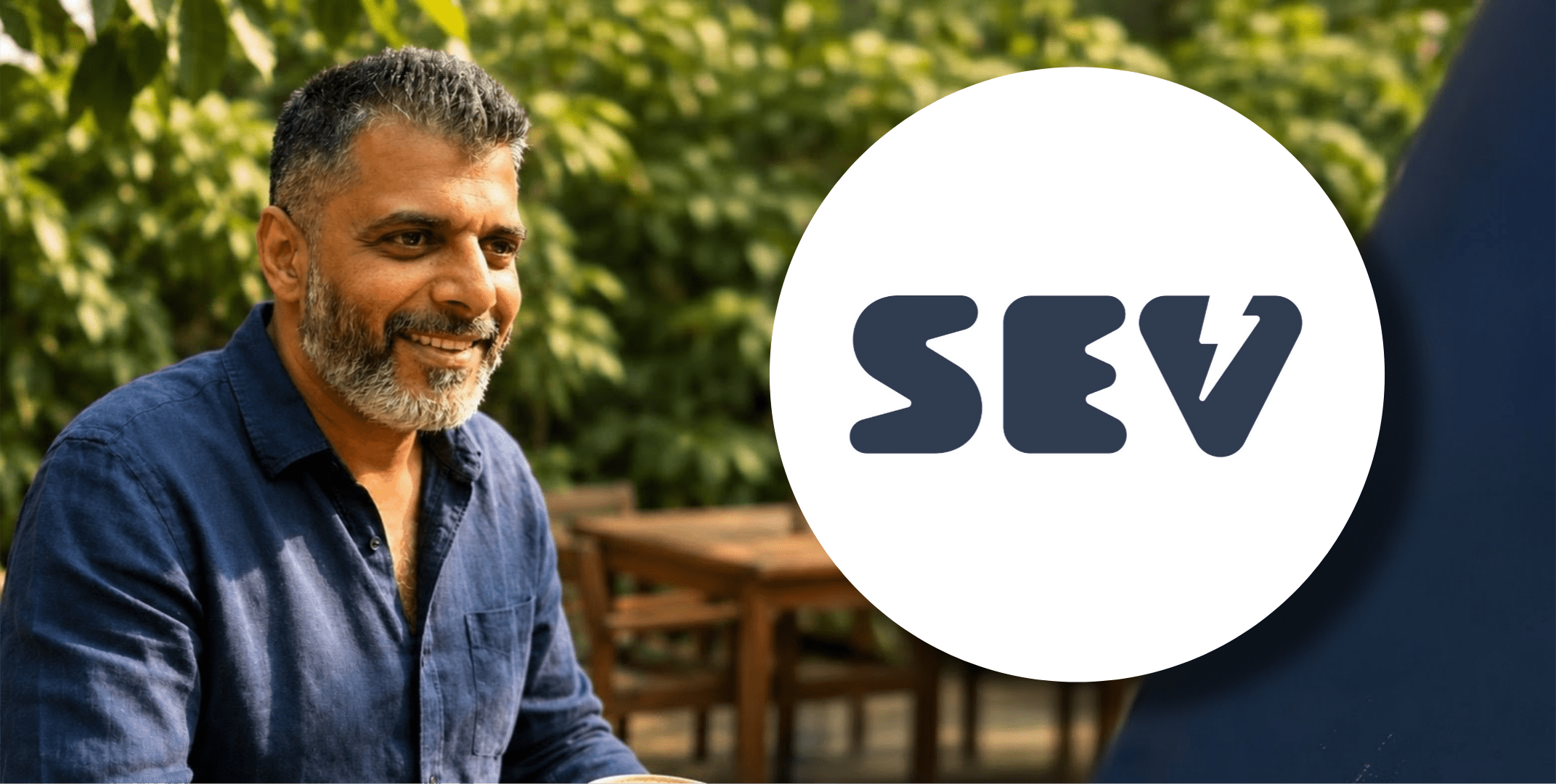
To solve this problem, Nithin Palal founded SEV Technologies, a carbon-tracking and offsetting platform for the mobility sector designed to replace approximation with accuracy. The premise is simple: every journey has a climate cost, and he is determined to not just measure it, but make it visible to others.
The SEV Mobility App uses a proprietary GPS-based algorithm to track emissions journey-by-journey and convert them into tradable points, redeemable as cash. A Brown Point equals 10 grams of carbon generated, while a Green Point equals 10 grams of carbon avoided. By transforming pollution into currency, Nithin hopes to reward greener practices, thereby instilling sustainable behaviour through real monetary benefits instead of depending solely on the conscience of the masses.
Turning Sustainability into Benefits
Going green is no longer a personal sacrifice; it is a financial gain. Users receive rewards of up to ₹1,000 for their daily travel, turning sustainable choices into daily income based on the challenges they participate in. The platform provides delivery riders and courier fleets with a pathway to reduce operational costs, earn more through incentives, and achieve dignity of labour through transparent, data-backed performance.
The platform generates a massive, accurate data set. It provides companies with the precise emissions reporting required for ESG compliance and gives universities the “ground truth” data necessary for serious climate research. By monitoring gig workers who travel 100–200 kilometres daily, SEV identifies the exact steps needed to reduce the national carbon footprint. Additionally, for businesses, the platform tracks employee travel emissions, providing a clear view of corporate impact.
Thus, the founder envisions SEV as the behavioural infrastructure layer for sustainable mobility.
The Business of Emissions and Emotions
Nithin has been an advocate of sustainability since the age of 14. As the sole founder of SEV Technologies, he has successfully converted his passion into a business, not just with the aim of scaling or revenue, but to make a genuine impact. A well-rounded personality, he is also a long-distance cyclist who once ran a cycle shop and built cycling clubs in his community.
As a teenager, he vowed never to own a polluting car and stood by it, finally purchasing an EV as his first vehicle. Since then, he has driven more than 1.5 lakh kilometres across India, founding SEV after witnessing the infrastructure gaps that were constraining India’s sustainability story.
Browsing through their website, their philosophy can be evident in one statement.
“Morality asks people to behave better; structure makes better behaviour inevitable.”
Deep down, we all want to do the right thing, but often there is no clear pathway to achieving these goals. Our systems shape social order and provide the requisite information, giving people better resources to develop sustainable practices in their everyday lives. The journey of a thousand miles begins with a single step, and the SEV Mobility App allows you to take that first step, not by hammering the importance of the cause, but by providing incentives, simplifying the process, and, most importantly, making crucial data visible using AI and related technologies.