Sivi: The AI Platform Making Professional Design Accessible to Everyone
Creating compelling visuals isn’t everyone’s forte, yet the aesthetic identity of a business can make or break a potential customer’s decision to engage. A poorly designed advertisement may fail to convey its message and lead to missed sales opportunities. The same principle applies to every form of graphical communication, from business cards to marketing collateral.
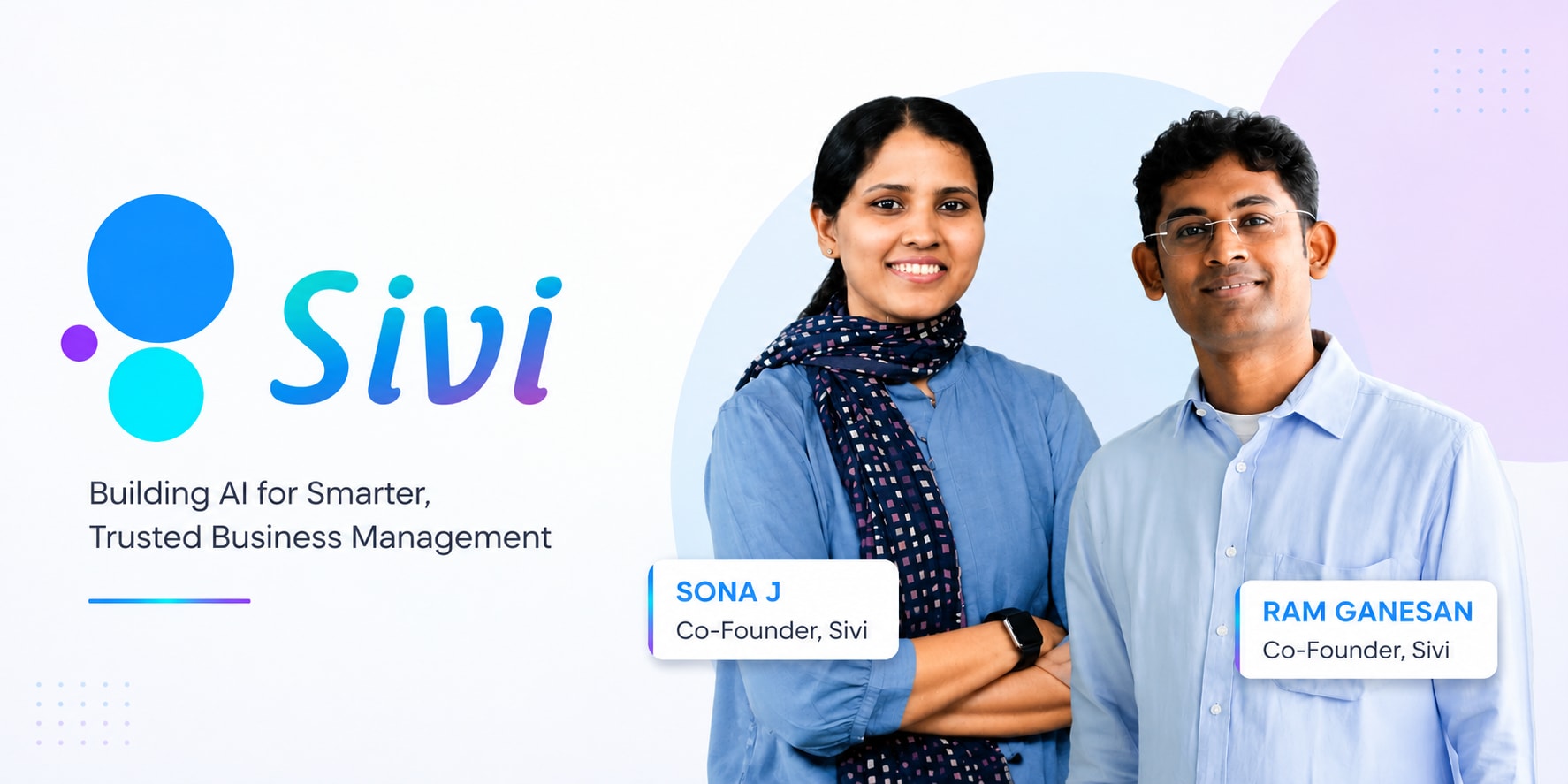
Bengaluru-based AI platform Sivi aims to solve this problem. Founded in 2019 by Sona J and Ram Ganesan, the startup allows users to input a simple message and instantly generate multiple AI-designed options. These designs can be used as-is or fine-tuned manually to create the final product.
Sivi’s product enables users to quickly generate ads, social media posts, product banners, profile covers, and more across multiple languages.
Building the Product from the Ground Up
Ram Ganesan, a computer science engineer, began his AI journey at Samsung, where he worked on natural language processing and machine learning projects and filed three US patents. He later founded MineWhat Inc, a sales intelligence and automation platform.
There he met Sona J, a domain expert who later co-founded Sivi with him. A BTech gold medalist with over 14 years of design experience, Sona previously served as chief designer at Bridgei2i.
The founders started Sivi after identifying a clear gap: most AI models struggled with customisable, layered designs. Existing tools often failed to produce reliable text—an essential element of business communication—and rarely delivered the desired design on the first attempt.
“Abundant data exists online for text and images. There is a lack of structured data for designs as it is multifaceted and multi-layered in nature. At Sivi, we built custom foundational models for layered design generation and prepared unique structured design datasets over a period of three years (beyond image and text datasets) to solve customisable design generation,” says Ganesan.
The team trained an in-house model on objects such as text, shapes, and images, collecting and creating over 30 million layered and structured design data points. After fine-tuning the model, they built the product around two core pillars: the Atomic Design methodology and a Human-in-the-Loop approach.
“Users provide the building blocks—assets, text, brand, and style preferences and Sivi analyses and understands these elements, gradually composing the designs from scratch, just like a designer would,” explains Sona.
Unlike popular image generation models such as Midjourney or DALL-E, Sivi’s system is trained on design compositions. This allows users to select and manipulate individual objects—such as a shape or text block—within a design.
Building this capability required creating an AI model from scratch due to the scarcity of structured design data. The company also faced challenges in hiring skilled AI engineers and training models on expensive cloud infrastructure while operating on a limited budget.
Standing Out from the Competition
Sivi aims to compete with established players like Sydney-based Canva. Microsoft has also developed a generative AI model capable of outputting layered designs, though it remains difficult to access and is currently limited to researchers.
While both Sivi and Canva operate through web portals, their approaches differ significantly. Canva relies on a vast repository of objects, fonts, and images combined with powerful editing tools. Sivi, by contrast, generates objects on the go and ensures no two layouts are identical. Users can easily modify any element of a layout they dislike.
Earlier this year, the 12-member team launched Sivi Gen 2 to improve design quality further. “Today, our design quality matches up to 65% of professionally designed templates. We plan to develop Sivi Gen 3, a more powerful model that can achieve up to 90% of professional design standards,” says Sona.
Customers and Market Opportunity
Sivi is particularly useful for generating designs at scale. The same core message can be iterated across multiple variations while maintaining consistent brand identity. With a single click, templates can be translated into any of the 72+ languages the platform supports, including 17 Indian languages.
“We have users from 140+ countries who have generated over a quarter of a million designs using Sivi. Most of our users are from the US and Europe,” notes Sona.
The platform currently serves more than 24,000 users, with early customers including ecommerce businesses and digital advertising agencies. While it targets a broad range of users—including freelancers, SaaS companies, education providers, and travel businesses—Sona believes the tool is especially valuable for digital advertising agencies that need to iterate designs quickly.
The global graphic design market is estimated at $45 billion, with nearly 200 million business users requiring visual content. With Sivi Gen 2, the company is targeting 60 million of those users.
Pricing and Funding
Sivi currently operates on a token-based pricing model. Users purchase credits to generate new designs. The platform offers six free designs to start, with paid plans scaling up to $160 per month for unlimited tokens and 16 GB of free online storage.
So far, Sivi has raised $650,000 from institutional and angel investors. The company is now looking to raise additional funding to strengthen its technology stack, build larger models, and expand marketing efforts to reach a wider user base.
The startup participated in TechSparks 2023, YourStory’s flagship tech startup event in Bengaluru, and was selected as one of the 30 most promising Indian startups in YourStory’s Tech30 cohort for 2023.
By combining custom AI models trained specifically for layered design with a user-friendly editing experience, Sivi is working to make high-quality visual content more accessible and faster to produce for businesses of all sizes.