STARTUP STORIES
From Social Experiments to ₹534 Cr Revenue: Inside CityMall’s Genius Grocery Pivot
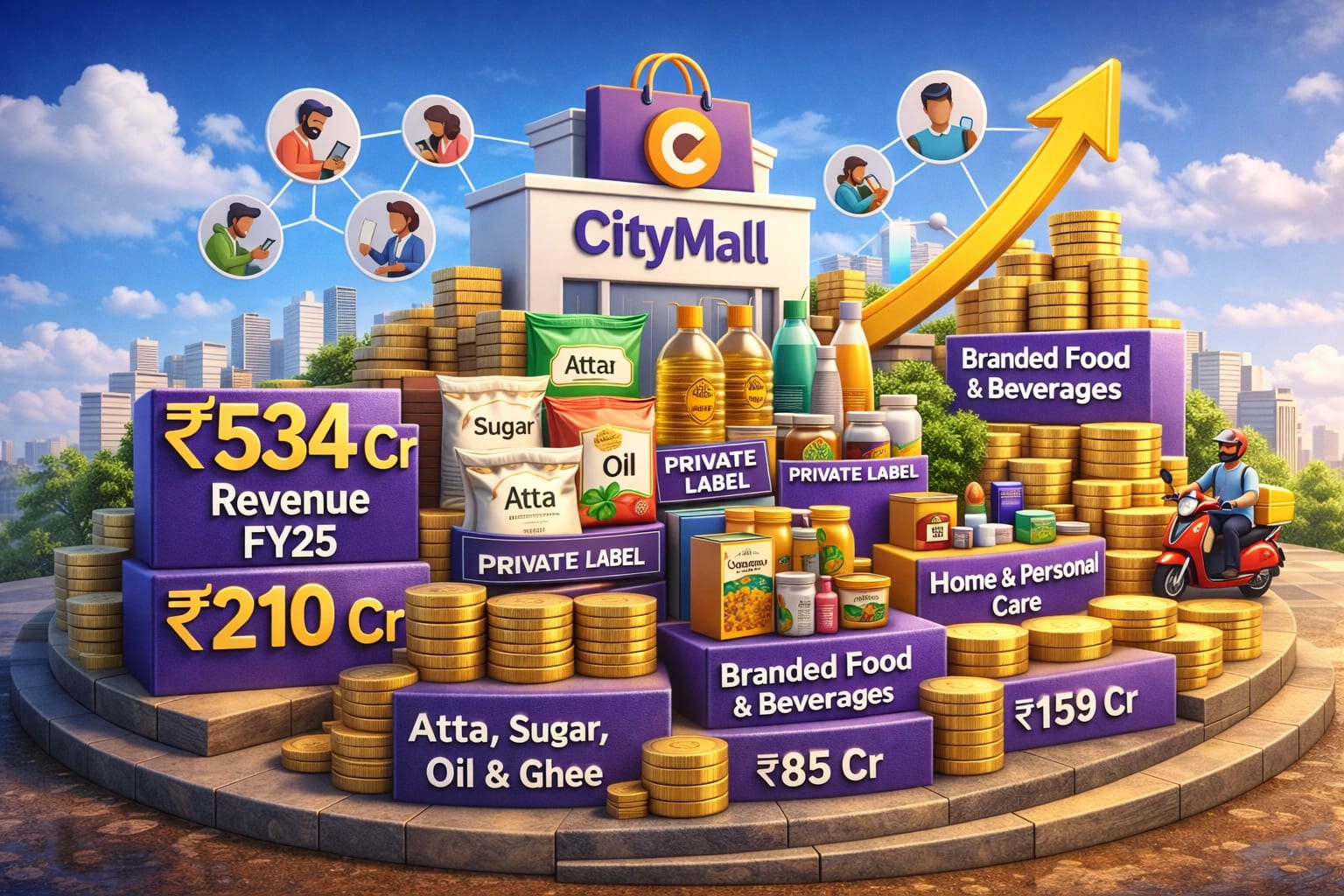
CityMall, founded in 2019, has transitioned from an experimental social commerce startup into a formidable force in India’s value-commerce landscape. Reporting ₹534 crore in revenue for FY25, the company has successfully cracked the code for Tier II and Tier III markets by pivoting toward high-frequency grocery essentials and a robust private label strategy.
Below is a detailed breakdown of CityMall’s strategic pivot, financial performance, and the "Bharat-first" distribution moat that defines its success.
Financial Performance: The Revenue Engine
In a year characterized by a shift from "growth at all costs" to "sustainable scaling, CityMall’s FY25 numbers reflect a healthy, core-focused business.
|
Revenue Stream |
Amount (FY25) |
% of Total |
Growth/Context |
|
Product Sales |
₹512 Crore |
96% |
30% YoY growth; driven by staples. |
|
Services (Logistics/Marketing) |
₹22 Crore |
4% |
Monetizing the existing supply chain. |
|
Total Revenue |
₹534 Crore |
100% |
Steady expansion in non-metro demand. |
This revenue mix indicates that CityMall has moved past the "discovery" phase and is now a high-volume retail powerhouse. By focusing 96% of its energy on product sales, the company is prioritizing the GMV (Gross Merchandise Value) that builds long-term customer habits.
The Strategic Pivot: From "Social" to "Essential"
CityMall’s most significant milestone is its departure from the traditional social commerce model (reliant on viral sharing) to a Grocery-Led Model.
-
The Problem with Discretionary Social Commerce: High customer acquisition costs (CAC) and low repeat purchase rates in categories like fashion or electronics.
-
The CityMall Solution: By placing Daily Essentials at the core, the company has ensured that customers return to the app 3–4 times a month rather than once a quarter.
Comparative Strategy Shift
-
Old Focus: Group buying, wide-ranging categories, and reseller-driven discovery.
-
New Focus: Predictive demand for staples, private label expansion, and optimized unit economics.
Category Deep-Dive: What Bharat is Buying
The FY25 data suggests that the "Bharat" consumer prioritizes the kitchen and the household budget. Essentials aren't just a category; they are the entry point for trust.
FY25 Category Breakdown:
-
Staples (Atta, Sugar, Oil, Ghee): ₹210 Cr (39%) — These are the "anchor" products that drive traffic.
-
Branded F&B: ₹85 Cr (~17%) — Popular FMCG brands that offer comfort and familiarity.
-
Home & Personal Care: ₹58 Cr (~11%) — High-margin items like detergents and soaps.
-
Miscellaneous & Others: ₹159 Cr (~31%) — Including seasonal goods and emerging categories.
Key Insight: Tier II/III consumers are value-conscious but brand-aware. CityMall’s mix of unbranded staples and branded F&B strikes a perfect balance between price and prestige.
The "Private Label" Margin Play
To combat the thin margins inherent in the grocery business, CityMall has doubled down on Private Labels. This strategy serves three critical functions:
-
Margin Expansion: Capturing the profit typically lost to mid-tier national brands.
-
Supply Chain Control: Direct sourcing allows for better quality control and price flexibility.
-
Exclusivity: Creating "CityMall-only" brands builds a unique identity that prevents users from price-shopping on competitor platforms.
The Distribution Moat: The Reseller Network
While CityMall has matured its product mix, its Community Reseller Network remains its secret weapon. This hybrid model solves the two biggest hurdles in rural e-commerce: Trust and Logistics.
-
Trust by Proxy: In small towns, people buy from people they know. Local resellers act as "mini-influencers" and customer service hubs.
-
Last-Mile Efficiency: By aggregating orders to a single reseller point, CityMall slashes the prohibitive cost of individual doorstep deliveries.
-
Low CAC: Word-of-mouth through resellers is significantly cheaper than Facebook or Google ads in regions with lower digital literacy.
Industry Significance: The Road Ahead
CityMall’s performance is a bellwether for the Indian startup ecosystem. It proves that:
-
Profitability is the new North Star: The shift toward staples is a shift toward predictable, repeatable cash flow.
-
The "Next Billion" are Ready: The digital infrastructure (UPI, cheap data) is now translating into real-world consumption in smaller towns.
-
Efficiency Wins: By optimizing the supply chain for high-frequency goods, CityMall is positioning itself to be the "Walmart of Bharat."
CityMall has successfully navigated the "trough of disillusionment" that many social commerce startups faced. By grounding its business in the reality of the Indian kitchen—and backing it with a sophisticated reseller network—it has built a high-frequency, grocery-led engine that is primed for sustainable growth in FY26 and beyond.
Follow Karostartup for more insights into the intersection of technology, policy, and the future of India.