Success Story of MittiCool the fridge that runs on zero electricity
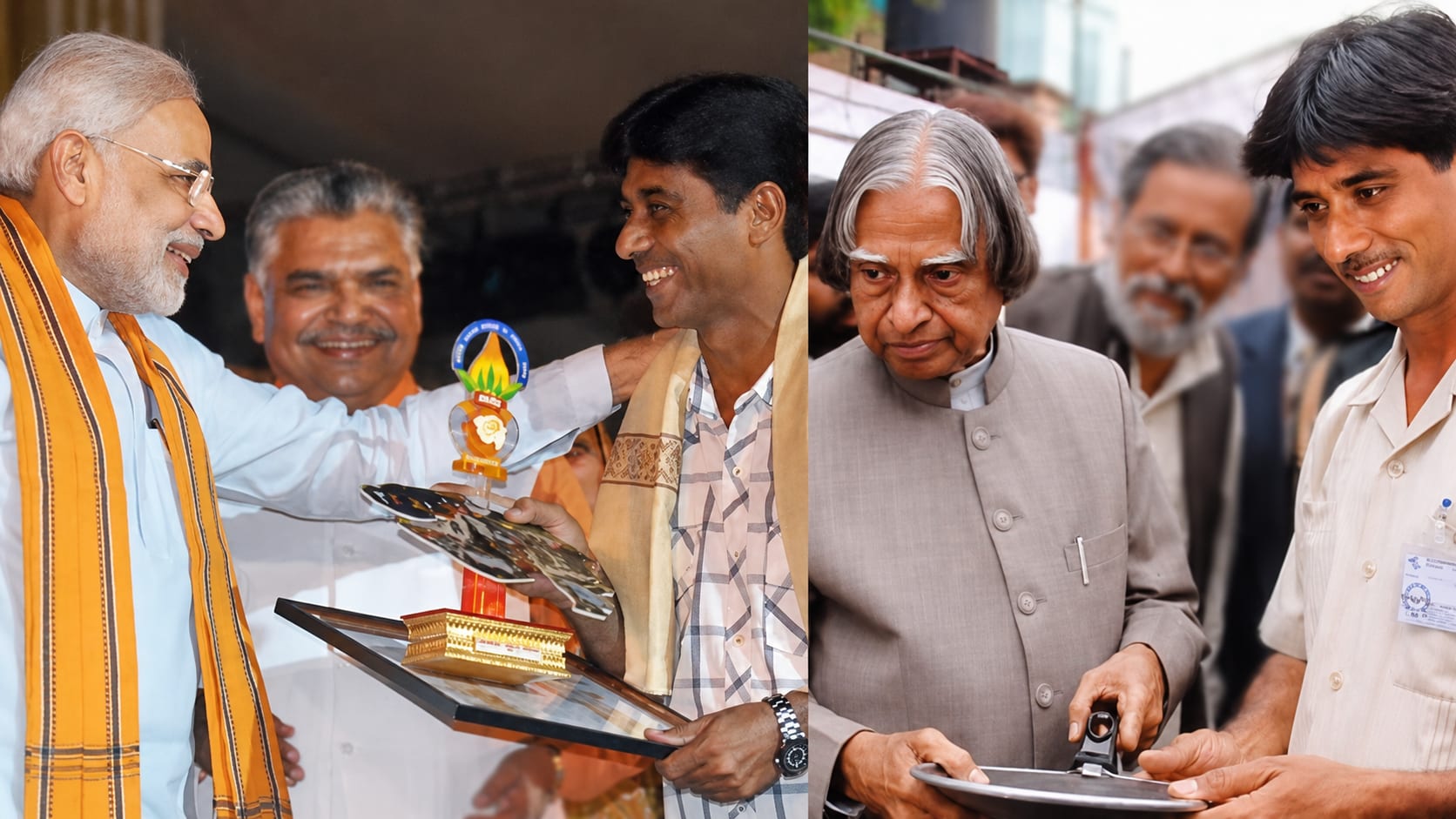
He lost everything in an earthquake. Then invented MittiCool, the fridge that runs on zero electricity
There's a small town in Gujarat called Wankaner, It's not the kind of place that shows up in headlines. Mansukhbhai Prajapati was born there, into a family that had been making pots and tawas for generations.
By the time he was a teenager, the family business was already struggling. There wasn't much money at home, and school stopped making sense after Class 10. He just didn't continue.
His father got him a job at a tea stall nearby. Simple work, steady income, nothing more expected of him. But Mansukhbhai didn't stay there for long. He moved to a ceramics factory instead, where he ended up putting in 12, sometimes 14 hour shifts.
There was no big plan behind it. He needed the work, and that's what was available but years around clay do something to a person. He'd grown up watching it being shaped on a wheel, fired in a kiln, broken and remade. By the time he was in his twenties, he understood almost instinctively what it could hold, how it behaved with heat and water, where it cracked and where it didn't.
In 1988, he borrowed 30,000 rupees and started a small unit making clay tawas, the flat plates people use to cook rotis. His father wasn't thrilled.
"There's no money in pottery," he told him. "No one's going to marry their daughter to a potter."
Mansukhbhai didn't argue. He just went back to work. Then 2001 happened,the Bhuj earthquake hit Gujarat in January that year, and it was devastating ,entire neighborhoods flattened in seconds, thousands of people gone. Mansukhbhai's stock, everything he'd built over more than a decade, was destroyed too.
Whatever survived, he didn't try to sell. He gave it away to people in Kutch who'd lost their homes. He had almost nothing left himself at that point, and he gave away the little he had anyway.
A few weeks after the earthquake, he was sitting with a copy of Sandesh, the Gujarati newspaper. There was a photograph from the disaster zone , broken clay pots lying among the rubble.
Under it, a small caption, almost an afterthought:
"Garibo ka fridge tut gaya." The poor man's fridge has broken.
He read it once. Then he read it again. For a lot of families, that's exactly what a clay pot was. Not decoration, not tradition for tradition's sake , it was how they kept their drinking water cool, how vegetables lasted a bit longer in the heat, all without spending a single rupee on electricity.
He kept thinking about that line for days. What if there was a way to build something better? Still made of clay, still needing no electricity, still costing almost nothing to run but an actual refrigerator.
Something that could keep food fresh for people who'd never be able to afford an electric one. It sounded like a strange idea even to him. He started experimenting anyway, in whatever time he could find. The early attempts didn't go well. Some pieces cracked while drying. Some held water but didn't cool anything inside. People in his community had already found it odd that he was making tawas instead of traditional pots, now he was telling them he was building a fridge out of mud. A few of them laughed. Most just shook their heads.
He kept going. At some point, he got in touch with the Grassroots Innovation Augmentation Network in Ahmedabad, and they took an interest in what he was trying to do, helping him refine the design. For close to three years, it was mostly failure. Cracked prototypes, leaks, batches that didn't work the way he'd imagined. He'd fix one problem and another would show up.
Then, in 2005, one version finally held. A terracotta body, with a small water reservoir on top. As the water slowly seeped through the porous clay and evaporated, it pulled the heat out from inside, cooling the chamber the same way an old clay pot keeps water cool on a hot afternoon ,just on a larger, more useful scale. No electricity, no wiring, nothing to plug in. Vegetables stayed fresh for nearly a week. Milk stayed cool for almost a full day.
He called it MittiCool
The first order that came in was for a hundred units, with an advance that finally gave him a bit of breathing room after years of just about managing. After that, things started moving on their own. Dr. APJ Abdul Kalam met him at some point and reportedly called him a "true scientist" , not in a ceremonial way, but because he genuinely seemed to mean it. In 2009, MittiCool was talked about at a conference hosted by the Judge Business School at the University of Cambridge. Today, more than 9,000 MittiCool fridges are sitting in homes across India. Made of clay. Built by a man who never finished Class 10. Started in a small workshop in Wankaner, not long after he read five words in a newspaper and couldn't stop thinking about them.