NEWS
Tech Mahindra x NVIDIA Launch Hindi-First Education LLM Under Project Indus
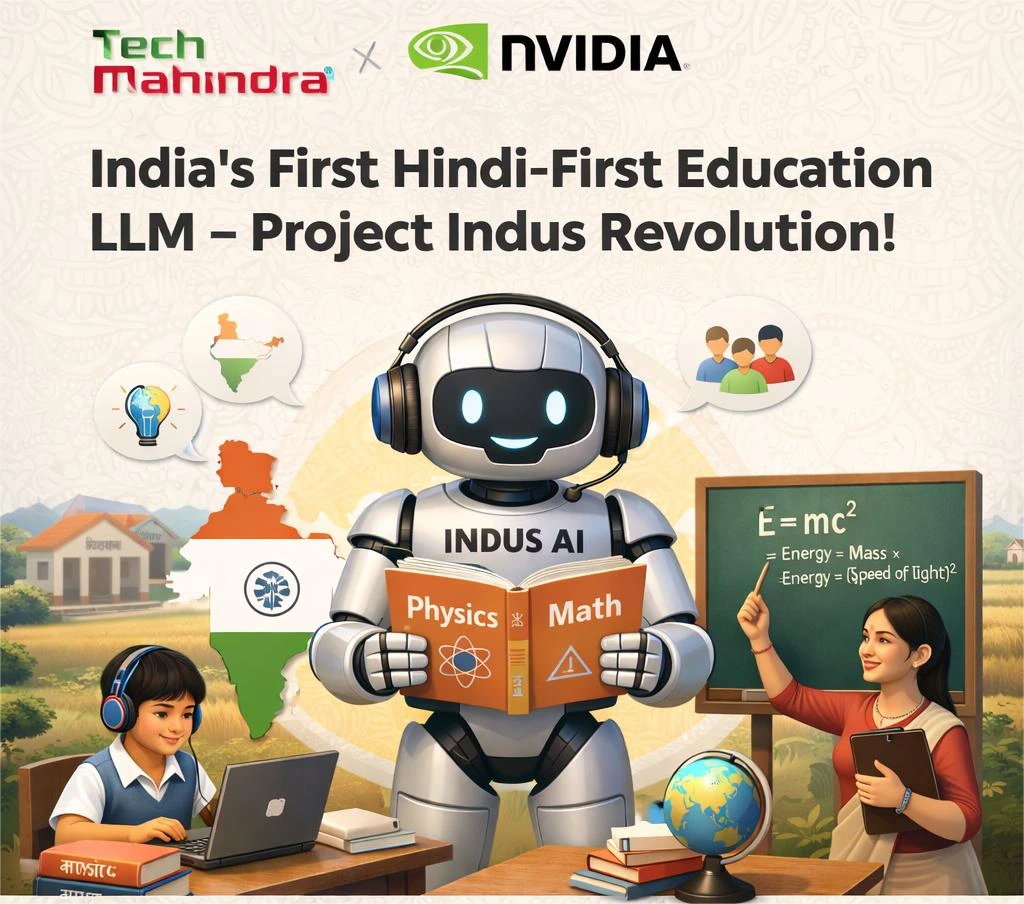
India is taking a major step toward building inclusive and locally relevant artificial intelligence. Tech Mahindra, in collaboration with NVIDIA, has unveiled a Hindi-first Large Language Model (LLM) under Project Indus, designed specifically to transform the education ecosystem for millions of Indian learners.
With a strong focus on regional accessibility and academic support, the initiative aims to bridge the language gap that has long limited the reach of digital learning in India.
What is Project Indus?
Model Overview: Powerful Yet Purpose-Built
The Project Indus model has 8 billion parameters. This puts it in the group of mid-to-large scale LLMs that can understand language well and reason with context.
Key Technical Highlights
- Model Size: 8 Billion Parameters
- Primary Language: Hindi
- Regional Coverage: Hindi + 37+ Indian dialects
- Specialization: Education and student learning
- Subjects Covered: Physics, Mathematics, Core Science, and academic fundamentals
- Infrastructure: Built using NVIDIA’s advanced AI computing platform
- Powered by NVIDIA’s high-performance AI infrastructure, the model is optimized for large-scale training and efficient deployment.
Why This Matters for India
India has more than 250 million Hindi speakers, but many digital learning platforms and AI-powered education tools mainly use English. This language gap makes it hard for students in Tier 2, Tier 3 cities, and rural areas, where English skills might be low. Consequently, many learners face challenges not due to a lack of ability, but because they have to grasp complex academic ideas in a language they do not fully understand.
Project Indus aims to address this issue by bringing AI education directly into students' native languages. By providing learning tools in Hindi and several regional dialects, the initiative makes sure that language does not prevent access to quality education.
The impact of this approach is multi-dimensional:
-
Accessible Learning in Native Language
Students can interact with AI in Hindi, ask questions naturally, and receive explanations in a language they think and learn in. This removes the mental burden of translating concepts from English before understanding them. -
Better Concept Clarity
Subjects like Physics, Mathematics, and Science often involve complex theories and problem-solving. When explanations are delivered in Hindi, students grasp concepts faster, retain information longer, and develop stronger academic confidence. -
Localized Support for Teachers
Educators can use AI to generate explanations, examples, practice questions, and teaching aids in Hindi. This helps teachers deliver lessons more effectively and saves preparation time, especially in resource-constrained schools. -
Personalized Learning at Scale
The AI can adapt to individual learning speeds, provide step-by-step solutions, clarify doubts instantly, and offer customized practice — something that is difficult to achieve in traditional classroom settings. -
Reducing the Urban–Rural Education Gap
By making high-quality academic assistance available through regional languages, Project Indus has the potential to bring the same level of learning support to rural students that is often available only in urban coaching ecosystems.
For millions of learners, studying subjects like Physics or Mathematics in Hindi rather than English is not just a convenience — it can significantly improve comprehension, engagement, exam performance, and self-confidence. In the long run, initiatives like Project Indus could play a crucial role in making India’s education system more inclusive, equitable, and truly accessible to all.
A Big Step Toward Inclusive AI
The collaboration between Tech Mahindra and NVIDIA signals a broader shift — from generic global AI models to domain-specific, culturally relevant AI solutions.
This initiative could power:
- AI tutors for schools and coaching centers
- Voice-based learning assistants
- Regional-language educational apps
- Government and public education platforms
If scaled nationwide, Project Indus has the potential to impact millions of students across India.
The Bigger Vision
Project Indus is not just about one model. It represents India’s effort to achieve AI sovereignty, where technology is built for local needs, languages, and contexts. As digital education grows quickly, Hindi-first and regional AI systems could become the foundation of the next generation of learning. This will make quality education accessible to everyone, no matter the language.
With an 8B-parameter Hindi-first education model powered by NVIDIA, Tech Mahindra’s Project Indus could redefine how India learns.
It aims to bring AI education support to the heart of Bharat, in the language that students truly understand.
Follow Karostartup for more insights into the intersection of technology, policy, and the future of India.