This Couple is Building India’s Answer to Barbie
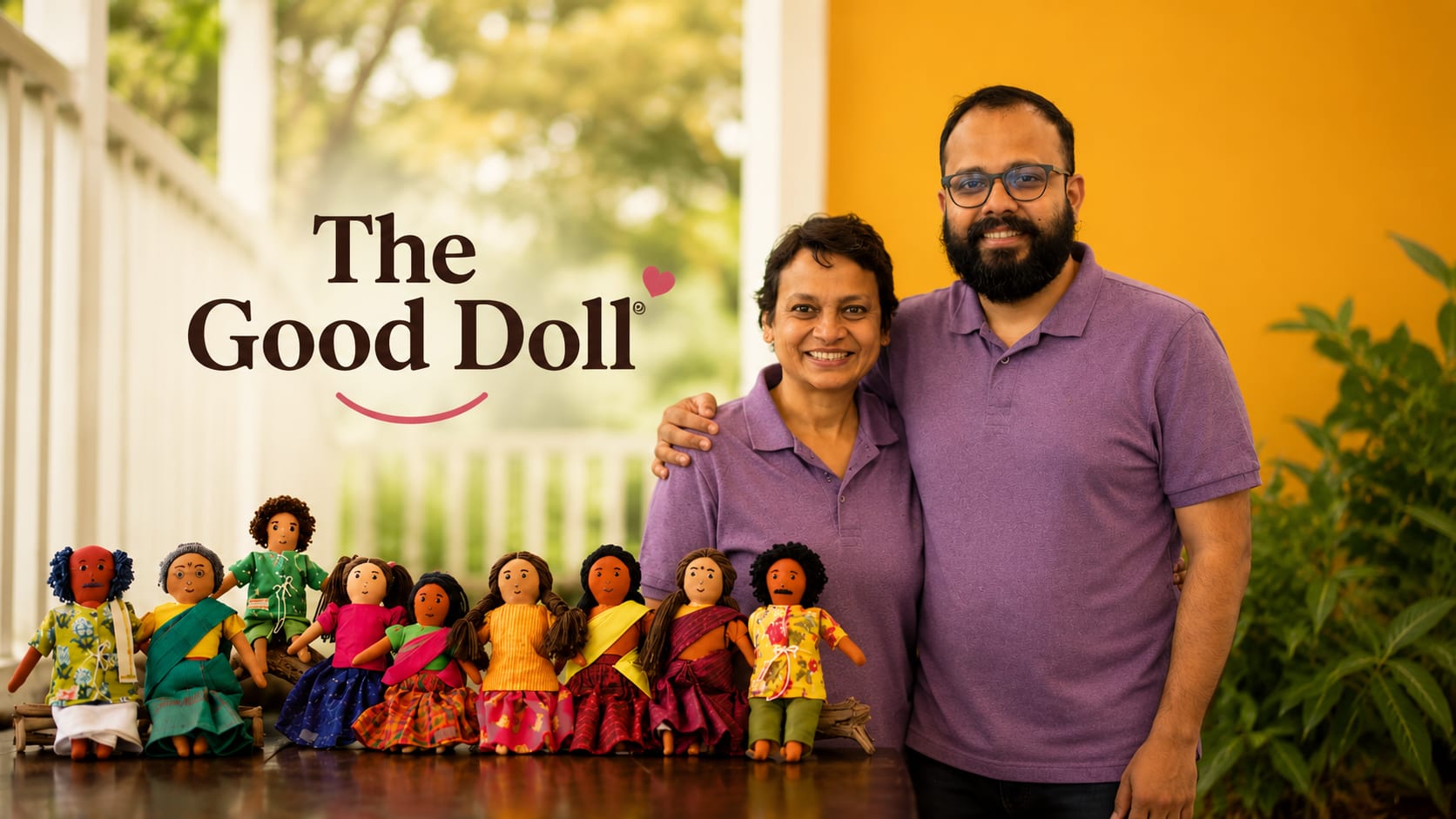
In the misty hills of the Nilgiris, far from the corporate hustle of Bengaluru, a couple has embarked on an extraordinary journey. Sunita Suhas and Suhas Ramegowda, former corporate professionals, left their comfortable city lives in 2017 to create something meaningful. Today, their venture, The Good Doll, employs over 100 women artisans and is crafting Nilah, a doll many are calling India’s answer to Barbie.
From Corporate Burnout to Purposeful Living
In 2017, Sunita and Suhas packed their lives into five bags and moved to a small cottage in Coonoor, Tamil Nadu. The decision came after deep existential questioning. “We realised that whatever we did with our lives or with material things, we could only generate happiness momentarily,” Suhas recalls.
They wanted a different future for their nine-year-old son. They “unschooled” him, allowing him to explore learning without a rigid curriculum. A transformative 10,000-kilometre road trip across rural India in 2016 further solidified their resolve. Living with villagers taught them that true happiness is internal.
Settling on a forested plot near Kotagiri, the couple initially planned an off-grid life. But they quickly became part of the local community. Over time, the contrast between their privileged experience of rural life and the daily struggles of their neighbours moved them deeply.
Discovering Purpose Through Craft
A conversation with a district forest officer nudged them toward community development. They decided to focus on women, as men in the villages already had daily-wage opportunities. Sunita, with her ability to learn crafts quickly (often from YouTube) and teach them effectively, took the lead.
In 2019, she began teaching patchwork quilting to five women in their living room. Within a year, they generated ₹30 lakh in revenue. During the pandemic, they pivoted to making three-layered masks from leftover fabric, delivering them across the country.
They experimented with macramé, crochet, and embroidery. In 2021, they formalised the business as The Macrame Decor Craft Limited and joined incubators like NSRCEL. Rainmatter, the investment arm of Zerodha co-founder Nithin Kamath, became their first investor in late 2022.
The Birth of Nilah
While designing a baby quilt, Sunita created a simple rag doll inspired by traditional Indian cloth dolls made by grandmothers. The quilt didn’t sell well, but the doll became an instant hit. Customers started calling it the “Indian Barbie.”
The couple shifted focus entirely to dolls. They refined designs through pop-up markets in major cities, listening directly to parents. By mid-2023, the team had grown to 55 women artisans.
In early 2025, they introduced Nilah, a carefully crafted character rooted in the Nilgiris. Named after the blue mountains that bloom with Neelakurinji flowers every 12 years, Nilah lives in the fictional village of Neelakumbai. She is curious, questions norms, and comes with a minimal, Waldorf-inspired expression that sparks children’s imagination.
Nilah’s world blends rural Nilgiris roots with modern Indian household elements, making her relatable to children across the country. Through the Raising Nilah storytelling series, she explores emotions, curiosity, and boredom.
Crafted with Care, Rooted in Sustainability
Today, over 100 women artisans work with The Good Doll. Around 40 work at the central unit in Ooty, while 60 stitch components from village-based groups. Each doll passes through five or six pairs of hands. Nearly 60-70% of the fabric is upcycled from textile rejects.
The company produces 4,000–5,000 dolls monthly. A Nilah doll starts at ₹1,250, with prices varying based on accessories. Sales happen through D2C (nearly half the revenue), retail, and B2B channels, including partnerships with Hilton, Hyatt, and Taj.
Transforming Lives
For many women, this is their first formal employment. They undergo two months of rigorous training under Sunita. Many have moved into leadership roles as trainers, supervisors, and coordinators. Several now contribute significantly to household income, some even earning more than their husbands, enabling better education, nutrition, and financial independence.
Funding, Growth, and Challenges
The Good Doll raised ₹1 crore from the Tamil Nadu government’s venture fund last year and secured another ₹3 crore recently, aiming for a ₹10 crore revenue run-rate. It is also part of Technoserve’s Greenr Accelerator Programme.
Challenges remain. Attracting professional talent to the Nilgiris for marketing, sales, and design roles is difficult. Building consumer awareness for a thoughtful, sustainable toy brand in a price-sensitive market also requires consistent education.
Building an Indian Toy Universe
Sunita and Suhas are now expanding Nilah’s universe with furniture, clothing, DIY kits, animal companions, and storybooks. They plan experiential retail spaces where children can immerse themselves in Nilah’s world.
While initially uneasy about the “Indian Barbie” label, they now draw inspiration from Barbie’s success while staying true to Indian values, craftsmanship, and purpose.
The Good Doll is more than a toy company. It is a movement that celebrates Indian craftsmanship, empowers rural women, promotes conscious parenting, and fills a critical gap in representation within the toy industry.
In the hills of the Nilgiris, Sunita and Suhas are proving that purpose-driven business can create lasting impact one handcrafted doll at a time.