Universal Typewriter Company: A Journey from Lahore to Bombay
As someone who has spent considerable time writing, the existence of writers before laptops still baffles me. As I type away at the keyboard, the blue light emanates from the screen, illuminating my face.
The laptop and the digital era brought unfathomable resources at our fingertips, and yet we see an increasing trend of younger people logging off, turning to analogue items. The smartwatch is being replaced by a mechanical watch exuding class; smartphones are being resuscitated by the flip phones that we adored in the late 90s and early 2000s. Vinyls are back in vogue again, not to mention the triumphant return of the wired headphones.
For Gen Z, aided by cheap internet plans, particularly after the arrival of Reliance Jio in 2016, the proliferation of smartphones meant that a large chunk of this generation was shaped online, with its own diction – memes, irony, and virality some of the buzzwords emanating out of it.
But a larger shift is being witnessed as we return to things that were just being considered ancient relics a few years ago. The typewriter is one of them, which is why I was happily astonished upon finding a company that not only sells but restores old typewriters, probably one of the only companies in India that still does that.
Starting the Business of Typewriters
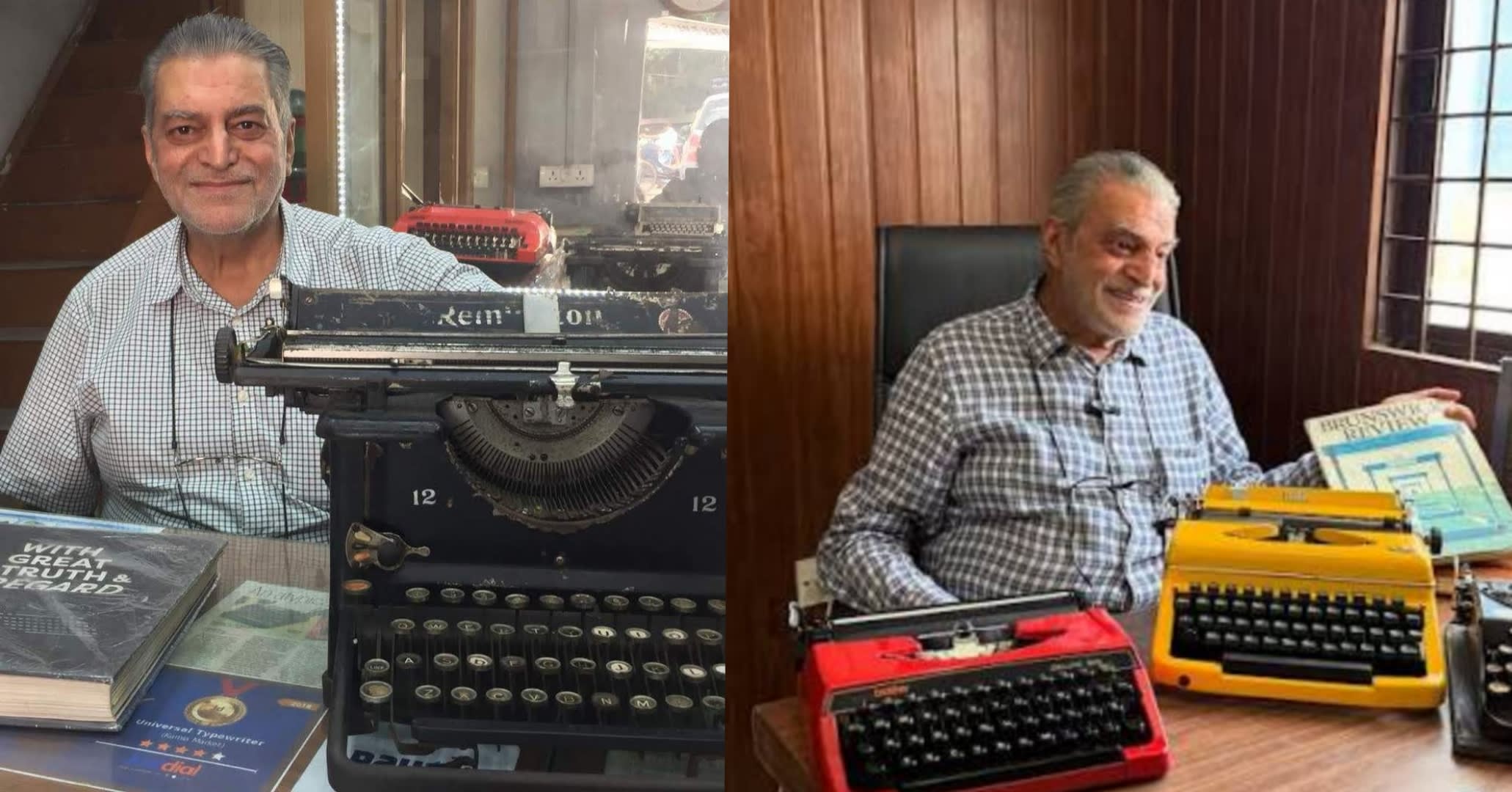
Rajesh Palta is the owner of Universal Typewriter Company, which was founded by his father in 1937 in Lahore. 10 years later, when the partition happened, his father, who established this company, moved to Bombay.
Since then, they’ve been operating out of Bombay, and since 1954-55 onwards, they have had a setup in Delhi. Currently, they have these two branches. Earlier, they also had branches at Ludhiana and Lucknow. His grandfather started selling typewriters in 1912, working with the Remington Brand Inc in the Lahore office. Subsequently, he encouraged Rajesh’s father to start his own business in typewriting, and finally, in 1937, it was established.
Handed down from generations, each of his family members has been a proud part of this family business. In Bombay, soon after independence, Rajesh’s elder brother started helping his father.
During our conversation, he shared an unprecedented observation. Creative writing, young boys and girls are doing creative writing, particularly on typewriters, despite having laptops and computers. Their reason was that there are too many distractions; the computer has everything to give, from spell check to autosuggest, diminishing their creativity.
Nothing spurs the creative juices like the tik-tik clanking sound of the typewriter and the hard copy in front of you. Thus, the younger generation is slowly pivoting towards the typewriter, and this trend is gaining popularity in India as well as the Western World.
Stories of a Generation Grown Up on Laptops
Mr Palta is catering to young people, many of whom have never used a typewriter before. When asked about how he teaches these youngsters, the quick question launched at me was.
‘Have you used a typewriter before?’ I conceded that I hadn’t.
To which Mr Rajesh humoured me with an interesting observation, stating that when youngsters like me walked into his store, he’d place a typewriter in front of them.
They’d press, and it wouldn’t type because they were used to the electronic keyboard, and then he had to explain that they have to press it hard and only after the tik tik sound will the impression go on the paper.
They do it, and then after typing a few words, one of them will press the backspace button and say that it is not erasing, resulting in innocent laughter. I would probably be one of them.
According to him, the Qwerty keypad developed by the typewriter is still used today, which is why he has branded the typewriter – the father of all computers.
Restoring old typewriters is not very easy, but technicians with more than 40 years of experience specialise in the restoration of old devices. Before my phone came, Mr Palta was communicating with a typewriter collector who had sent him an image of a 100-year-old machine. One that was ordinarily tough to restore, but a task he assured would be done with the confidence of someone who has spent more than three decades in this field.
Young people are also sending him typewriters, asking him to restore them as an emotional keepsake that belonged to their father, grandfather, and other next of kin. So, in the age of multiple software updates, apps, and electronic devices, one man is slowly working to preserve the traditions of the typewriter.
It enforces our belief that not all businesses are meant to scale, to reach towering heights; some of them slowly coexist like an invisible guardian protecting your memories, while others are busy telling you to change with the times or be forgotten.