Wastelink Turns India’s Food Surplus into Animal Feed, Addressing Two Problems at Once
India wastes as much as 74 million tonnes of food every year—equivalent to 22% of its foodgrain production according to United Nations Environment Programme data from 2021. Much of this food remains edible yet ends up in landfills or compost pits. At the same time, the country’s dairy and poultry industries face steadily rising costs for key raw materials such as maize and soya.
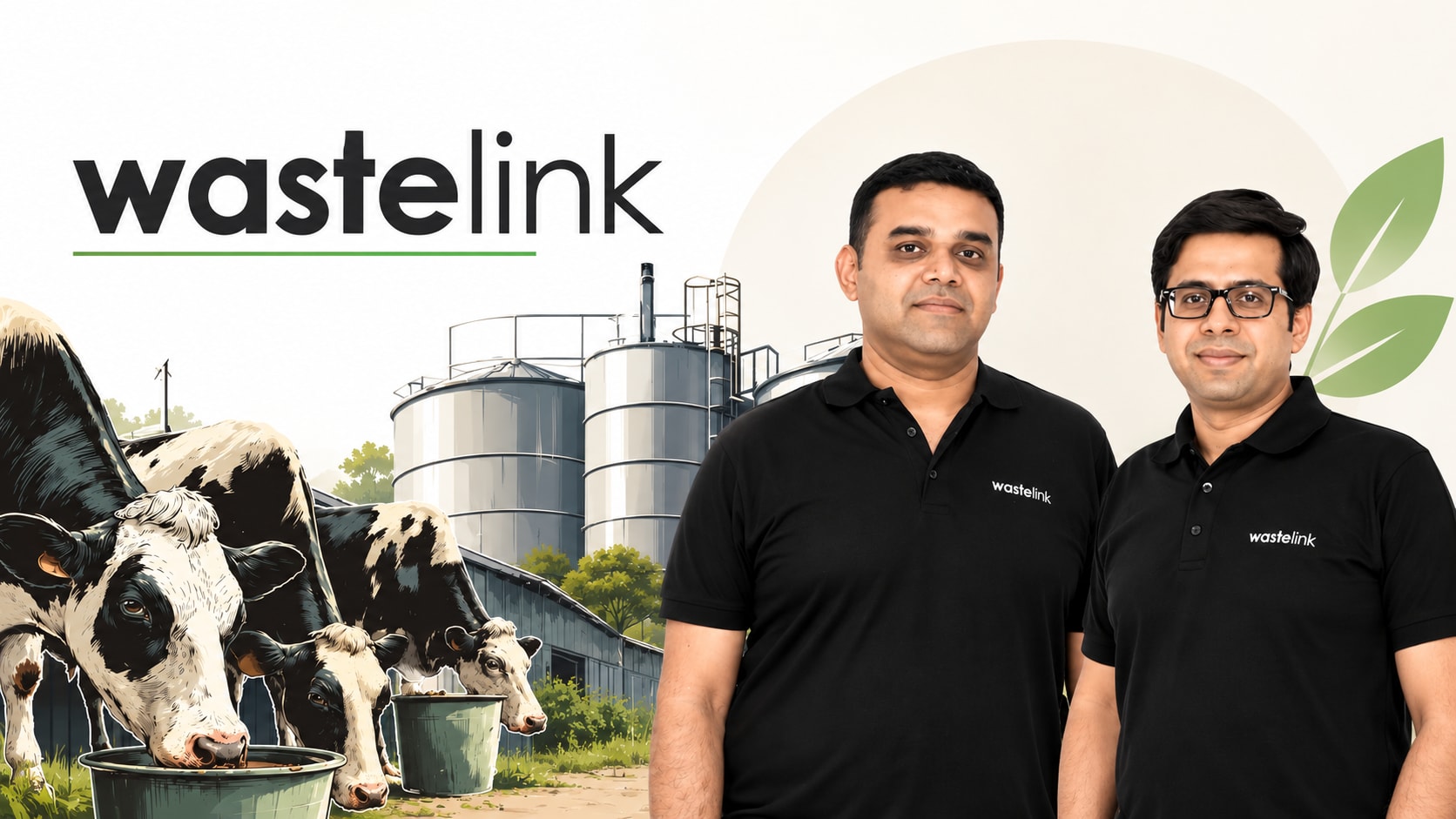
What if one problem could help solve the other? That question led to the creation of Wastelink, a Delhi-based startup founded in 2018 by Saket Dave, a chemical engineer. He was later joined by Krishnan Kasturirangan, his former colleague from the cloud communications firm Knowlarity.
Today, Wastelink converts surplus food into consistent feed ingredients for cattle, poultry, and aquaculture. “While we use the word food waste, actually, it’s more food surplus,” Dave explains. “We use food that is good enough for humans, but could not reach them; we prevent it from becoming waste.”
From Conversation to Company
Dave’s earlier work on recycling and zero-waste projects made him acutely aware of how much edible food was being discarded. While at Knowlarity, he and Kasturirangan frequently discussed the mismatch between surplus food going to waste and the growing pressure on animal-feed prices. In 2018, they decided to turn that observation into a business.
The original concept was broader: a platform handling multiple waste streams including plastics, apparel, electronics, and food. Food, however, proved different. Plastics recycling and electronics recovery already had established players, while surplus food largely ended up as compost or biogas. Seeing the dairy sector’s need for more affordable nutrition, the founders narrowed their focus to upcycling edible surplus into animal feed.
EcoMix: Consistency from Variable Inputs
Wastelink’s flagship product, EcoMix, blends diverse food streams into a single, uniform ingredient. Whether incoming material includes chocolate, spices, or other surplus items, the final output remains consistent. According to Dave, replacing just 30% of conventional cattle feed with EcoMix can increase milk output by 15%. That combination of nutritional reliability and cost advantage has become a key differentiator.
The company manufactures everything in-house and tests every batch before it reaches customers. It works with more than 30 food suppliers across the country, including brands such as Wholsum Foods (behind Slurrp Farm and Mille) and The Baker’s Dozen. Surplus is collected nationwide and processed at four factories located in Sonipat, Lucknow, Mumbai, and Bengaluru.
The Four-Stage Process and AI Backbone
Production follows a structured sequence: inspection and quality checks, segregation, unpacking of food from its packaging, and drying. Only then is the material blended into final formulations. Removing packaging at scale and handling ingredients with widely varying moisture levels required the team to develop specialised methods.
Technology underpins both logistics and formulation. Wastelink built its own system, Wrapper AI, to manage routing, inventory, and recipe adjustments. Because the company collects from thousands of locations, intelligent routing improves efficiency and even anticipates pickup needs. On the production side, AI compensates for daily fluctuations in the nutritional profile of incoming surplus. “Even with big suppliers, nutrition levels change daily,” Dave notes. “AI helps us adjust the formula so the final product stays consistent.”
By substituting expensive commodities such as maize and soya with its surplus-based ingredient, Wastelink helps feed manufacturers lower raw-material costs without compromising nutritional standards.
Business Model and Early Traction
Wastelink operates a B2B model, selling feed ingredients directly to animal-feed manufacturers at Rs 25,000–35,000 per tonne. It currently serves 15–20 paying customers. Some food suppliers also benefit financially; a subset of brands treat the partnership as a waste-to-value opportunity and earn revenue by providing surplus.
The company began generating sales early. Its first customer arrived within three months of incorporation and remains a client today. Over time the business evolved from a trading-oriented model into a formulation-led product company. “Many of our customers’ animals are now used to the taste of our feed, and there is no going back for them,” Dave says.
Wastelink employs about 80 staff and roughly 250 labourers across its factories. Approximately half the workforce is engaged in production, while a lean technology team of fewer than ten people maintains the proprietary AI platform. In FY25 the company reported revenue of Rs 27 crore. In August 2025 it raised $3 million in Series A funding led by Avana Capital.
Building Trust in a Sensitive Category
One of the most persistent challenges has been establishing trust—both with food suppliers and with feed buyers. “Trust is the biggest USP in agri,” Dave observes. Suppliers needed assurance that their surplus would be handled responsibly; buyers required confidence that every batch would be safe and nutritionally consistent. Developing reliable processes for packaging removal and variable-moisture drying was essential to meeting those expectations.
Dave notes that Wastelink is currently the only organised player operating at this scale in India. Informal competitors exist, but they largely operate in unorganised recycling and trading. Internationally, companies such as Darling Ingredients in the United States occupy a comparable space.
Market Opportunity and Future Plans
India’s animal-feed market was valued at approximately Rs 1,110 billion in 2024 and is projected to grow at a compound annual rate of 6.9%, reaching Rs 2,025 billion by 2033, according to IMARC. Within this large and expanding market, Wastelink aims to process 24,000 tonnes per year within the next three years.
With the recent funding, the company plans to expand factory capacity four- to five-fold and introduce additional products for poultry and aquaculture. “We are already a pan-India company, but we want to double down at all locations,” Dave says. Further priorities include incorporating new categories of surplus inputs, strengthening the AI laboratory for improved traceability and formulation, and exploring export opportunities in markets seeking maize alternatives.
By converting edible surplus that would otherwise be discarded into reliable animal nutrition, Wastelink is attempting to close two loops at once: reducing food waste and easing cost pressures on livestock producers. The coming years will test how far this dual-impact model can scale.