When GPS Fails, These Drones Keep Flying: How Enord Is Opening Up Confined Spaces for Inspection
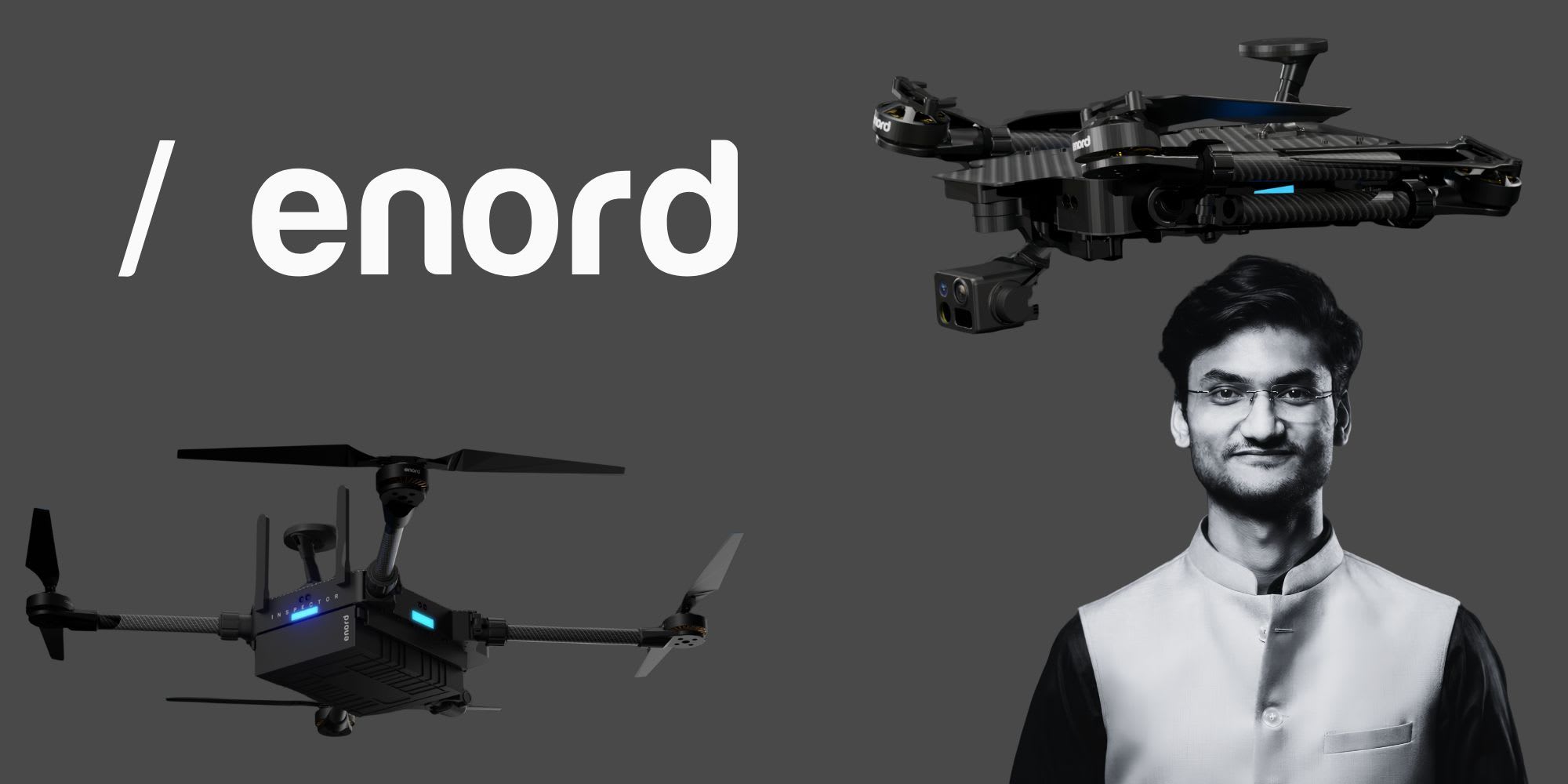
A drone flying over open ground can track its position using satellites. Take it inside a boiler, a tunnel, or a tight gap between machines, and that signal is gone. This matters because many of the places worth inspecting are exactly those confined, hard-to-reach spaces where sending a person is slow and dangeroaus.
enord, a Delhi startup, builds drones designed to work there. Its drones navigate on their own no GPS, no compass, no pilot. The company was founded in 2021 by Muhammad Anas, CEO, and Zain Saeed Alig, COO. Anas was introduced to drones through a college robotics competition, then ran a venture that trained students to fly them. That early exposure shaped the company’s focus on autonomy rather than remote control.
Drones That Navigate by Looking
enord’s main product line is INSPECTOR, a drone built with an AI Pilot system. Information processing happens on the drone itself, keeping it operational where connectivity is poor. Instead of relying on external signals, the system uses onboard sensors and computer vision to understand its surroundings, map the space, and move through it safely.
The drones inspect high-voltage transmission lines, telecom towers, and thermal plants, as well as routine industrial checks. A foldable variant takes swappable payloads for different jobs, and the company also sells an air-monitoring device that reads gases and particulate matter. This combination of autonomy and modularity allows a single platform to handle varied inspection tasks without constant human guidance.
enord describes itself as India’s first AI-on-edge drone company. It has signed a research agreement with IIIT Delhi on drone navigation and says it holds several patents. Processing decisions on the edge directly on the aircraft means the system does not need a continuous data link to a ground station or the cloud. In environments where radio signals are blocked or unreliable, that independence is essential.
Why Autonomy Changes the Economics of Inspection
The commercial logic is straightforward. Inspecting a transmission line or a tall tower by hand means sending someone up and often shutting equipment down. A drone that can do it unaided removes the risk and the downtime together. The same advantage applies inside boilers, chimneys, storage tanks, and other confined industrial spaces where human entry requires permits, scaffolding, or breathing apparatus.
In utilities and infrastructure, scheduled inspections are necessary but disruptive. An autonomous drone can complete visual and thermal checks with far less interruption to operations. For construction and defence applications, the ability to enter GPS-denied zones expands the range of sites that can be surveyed quickly and repeatedly. Agriculture also benefits in dense crop canopies or indoor growing environments where satellite signals weaken.
Because the navigation intelligence sits on the aircraft, the same hardware can operate in open fields one day and inside a structure the next. Operators do not need separate systems for different environments. That flexibility reduces the total cost of ownership for organisations that manage mixed portfolios of assets.
Small Funding, Real Customers
The company sells to businesses and government agencies in utilities, infrastructure, construction, agriculture and defence. enord has raised about $80,600, largely from institutional backers including IIT Mandi Catalyst and iHub. Its annual revenue is higher than the total it has raised. The startup has built a team of more than fifty people, and it chooses to concentrate on building technology that is hard to copy and easy to scale, rather than chasing capital in a tight funding market.
This capital-efficient approach is unusual in a sector that often attracts large funding rounds for hardware development. By focusing on the software and AI layer that enables GPS-free flight, enord has kept its burn low while still advancing a differentiated capability. Revenue already exceeding total capital raised suggests that customers are willing to pay for drones that solve a concrete operational problem rather than for speculative future features.
Building Technology That Is Hard to Replicate
The technical challenge of reliable indoor and confined-space navigation remains significant. Lighting varies, surfaces can be reflective or featureless, and the risk of collision is high. An AI Pilot that can handle these conditions without external positioning must combine robust perception, real-time mapping, and safe path planning. Patents and the research partnership with IIIT Delhi indicate that enord is investing in the foundational algorithms rather than simply integrating off-the-shelf components.
For industrial buyers, reliability and safety certification matter more than novelty. A drone that works consistently in a live power plant or inside a boiler earns trust through repeated successful flights, not through marketing claims. enord’s emphasis on edge processing and autonomous decision-making is designed to meet those practical requirements.
Looking Ahead
As Indian industry continues to modernise inspection practices, demand for systems that can operate where satellites cannot reach is likely to grow. Transmission networks, aging thermal plants, dense urban infrastructure, and expanding defence applications all contain spaces that are costly or hazardous for human entry. A drone capable of navigating those spaces independently offers a practical alternative.
enord’s approach keeping the intelligence on the aircraft, designing for modular payloads, and maintaining a lean funding model positions it to serve that demand without the overhead of a heavily capitalised hardware company. The test will be continued growth in deployments and the ability to maintain performance as the variety of operating environments expands.
In the end, the value of a drone is not measured only by how far or how fast it flies in open sky. It is also measured by where it can usefully go when the sky is no longer available. By solving navigation in those GPS-denied places, enord is making a larger set of critical assets inspectable, safer, and less disruptive to keep online.