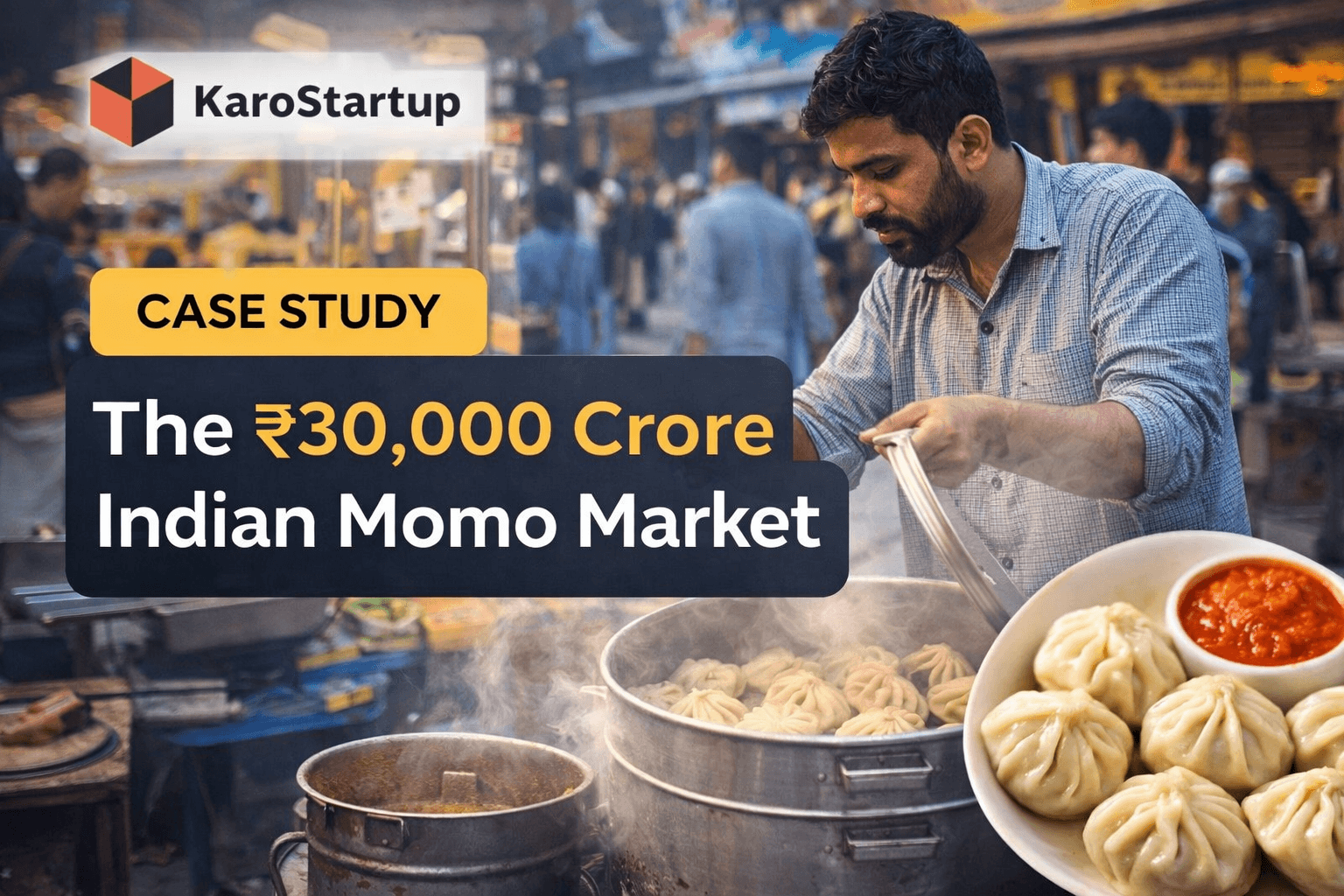
If you walk through Delhi University, Pune FC Road, Bengaluru tech parks, or a Tier-2 railway station market at 6 PM, you’ll see the same thing: steam rising from aluminium pots, red chutney in steel bowls, and a line of customers waiting.
Momos are no longer just a snack.
They are a ₹30,000+ crore annual market in India.
And yet, 90% of it is still unorganised.
This is not just a food story.
This is a case study in distribution, branding, and formalising a street category.
Momos originated in Tibet and Nepal and entered India primarily through:
Tibetan refugee settlements (1960s onwards)
Darjeeling & Northeast India
Delhi’s Majnu Ka Tila and North Campus
Hill stations and border trade routes
For decades, momos were hyperlocal.
But two factors changed everything:
Cheap, filling, shareable food.
What started at ₹20 per plate moved into food courts at ₹120 per plate.
The category scaled because:
It is veg & non-veg adaptable
Low raw material cost
Fast cooking cycle
Works in both street carts and QSR chains
| Segment | Market Size | Nature |
|---|---|---|
| Total Momo Market | ₹30,000+ crore annually | Mostly unorganised |
| Organised Segment | ~₹3,000 crore | QSR, frozen FMCG, B2B |
👉 Nearly 90% of the market is still street-driven and informal.
There is no official audited number.
But we can derive a transparent estimate.
If annual market ≈ ₹30,000 crore
Assume average realised price per momo = ₹12–₹15
Annual pieces ≈
₹30,000 crore ÷ ₹12 = 2,500 crore pieces per year
Per day ≈
5 to 7 crore momo pieces daily
That is comparable to India’s burger or pizza volume — without multinational dominance.
450–650+ stores
~1.2 million pieces sold per day
FY revenue ~₹480 crore
Valuation ~₹2,500 crore
Target: ₹1,000 crore revenue
Investing ₹35 crore in 1 million/day production facility
Wow! Momo formalised the category by:
Mall penetration
Centralised kitchens
Brand positioning as youth QSR
Expanding into Wow! China & Wow! Chicken
~100 million pieces per year
Retail + Modern trade + E-commerce
Focus on premiumisation
This signals a second wave:
From fresh QSR → to frozen retail distribution.
Let’s break this down.
Example:
Selling price per plate (6 pieces): ₹40–₹60
Raw material cost per plate: ₹15–₹20
Gross margin: 50–60%
No rent (or minimal)
Daily sales: ₹5,000–₹12,000 possible
Monthly profit (good location): ₹40,000–₹1.2 lakh
Capital required: ₹50,000–₹2 lakh
This is why the category exploded.
Average price per plate: ₹120–₹180
Food cost: 35–45%
Rent: 12–18%
Staff: 10–15%
Marketing: 5–10%
Net EBITDA margin: 12–20% (if scale is achieved)
The key here is centralised production.
Without supply chain control, margins collapse.
Unlike chaat or dosa, momos:
Can be frozen
Standardised easily
Have long shelf stability (compared to many street foods)
Adapt across cuisines (Tandoori, Cheese, Schezwan, Butter Chicken)
It behaves like:
A desi pizza in pocket format.
| Category | Share |
|---|---|
| Unorganised Street | ~90% |
| Organised QSR/Frozen | ~10% |
This means the real opportunity lies in:
Supply chain formalisation
Frozen distribution
Cloud kitchens
Tier-2 & Tier-3 branding
The momo story is not over.
Here’s what is still untapped:
There is no dominant national momo brand.
Unlike Domino’s in pizza.
India is still fragmented.
Indian diaspora demand for:
Veg momos
Paneer momos
Butter chicken momos
Frozen exports could be massive.
Millet wrappers
Gluten-free
High-protein variants
Vegan plant-based
Nobody owns the premium health momo space yet.
Instead of building 1,000 stores,
build supply chain + branding for 5,000 street vendors.
White-label mass scale.
Industrial momo lines are underdeveloped.
A ₹30,000 crore market
needs large-scale food-tech automation players.
No case study is complete without risks.
Anyone can start a cart.
Consumers shift easily.
Maida, chicken, oil price volatility.
Unorganised vendors are under regulatory pressure.
Momos are not just a snack.
They represent:
Street-to-brand formalisation
Bharat consumption story
Youth-driven food behaviour
Fast SKU scalability
It’s a blueprint for how Indian street food can scale nationally.
Total Market Value ₹30,000+ Cr
Organised Segment ₹3,000 Cr
Estimated Pieces / Day 5–7 Crore
Top Brand Revenue ₹480+ Cr
Street Vendor Margin 50–60%
QSR EBITDA Margin 12–20%
Momos teach us three startup lessons:
Product was already there.
Execution created value.
₹40 plate → ₹160 plate
Same product, different positioning.
India’s next 100 brands will come from organising informal sectors.
India eats 5–7 crore momos per day.
Yet we have:
No dominant national monopoly
No global export giant
No listed momo company
No billion-dollar food-tech deep integration
This category is still in early innings.
The momo market isn’t saturated.
It’s fragmented.
And in India, fragmentation is opportunity.
Quick Share