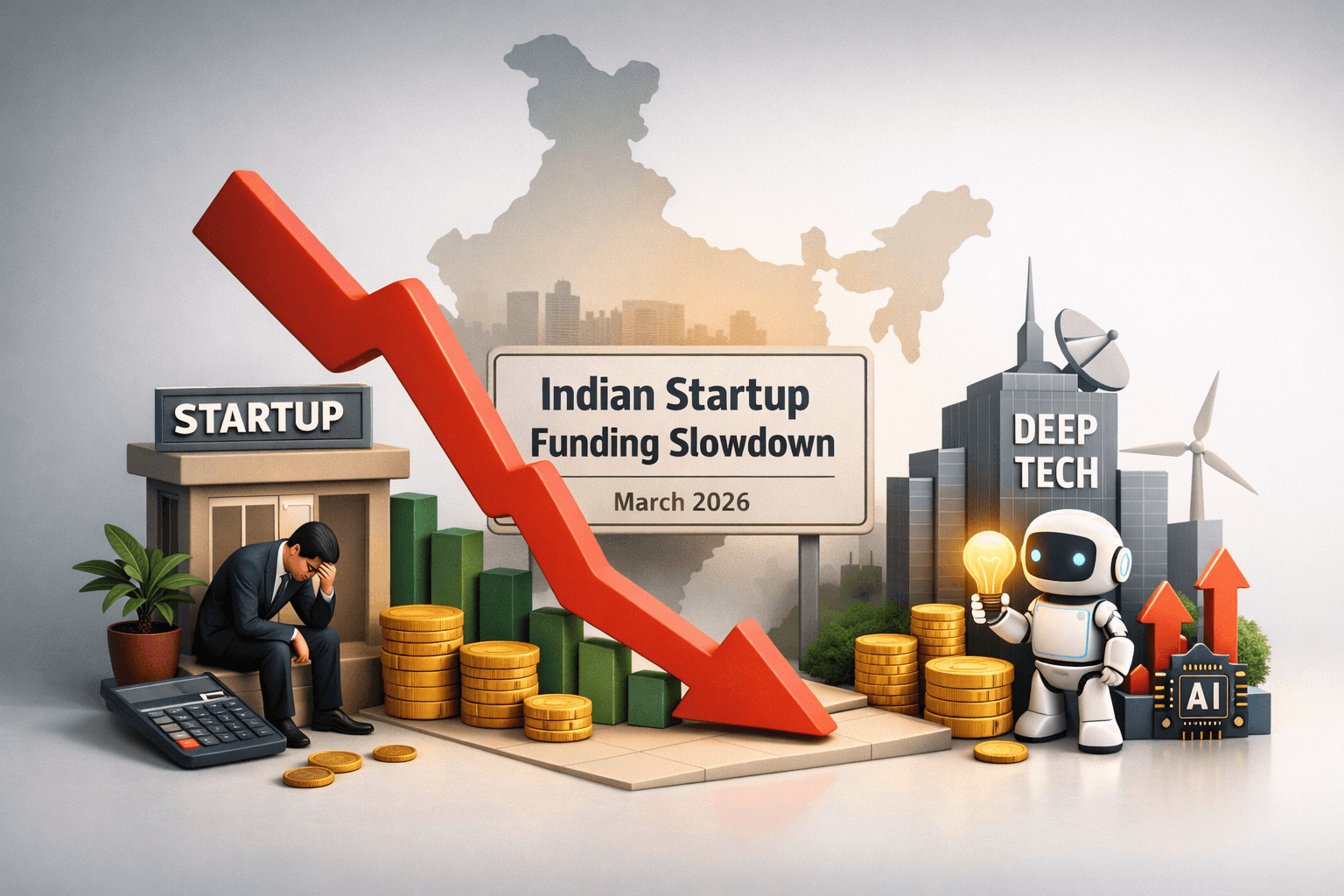
The 2026 numbers do not represent an isolated case. The total amount of startup funding rounds decreased by almost 39 percent in 2025 compared to 2024, to 1,518 deals, and the total amount has been reduced by more than 17 percent to $10.5 billion. That was not a pullback that was restricted to a stage. Investor cutback on more experimental bets, and late-stage funding also tamed, falling to $5.5 billion -26 percent -investors reduced seed-stage funding to the lowest since 2024, to $1.1 billion, and late-stage funding declined to $5.5 billion, a decrease of 26 percent, in a more critical attitude toward scale, profitability, and exit prospects. By early 2026, the total funding had declined by another 22.93 percent as compared to the same time year 2025.
The dwindling number of active investors perhaps tells more than the dollar numbers, though. The number of investors became extremely small, and in 2025 approximately 3170 investors were involved in funding rounds in India, which is 53% lower than the number of funds involved in the previous year (1.68). Global venture capital firms that had previously pouring money in Indian startups at the expense of growth stories have become significantly pickier. Curtesy of India-based investors, about half the activity in terms of financing was done, featuring about 1,500 domestic funds and angels - a fact indicating that the local capital showed a stronger presence when global investors became wary.
The change of philosophical direction is arguably the more important factor than the funding figures per se. The Indian startup market is over with the cash burn times. The ecosystem will now compensate those businesses that prove to be profitable, and 2026 is institutionalising profitability as an indicator of brand credibility, as opposed to financial success only.
This is to say that startups are snipping product lines, localise production, rationalising personnel, and implementing tech-based automation to substitute expensive processes. The move towards profitability has resulted in a two-level ecosystem: well-established unit economics companies are raising capital in healthy valuations, and those with weak fundamentals are down rounds or bridge financing.
Although the economy is generally slowing down, some industries are still going on. The activity of startup financing in Q1 2026 indicated that investors continued to support robust business models in various industries such as EV mobility, deeptech, fintech, quick commerce, healthcare and manufacturing in India. One area has been the bright spot of deep tech. Deep tech Indian startups, in 2025, had low raises of 1.65 billion, a drastic drop compared to 1.1 billion in the two years before. This has been accelerated by the Indian government with the ₹1 trillion Research, Development and Innovation Fund and the establishment of a private India Deep Tech Alliance valued at over $1 billion, with the backing of a multitude of players such as Accel, Blume Ventures, Qualcomm Ventures and Nvidia acting as an advisor. Startups using AI to achieve operational efficiency, customer acquisition, or product development are getting far more valuations than comparable firms in the same lines of operation, with investors perceiving them as more likely to scale efficiently and develop defensible market positions, with technology.
Geographic diversification is one of the quiet changes that is on a tightening funding environment. Among the 200,000 startups that have been identified by the DPIIT, over 48 percent have emerged in Tier 2 and Tier 3 and this will change to mainstream by 2026. Other cities such as Jaipur, Pune, Indore, Bhubaneswar and Surat are taking the shape of new centres of startup activity, which have lower costs of operation and unexploited consumer markets, an attractive offer to investors who has come to value efficiency.
The story behind the India startup ecosystem is still an image of endurance and maturing in spite of the contraction of funding. Although the market fixes have necessitated some fundamental strength, India has remained the third-largest startup ecosystem in the world. The changes observed in 2025 and into 2026 are pointing to the fact that the startup ecosystem is maturing, not receding, one in which capital is being put into deployment more strategically, exits are becoming more predictable, and domestic market forces are starting to increasingly influence its evolution.
The funding recession in March 2026 is therefore to be interpreted, not as a decline, but as a maturation - the natural process of an ecosystem maturing. Startups in India have passed the days of raising hundreds of millions on pitch deck and a promise. The future is more difficult, but presumably healthier, to create real businesses with real income, sustainable designs, and the discipline to survive.
Quick Share