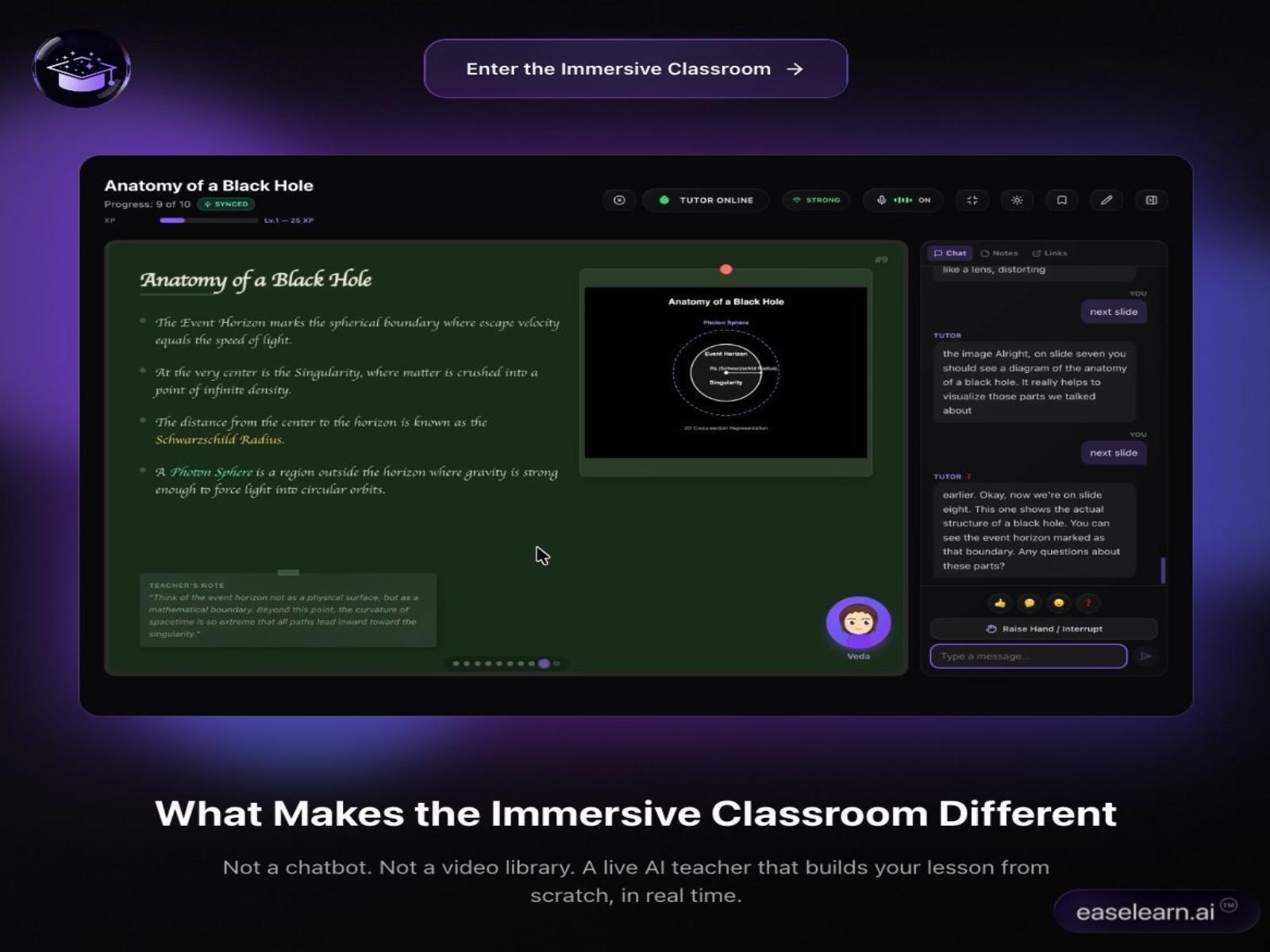
By Staff Feature | April 2026: EaseLearn AI launches its Immersive Classroom on April 17, bringing real-time adaptive tutoring in all major Indian languages to 300 million underserved students — backed by AWS, Google, Anthropic, NVIDIA, and a coalition rarely seen behind a bootstrapped Indian startup.
Lucknow-based EaseLearn AI Technologies Pvt Ltd has quietly built what may be the most ambitious AI tutor to come out of India this year. On April 17, the company launches its Immersive Classroom — a voice-first, real-time adaptive learning environment that detects when a student is confused, switches teaching methods on the fly, and flatly refuses to advance to the next concept until comprehension is confirmed. It covers 100-plus subjects across CBSE, ICSE, JEE, and NEET curricula, works in all major Indian languages, and costs nothing. In under a month since its initial rollout, EaseLearn has crossed 100,000 users and 10,000 app downloads with zero marketing spend.
What Launched
The Immersive Classroom is not a chatbot bolted onto a question bank. It is a full-session AI tutor that conducts live, interactive lessons — explaining concepts, asking questions, gauging understanding through voice and text responses, and dynamically adjusting its pedagogy in real time. If a student struggles with quadratic equations explained algebraically, the system automatically pivots to a graphical approach or a real-world analogy. If confusion persists, it breaks the concept into smaller steps. The session does not move forward until the AI confirms the student has grasped the material.
The platform also includes AI Vision, a camera-based feature that lets students point their phone at a handwritten problem and receive step-by-step solutions. Together, these tools are designed to replicate the experience of a private tutor — the kind that costs INR 2,000 to 5,000 per month in most Indian cities and remains out of reach for the vast majority of K-12 students.
Why It Matters
India has roughly 300 million school-age students. The private tutoring market is valued at over $30 billion, yet access remains deeply unequal. Students in Tier-2 and Tier-3 cities — and across rural India — routinely lack access to quality instruction in their preferred language. The collapse of BYJU’S, once valued at $22 billion, left a crater in the edtech landscape and deepened skepticism about whether technology can meaningfully improve learning outcomes at scale.
EaseLearn’s bet is that the previous generation of edtech failed not because of technology, but because of approach. Recorded lectures and static content do not adapt. They cannot detect confusion. They move at the pace of the curriculum, not the student. The Immersive Classroom is built on the opposite premise: the AI adapts to the learner, not the other way around.
“We watched an entire generation of edtech pour billions into content libraries and celebrity teachers. None of it solved the core problem — every student learns differently, and a recorded lecture cannot respond to the blank stare of a 14-year-old who just lost the thread. That is the problem we built Immersive Classroom to fix.”
— Rahul Jaiswal, Co-founder and COO, EaseLearn AI
How It Works
Under the hood, the Immersive Classroom runs on a multi-model AI architecture that combines large language models with real-time comprehension detection. The system maintains a live cognitive profile of each student, tracking not just correct and incorrect answers but response latency, confidence signals, and patterns of misunderstanding across sessions.
When the AI detects a drop in comprehension — through hesitation, incorrect responses, or explicit signals from the student — it triggers what the team calls an adaptive pivot. This is not a simple retry. The system selects an entirely different pedagogical approach from its repertoire: visual explanation, analogy, Socratic questioning, worked examples, or decomposition into sub-concepts. The voice-first interface is critical to this design. Students interact naturally in all major Indian languages, without needing to type or navigate menus.
“Most AI tutors are really just search engines with a chat interface. They answer questions. We do not answer questions — we teach. There is a fundamental difference. Teaching means you do not move on until the student actually understands. That required us to build comprehension detection from scratch, because no off-the-shelf model does that.”
— Aryan Singh, Co-founder and CEO/CTO, EaseLearn AI
The Backing
For a company incorporated in 2025 with no venture funding announced, EaseLearn has assembled a support coalition that would be unusual for a Series A startup, let alone a bootstrapped one. The company is part of active startup programs run by Amazon Web Services, Google, Anthropic, NVIDIA, Salesforce, and Zoho. It has received recognition from MeitY, the Indian government’s Ministry of Electronics and Information Technology. Institutional partnerships include the Indian School of Business (ISB), VIT Vellore, Banaras Hindu University (BHU), SRM University, the Wadhwani Foundation, and Teach For India.
The breadth of this coalition is notable. AWS and Google provide cloud infrastructure and AI credits. Anthropic and NVIDIA offer access to frontier models and compute. Salesforce and Zoho support operational tooling. ISB and Wadhwani bring institutional credibility and mentorship networks. Teach For India provides ground-level access to underserved classrooms. Together, they form an ecosystem that gives EaseLearn resources typically available only to well-funded startups — without the dilution.
Traction Without Marketing
EaseLearn’s early numbers are striking, particularly given the absence of paid marketing. The platform has crossed 100,000 users and recorded over 10,000 app downloads on Google Play in under a month. Internal surveys show a 97 percent satisfaction rate among active users. Growth has been driven entirely by word of mouth and organic discovery — a signal that the product is resonating with students and parents in ways that marketing-heavy edtech predecessors often did not.
Competitive Context
The Indian edtech landscape has undergone a painful correction. BYJU’S, once the sector’s flagship, collapsed under the weight of aggressive sales tactics and unsustainable unit economics. Unacademy has retrenched significantly. PhysicsWallah and Doubtnut remain popular but rely primarily on recorded content and doubt resolution — neither offers a real-time adaptive AI classroom.
Globally, Khan Academy’s Khanmigo, powered by OpenAI, is the closest comparable product. But Khanmigo is English-only, priced at $44 per year (roughly INR 3,700), and designed primarily for the American curriculum. EaseLearn’s Immersive Classroom is free, bilingual, built for Indian curricula, and voice-first — a combination that currently has no direct competitor in the market.
The Founders
EaseLearn AI was founded by young entrepreneurs Aryan Singh and Rahul Jaiswal. Singh, who serves as CEO and CTO, built the technical architecture. Jaiswal, the COO, leads operations, partnerships, and growth strategy. Shashwat Harsh, the CMO, drives marketing and brand strategy. The company is headquartered in Lucknow, Uttar Pradesh.
The founders are deliberate about what EaseLearn is not. It is not a content marketplace. It is not a test-prep factory. It is not chasing revenue through aggressive sales funnels. The decision to keep the product free is central to their thesis: that the scale of India’s education gap demands a solution that does not have a paywall as its first interaction with a student.
Beyond Students: The Enterprise Play
While the consumer-facing Immersive Classroom is the headline product, EaseLearn is also building an institutional layer. The company’s enterprise tools include dropout prediction models that flag at-risk students before they disengage, placement analytics for colleges and coaching institutes, and a Teacher’s Copilot that helps educators identify learning gaps across their classrooms. These tools are designed to give institutions actionable intelligence, not just dashboards.
What’s Next
EaseLearn plans to deepen its coverage of competitive exam preparation, expand further across all regional languages, and scale its institutional partnerships. The company is also exploring integrations with state education boards to bring the Immersive Classroom into government schools — a move that could dramatically expand its reach into the student populations that need it most.
“We are not building this for the students who can already afford a great tutor. We are building this for the 300 million who cannot. If the AI works, it should be free. That is not charity — it is the only way to solve a problem at this scale.”
— Rahul Jaiswal, Co-founder and COO, EaseLearn AI
EaseLearn AI is available at easelearnai.in and on Android via Google Play. The Immersive Classroom is live from April 17, 2026.
About EaseLearn AI
EaseLearn AI Technologies Pvt Ltd is an Indian artificial intelligence company building adaptive learning technology for K-12 students. Founded in 2025 and headquartered in Lucknow, the company’s products include the Immersive Classroom, an AI Vision problem solver, and enterprise analytics tools for educational institutions. EaseLearn is part of startup programs by AWS, Google, Anthropic, NVIDIA, Salesforce, and Zoho, and is recognized by MeitY. The platform is available at easelearnai.in.
Email - connect@easelearnai.in
Website - https://easelearnai.in
Website - https://easelearn.ai
Android App - https://play.google.com/store/apps/details?id=com.easelearnai
Quick Share

In a fast evolving era, the financial sector is one of the sectors growing fast on an international level. There are various leaders who stand apart and combine deep knowledge with their innovative...
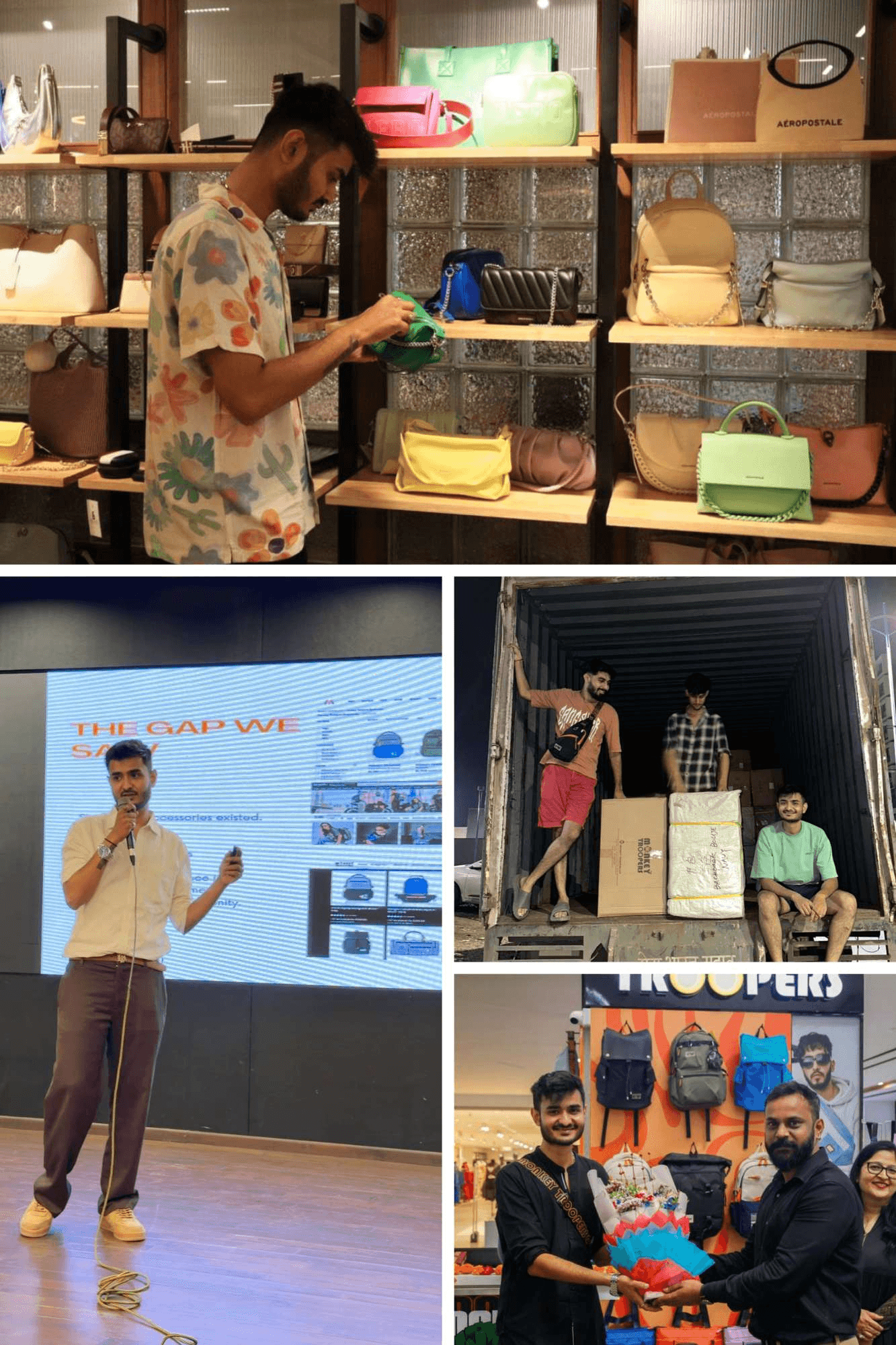
Ahmedabad, India — April 14, 2026: In a market saturated with trend-driven accessories, Monkey Troopers is quietly building a new category—where functionality, design, and real-world usability...

In today’s fast-paced world, where uncertainty often clouds decision-making, people are increasingly turning toward spiritual guidance for clarity. Among the many names in this field, one stands out...