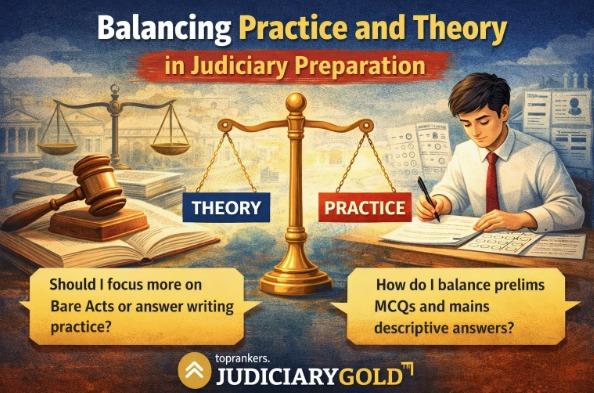
For thousands of law graduates and final-year L.L.B students across India, cracking the Judiciary exam is more than just a career goal—it is a dream of entering the justice system as a Civil Judge. However, with rising competition, evolving exam patterns, and vast syllabi, one question continues to trouble aspirants:
Should I focus more on theory or practice?
According to experts at Judiciary Gold by Toprankers , one of India’s leading platforms for judiciary preparation, the answer lies not in choosing one over the other—but in striking the right balance between theory and practice .
The Changing Nature of Judiciary Exams
Judiciary exams in India typically consist of three stages:
While prelims test conceptual clarity and speed, mains focus on legal articulation, structured thinking, and application of law .
With states like Rajasthan, Uttar Pradesh, Madhya Pradesh, and Bihar conducting highly competitive exams each year, the margin for error has reduced significantly.
Earlier, students could clear prelims with strong Bare Act knowledge alone. Today, success depends on how well you can apply that knowledge in writing.
The Core Dilemma: Theory vs Practice
Many aspirants spend months reading Bare Acts, standard textbooks, and notes—but struggle when it comes to writing answers in mains.
On the other hand, some students jump directly into answer writing without building strong conceptual clarity.
Both approaches create gaps.
Experts at Judiciary Gold by Toprankers emphasise that theory builds your foundation, while practice converts that knowledge into marks .
Should I Focus More on Bare Acts or Answer Writing Practice?
Here’s the right approach:
Bare Acts are the backbone of judiciary exams. They help you understand the exact language of the law, which is crucial for both prelims and mains.
Once your basics are clear, start writing answers regularly. This helps you learn how to structure responses and present legal provisions effectively.
The real skill lies in translating what you read into how you write.
According to mentors at Judiciary Gold by Toprankers, students who combine Bare Act study with consistent answer writing practice perform significantly better in mains .
The Prelims–Mains Balance: A Strategic Challenge
Another major concern for aspirants is managing preparation for both prelims and mains simultaneously.
Prelims require:
Mains require:
Balancing both is not easy—but it is essential.
How Do I Balance Prelims MCQs and Mains Descriptive Answers?
Experts at Judiciary Gold by Toprankers recommend a dual-preparation strategy :
1. Build a Strong Conceptual Base
Focus on understanding the law through Bare Acts and standard notes. This supports both prelims and mains.
2. Allocate Daily Time for MCQs
Solve a fixed number of MCQs daily. This improves speed and helps identify weak areas.
3. Practice Answer Writing 3–4 Times a Week
Start with simple questions and gradually move to complex, analytical ones.
4. Analyse Your Performance
Whether it’s MCQs or written answers, analysis is key. Identify mistakes and improve.
5. Integrate, Don’t Separate
Study in a way that supports both stages. For example, while reading a topic, think about how it can be asked in both MCQ and descriptive formats.
“Prelims and mains are not separate journeys. They are two sides of the same preparation,” say experts at Judiciary Gold by Toprankers.
Why Many Aspirants Struggle
Despite hard work, many aspirants fail to clear judiciary exams due to:
This imbalance creates a situation where students either clear prelims but fail mains—or vice versa.
The Role of Structured Preparation
For many aspirants, especially those exploring Judiciary coaching , structured guidance becomes crucial.
At Judiciary Gold by Toprankers , the preparation model is designed to ensure balance.
It includes:
This integrated approach helps students develop both conceptual clarity and practical application skills .
From Law School to Judiciary Prep: A Mindset Shift
Students transitioning from law school to judiciary preparation often face difficulty adapting.
Law school focuses on:
Judiciary exams, however, demand:
This shift requires a change in preparation strategy.
The Importance of Consistency
Balancing theory and practice is not a one-time effort—it is a daily process.
Aspirants who succeed are those who:
Consistency ensures that both theory and practice improve together.
Conclusion: Balance is the Key to Success
Judiciary exams are not just tests of knowledge—they are tests of application.
Focusing only on theory or only on practice creates gaps that can cost valuable marks.
The real success lies in balance.
For every judiciary aspirant—whether a final-year student, a drop-year candidate, or someone transitioning from law school—the message is clear:
As experts at Judiciary Gold by Toprankers highlight, it is not theory or practice—it is the balance between the two that defines success in judiciary exams .
Quick Share

How a Small Team is Bringing Live B2B Intelligence into AI Conversations For decades, market research has been a slow, painful sport. You start with a question — "Who are the top 50 fintech founders...

Travelling by train in India is one of the most loved experiences. Whether you are on a short journey or a long overnight ride, one thing that always comes to mind is food. Thanks to modern food...

A Founder's Confession on the Cost of "I'll Turn It Off Later" Most startup mistakes happen quietly. A wrong hire, a missed deadline, a feature that nobody wanted. The damage compounds over weeks and...