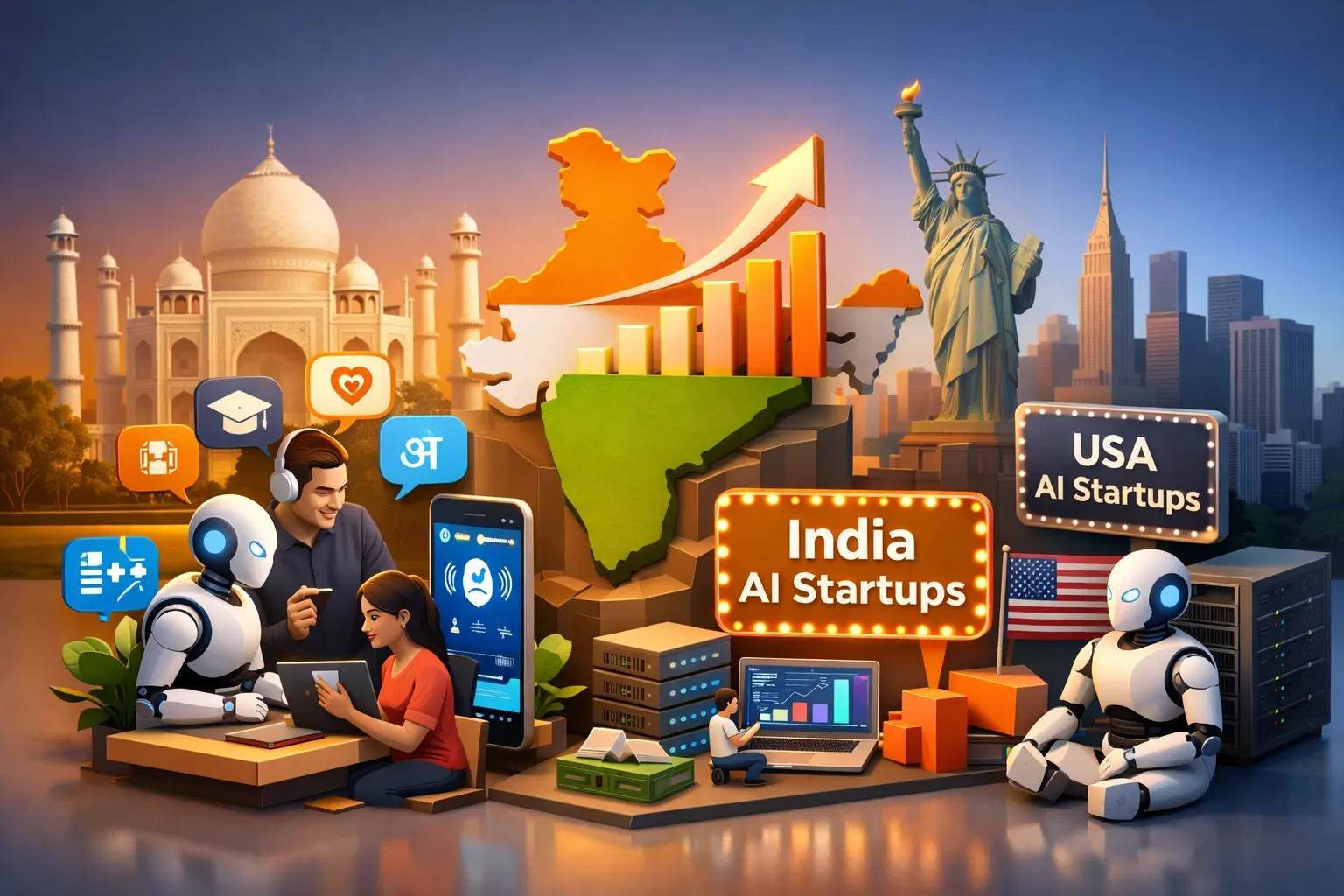
At the recent AI Impact Summit in New Delhi, a striking observation from Meta’s Chief AI Officer and Scale AI founder Alexandr Wang captured global attention: India may now have more consumer-focused AI startups than the United States.
The statement reflects a deeper shift in the global technology landscape—one where India is rapidly emerging not just as a technology talent hub, but as a major innovation center for real-world AI applications.
During a discussion with former UK Prime Minister Rishi Sunak , Wang emphasized that the world is entering a phase of unprecedented technological acceleration. According to him, the coming years will mark a major inflection point where:
He described the current phase as the beginning of a true AI expansion cycle, where the focus shifts from building models to building products that impact millions.
India offers one of the largest digital markets in the world:
This creates a massive opportunity for startups to build AI tools that solve everyday problems in education, jobs, finance, health, and productivity.
Unlike many developed markets where growth is slowing, India still has hundreds of millions of new users coming online, making it a high-growth environment for consumer AI.
Indian startups are not building artificial intelligence just for innovation or experimentation; they are focusing on solving real, everyday problems faced by millions of people. Across sectors, AI is being designed with practical impact in mind. In education, AI-powered tutors are helping students prepare for competitive exams and improve school learning with personalized guidance. In the career space, intelligent resume builders and interview preparation platforms are supporting job seekers in improving their chances of employment. For users with limited literacy or digital familiarity, voice-based assistants are making technology more accessible and easier to use.
At the same time, AI-driven regional language translation tools are breaking language barriers and enabling millions of non-English speakers to access digital services. In healthcare, startups are developing AI systems for symptom analysis and telemedicine support, helping users get basic medical guidance and connect with professionals remotely. Because these solutions address real and immediate needs rather than abstract use cases, their adoption is often faster, broader, and more impactful across diverse segments of the population.
India’s linguistic diversity, with 22 official languages and hundreds of dialects , has pushed startups to build solutions tailored to a multilingual population—an area where many Western products often face limitations. Instead of relying on English-first systems, Indian companies are designing AI that can communicate naturally across regional languages and cultural contexts. This has led to the development of multilingual chatbots that can interact with users in their native language, making digital services more inclusive and user-friendly.
At the same time, startups are focusing on voice-based interfaces that allow rural and low-literacy users to access technology without needing advanced reading or typing skills. Many solutions are also being built to work efficiently in low-bandwidth environments, with low-data consumption and even offline capabilities to suit areas with limited internet connectivity. Additionally, AI-powered regional content generation is helping create localized educational, informational, and entertainment material at scale. This vernacular-first and accessibility-driven approach is emerging as one of India’s strongest competitive advantages in the consumer AI landscape.
India produces millions of engineers every year, creating one of the world’s largest technical talent pools and a rapidly expanding AI/ML community . This strong human capital gives startups the ability to build and scale products efficiently. Compared to Silicon Valley, development costs in India are significantly lower, allowing companies to operate with leaner budgets. At the same time, teams can scale quickly, enabling faster hiring and expansion as products grow. This environment also encourages experimentation, as startups can test multiple product ideas without the high financial risk seen in more expensive ecosystems.
As a result, India is witnessing higher startup density and much faster product iteration cycles. Companies can launch, test, improve, and pivot at speed, which accelerates innovation in the consumer AI space. This combination of abundant talent, cost efficiency, rapid scaling, and experimentation is a key reason behind the surge in consumer-focused AI startups—supporting Alexandr Wang’s observation about India’s growing leadership in this segment.
The first phase of the global AI race was primarily focused on building the core technological foundation—developing large language models, expanding compute power, and advancing foundation model research. During this stage, the competition centered on infrastructure, data, and model capabilities. However, the industry is now entering a new phase where the focus is shifting from building powerful models to creating practical applications—tools that people can use in their daily lives.
In this application-driven phase, India is emerging as a strong player. The country is seeing rapid growth in areas such as AI-powered education platforms, content creation tools, personal productivity assistants, AI-based career and job support platforms, and automation solutions for small businesses. These products are designed to solve real-world problems for students, professionals, and entrepreneurs. With its massive and diverse digital population, India is becoming a large-scale testing ground for consumer AI adoption, enabling startups to quickly validate, refine, and scale their solutions across millions of users.
For Meta, India is already one of the largest markets for its platforms:
The rise of Indian AI startups opens opportunities for:
Global tech companies increasingly see India not just as a market—but as a strategic AI growth region.
India’s growth is also supported by:
This ecosystem reduces barriers for startups and accelerates product development.
Despite the momentum, several hurdles remain:
1. Compute Infrastructure
High-performance GPUs and cloud resources are still expensive and limited.
2. Funding for Deep-Tech AI
Most funding is focused on applications rather than core AI research.
3. Data Quality and Privacy
Large-scale, high-quality datasets are still developing.
4. Regulatory Clarity
Clear AI governance policies are still evolving.
Addressing these challenges will determine whether India can move from application leadership to full-stack AI leadership.
Alexandr Wang’s observation reflects a larger global shift in the artificial intelligence landscape. Innovation is no longer confined to Silicon Valley, as technology development becomes more geographically distributed. Today, emerging markets like India are actively shaping the future of AI, driven by large digital populations, real-world problem-solving needs, and rapid technology adoption. In this new phase, the true leaders in AI will not just be those who build the most advanced models, but those who can solve problems at population scale and deliver practical value to millions of users.
If current momentum continues, India is well positioned to play a defining role in the global AI ecosystem. The country has the potential to become the world’s largest consumer AI market, supported by its massive internet user base and growing digital economy. At the same time, India could evolve into a global hub for AI product innovation, where startups rapidly design, test, and scale real-world applications across sectors like education, healthcare, finance, and small business services. Additionally, with its strong talent pipeline, expanding startup ecosystem, increasing investor interest, and supportive digital public infrastructure, India may emerge as a key driver of mass AI adoption worldwide.
Beyond market size, India’s strength lies in building affordable, scalable, and accessible AI solutions, including multilingual and mobile-first technologies tailored for diverse user groups. This combination of scale, talent, cost efficiency, and real-world innovation positions India not just as a growing participant, but as a potential leader in the next wave of global AI transformation.
The rapid rise of consumer AI startups in India marks a turning point. As AI becomes part of daily life, success will depend less on who builds the biggest model and more on who builds the most useful products for the most people.
With its scale, talent, and real-world focus, India is uniquely positioned to lead this phase. Alexandr Wang’s observation is not just a statistic—it’s a signal that the center of consumer AI innovation may be shifting toward India.
Follow Karostartup for more insights into the intersection of technology, policy, and the future of India.
Quick Share