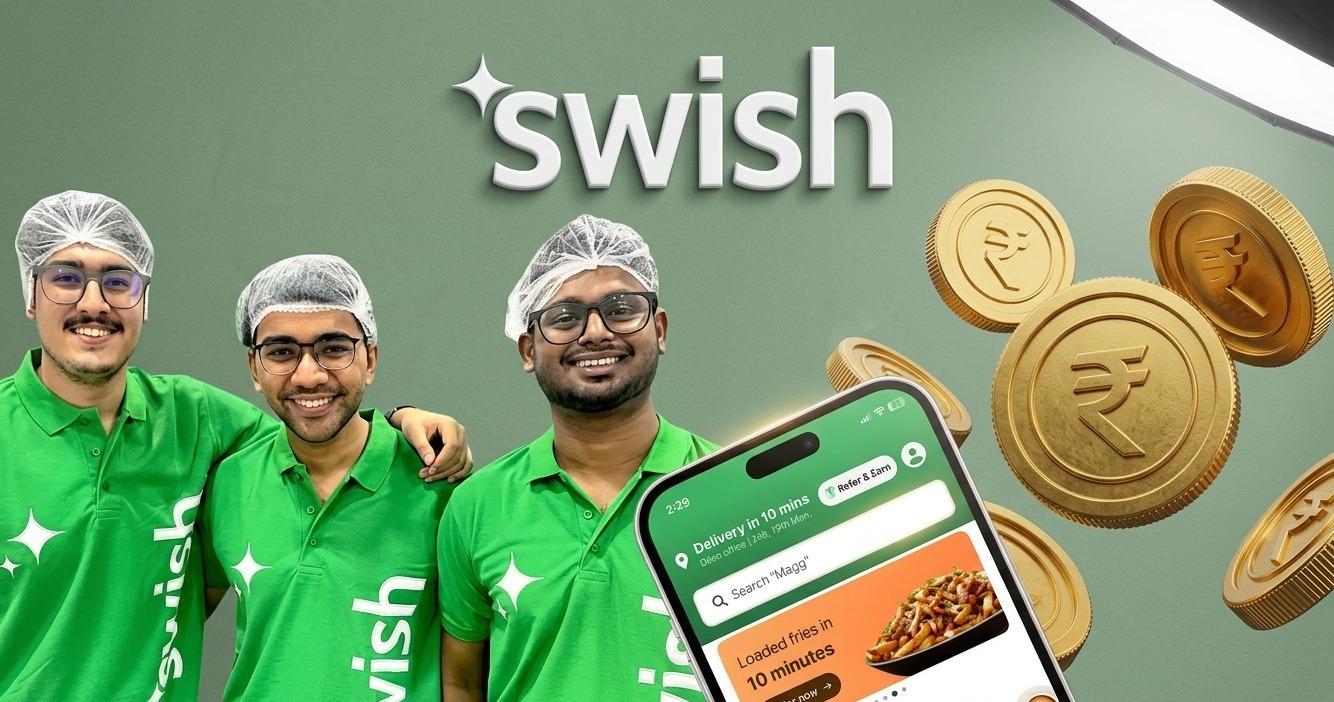
Swish was started in 2024 by Aniket Shah , Ujjwal Sukheja , and Saran S . It uses a network of cloud kitchens that are strategically located near areas with a lot of customers to deliver food in 10 minutes. The company is based in Bengaluru and uses a vertically integrated model, which means it has its own kitchens, logistics, and delivery to get fresh food to customers in minutes.
Hara Global and Bain Capital Ventures led a Series B round for Swish that raised $38 million. Accel, Stride Ventures, and Alteria Capital also took part. The round gives Swish a value of $139 million after the money is in, which is more than twice what it was worth a year ago. The total amount of funding is now $54 million. Hara Global and Accel are already investors in Swish. Alteria Capital and Stride Ventures also gave money to this round in the form of venture debt. The money will be used to grow the team, move into new cities, and buy kitchen automation and supply chain infrastructure.
In March 2025, Hara Global led a Series A round for Swish that brought in $14 million. Accel and a number of angel investors also helped. Before that, in November 2024, Accel gave the company $2 million in a seed round. Gaurav Munjal, the founder of Unacademy, is one of the most famous angel investors.
| Round | Date | Amount | Lead Investors |
| Seed | Nov 2024 | $2M | Accel |
| Series A | Mar 2025 | $14M | Hara Global, Accel |
| Series B | Mar 2026 | $38M | Hara Global, Bain Capital Ventures |
| Total | $54M |
Swish has a vertically integrated, full-stack model, which means it runs its own kitchen, supply chain, and delivery system. Swish makes and delivers its own food, which gives it more control over quality, speed, and unit economics than marketplace-based platforms that rely on third-party restaurants. The company focuses on dense, hyperlocal clusters with delivery areas that are about 1 kilometer wide. It has more than 200 items, including meals, snacks, and drinks. The average order value is ₹200 to ₹250 (about $2 to $3). Usage is very repeat-driven, with the most active users ordering more than 10 times a month. Most of these users are young urban consumers aged 20 to 35, and they order food for a variety of occasions throughout the day, from breakfast and tea time to late-night orders.
Swish now handles more than 20,000 orders every day, mostly in Bengaluru. This is a big jump from the 5,000 orders it handled four months ago. That's a fourfold increase in the number of orders per day in less than six months.
CEO Aniket Shah said, "We are very dense, very close to the customer, making sure that we can almost act like a restaurant kitchen, bringing food to your table."
Saanya Ojha, a partner at Bain Capital Ventures, said this about the thesis: "India's quick commerce adoption has changed what consumers expect in terms of speed, reliability, and convenience, but food delivery has mostly been optimized for planned, higher-value meals." Swish is going for a much bigger and more common surface area: breakfast, snacks, tea, late-night, and meals alone. Not only is there a chance to take market share in food delivery, but there is also a chance to grow the market by getting more people to buy food online every day.
Swish is in the ultra-fast food delivery market as well as other large market competitors, such as Zomato, Swiggy, and Zepto, yet this market has experienced a few failures. Swiggy has closed its Snacc 1015 minutes delivery app in a year. Zomato had previously tried fast formats such as the Quick and Everyday but stopped these in 2025 having found their demand weak and their profitability doubtful. Swish is competitive because of its design: according to the CEO Aniket Shah, no other way can provide quality, fresh food to consumers on a high scale within 10 minutes, but by owning all of the elements of the decision in the food supply chain. The company also observed that its older kitchen clusters have become profitable, and it is possible that the model would create good unit economics in the appropriate environment.
The new capital will be invested to grow operations to new neighbourhoods and cities - such as Delhi-NCR and Mumbai - and to invest in automating their kitchens, supply chain infrastructure and staffing. Simply, Swish is making a wager that where the giants faltered, attempting to attach ultra-fast delivery to the already existing models in the marketplace, an entirely owned, specifically designed kitchen-to-doorstep system will be the solution. Investors are obviously on the same page with 3 rounds of funding in 18 months and 4x growth in the order in four months.
Visit Karostartup for more insights into the intersection of technology, policy, and the future of India.
Quick Share