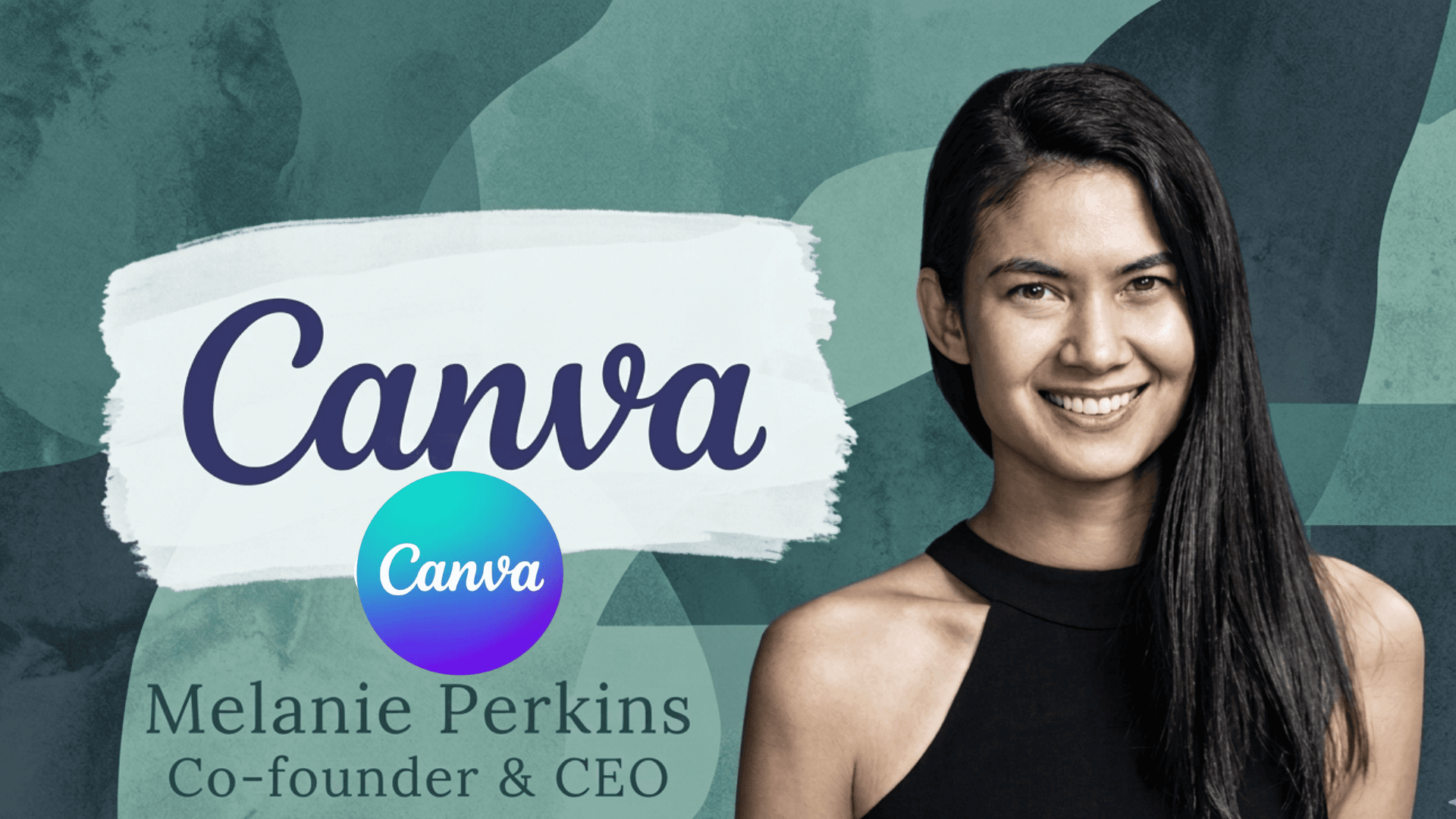
"I learned to kitesurf so I could be in the water with Bill Tai and talk about Canva ." — Melanie Perkins
The year is 2006. Melanie Perkins is a 19-year-old student at the University of Western Australia, tutoring other students on how to use Adobe Photoshop and InDesign. Every single session, she watches the same thing happen: intelligent, capable people spending an entire lesson just learning the interface — before touching a single creative idea. They weren't learning design. They were learning software.
Perkins grew up in Perth, the most remote major city on earth — a place so geographically isolated from the world's startup hubs that the idea of founding a billion-dollar tech company from there seemed almost laughable. Her mother was a craft teacher; her father, a Malaysian-born engineer . She wasn't born into wealth or Silicon Valley connections. She was born into curiosity.
That frustration in the tutorial room planted a seed. What if design software wasn't a fortress of menus and panels, but an open door? What if a tool existed that was so intuitive, anyone — a small business owner, a student, a nonprofit worker — could produce beautiful things without a design degree?
The insight wasn't just about simplicity. It was about democratization. The design industry in 2006 was controlled by expensive professional tools: Adobe's Creative Suite cost hundreds of dollars a year and required months of practice. The gap between "person with a creative idea" and "person who can execute it" was enormous. Melanie saw that gap — and decided to close it.
She partnered with her then-boyfriend (later co-founder) Cliff Obrecht , and the two of them started not with a grand plan to disrupt tech, but with a very small, very specific first step: school yearbooks.
In 2007, Melanie and Cliff launched Fusion Books — an online tool that let Australian schools design and print their own yearbooks. Drag-and-drop. No design expertise needed. Schools could pick templates, add photos, write text, and order printed copies.
It worked. Fusion Books grew steadily, eventually becoming one of Australia's largest yearbook companies. But more importantly, it proved the core thesis: ordinary people, given the right tool, could produce professional-looking design work. The market for easy, accessible design wasn't theoretical. It was real, and it was hungry.
For Melanie, Fusion Books was never the destination — it was the proof of concept. Now she wanted to scale it to every design need in the world: social media posts, presentations, posters, flyers, business cards, invitations. Everything. For everyone.
The vision was audacious: a single online platform where anyone could design anything, beautifully, in minutes. No downloads. No expensive licenses. No learning curve. Cloud-based and collaborative from day one.
The year was 2011. Melanie packed her pitch. And the rejections began .
Between 2011 and 2013 , Melanie Perkins pitched Canva to investors and was rejected more than one hundred times. Investors said the market wasn't big enough, the idea wasn't novel enough, or that design tools were already "solved" by Adobe. She kept going anyway.
Getting in front of Silicon Valley investors from Perth, Australia is not simply a matter of emailing a pitch deck. The VC ecosystem ran on warm introductions, Stanford networks, and Sand Hill Road proximity — none of which Melanie had.
Her strategy? Find a way in through a side door.
She discovered that Bill Tai, a prominent Silicon Valley venture capitalist, was also a passionate kitesurfer. He hosted an annual event in Perth called MaiTai — a gathering of tech entrepreneurs and investors built around kitesurfing.
Melanie didn't know how to kitesurf. So she learned.
She attended MaiTai, got her moment with Tai on the beach, and pitched Canva. He was interested — not with a check immediately, but as a connector. He introduced her to investors in his network. Even then, the rejections continued. Over 100 meetings. Over 100 nos.
Through Tai's network, Melanie eventually connected with Cameron Adams, a former Google engineer who had built some of the web's most beloved early interface experiments. He became the third co-founder, bringing engineering credibility the team had lacked. And then, finally — a breakthrough. Matrix Partners led a seed round. The money was in. Canva could be built for real.
Canva officially launched to the public on August 19, 2013 .
The premise: a web-based design tool with thousands of professional templates, a massive library of photos, fonts, and graphics, and a drag-and-drop interface so intuitive that first-time users could create something beautiful in under ten minutes.
The response was immediate. Within the first month — 750,000 users. Within a year — over a million. People who had never considered themselves "designers" were suddenly producing polished social media graphics, elegant presentations, and eye-catching flyers.
Teachers. Small business owners. Bloggers. Nonprofit coordinators. Canva wasn't targeting professional designers — it was giving everyone else a seat at the table.
The freemium model was key: the core product was free. No gatekeeping. No trial period. No credit card. You could be designing within sixty seconds of landing on the homepage. That frictionlessness was intentional — and it was lethal to competitors.
| Year | Milestone |
| 2006 | Melanie (19) realizes design tools are broken while tutoring. |
| 2007 | Fusion Books launches; becomes a major success. |
| 2011 | Pitching begins; 100+ rejections follow. |
| 2012 | Cameron Adams joins; seed round secured. |
| 2013 | Canva launches publicly; 750k users in 30 days. |
| 2015 | Canva for Work (Pro) launches, scaling revenue. |
| 2019 | Valuation hits $3.2 billion. |
| 2021 | Valuation hits $40 billion; Giving Pledge announced. |
| 2023 | Magic Studio (AI) launches; Affinity acquired. |
The cynical question every investor asked: "If it's free, how do you make money?"
The answer was freemium done right — the same playbook that worked for Spotify, Dropbox, and Slack.
The free tier was generous enough to be genuinely useful. This created real, loyal users. And a portion of those users eventually needed more: premium templates, brand kits, background removal, larger storage, team collaboration. That's where Canva Pro came in at ~$13/month.
Then came Canva for Teams — aimed at organizations. A startup's marketing team, a school district's communications department, a multinational's content team — all subscribing at the organizational level. When a single company purchases seats for a hundred employees, the economics become enormous.
By 2021, Canva was reportedly generating over $1 billion in annualized revenue — and doing so profitably. While many unicorns burned cash chasing growth, Canva had built a business that actually worked. This was what made investors who had once said no look away in regret.
In September 2021, Canva raised $200 million at a $40 billion valuation — making it one of the ten most valuable private technology companies on the planet. Melanie, just 34 years old, became one of the world's youngest self-made female billionaires. She and Cliff were worth approximately $16 billion combined.
Then they did something extraordinary.
On the same day their valuation was announced, they quietly confirmed they had joined The Giving Pledge — the philanthropic commitment championed by Bill Gates and Warren Buffett, through which signatories pledge to give the majority of their wealth to charitable causes.
"We're committed to doing the most good we can with our good fortune." — Melanie Perkins & Cliff Obrecht
For founders who had bootstrapped, been rejected a hundred times, and built from a Perth apartment — it was a statement about what success actually meant. They hadn't chased a billion dollars because they wanted a yacht. They had chased a mission. And having reached the mountaintop, they looked around and asked: what can we do with this?
The rise of generative AI could have been an existential threat to Canva. If AI could generate images, write copy, and design layouts from scratch — why would anyone need templates?
Melanie's answer was aggressive: integrate AI, don't compete with it.
In 2023, Canva launched Magic Studio — a full suite of AI tools built directly into the platform:
Magic Write — AI copywriting inside designs
Magic Design — instant layout generation from a prompt
Magic Edit — AI-powered image manipulation
Text-to-Image — generate visuals without leaving the canvas
AI Presentation Builder — a full deck from a single sentence
Then came the acquisition that announced Canva's ambitions loudly: Affinity — the British company making professional-grade alternatives to Adobe's Creative Suite. Suddenly Canva wasn't just the "easy" tool. It had the muscle to challenge Adobe directly, at every level of the market.
By 2024: 170 million monthly active users. 190 countries. 85% of Fortune 500 companies. The girl from Perth had built something that reached nearly every corner of the globe.
| Metric | Figure |
| Monthly Active Users | 170 million+ |
| Countries | 190 |
| Peak Valuation | $40 billion |
| Investor Rejections | 100+ |
| Designs Created | 16 billion+ |
| Fortune 500 Penetration | 85% |
| Annual Revenue (est.) | $1.7 billion+ |
| Co-founders | 3 |
1. Persistence over Permission 100+ rejections didn't mean the idea was wrong. It meant the market hadn't caught up yet. Perkins didn't wait for permission — she built proof instead.
2. Start Small, Think Big Fusion Books was not Canva. But it proved the model, generated revenue, and gave the founders the credibility and confidence to pitch something larger.
3. Democratization Is a Billion-Dollar Strategy The biggest market isn't the experts — it's everyone who was excluded by complexity and cost. Canva's power came from who it served, not what it sold.
4. Find Your Cameron Adams The right co-founder changes everything. Vision + execution + engineering credibility = a complete team. The sum was far greater than the parts.
5. Freemium Is a Philosophy, Not a Trick Give generously. Build real value in the free tier. Let users fall in love before you ask for money. Trust compounds like interest.
6. Purpose Beyond Profit The Giving Pledge wasn't PR. It was the logical conclusion of founders who built a company around enabling others. Mission and margin can coexist — and often must.
"Every no was just one step closer to the yes that mattered." — Melanie Perkins
Today, Canva is used by more than 85% of Fortune 500 companies . It operates in 190 countries and over 100 languages . More than 16 billion designs have been created on the platform.
It started in a small apartment in Perth, Australia — the most isolated major city on earth — in the mind of a 19-year-old who was frustrated watching people struggle with expensive, complicated software.
It was rejected over a hundred times.
And it changed the world anyway.
Melanie Perkins. Cliff Obrecht. Cameron Adams. Three founders. One surfboard pitch. A hundred rejections. And a $40 billion answer to everyone who ever told them no.
Visit Karostartup for more insights into the intersection of technology, policy, and the future of India.
Quick Share