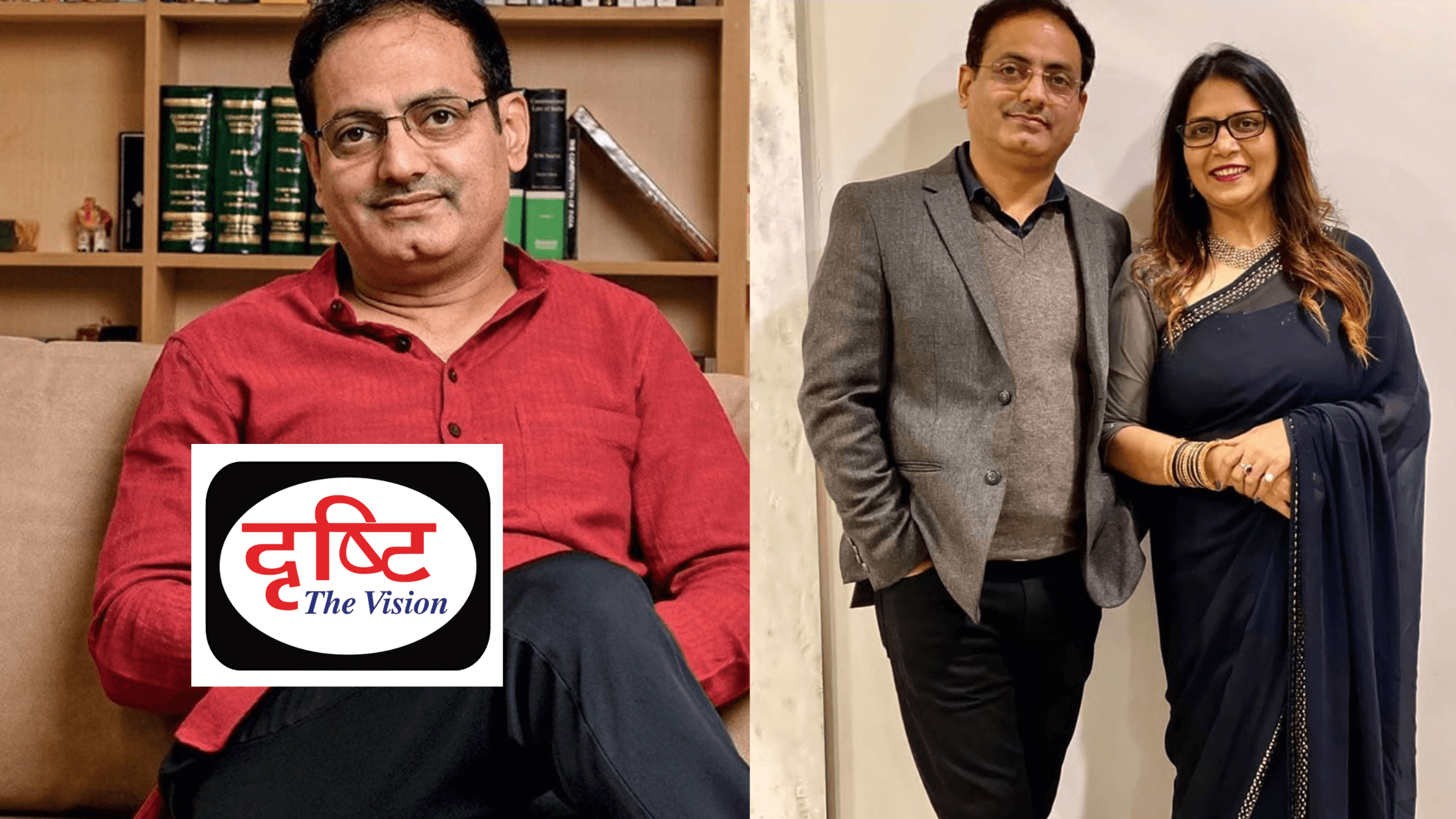
Drishti IAS is one such story.
In FY25, the coaching institute reported ₹364 crore in revenue and ₹61 crore in profit — numbers that place it among the most profitable education companies in the country. But Drishti IAS did not begin with spreadsheets, growth plans, or investor decks. It began with a teacher, a blackboard, and a deep sense that something in India’s education system was unfair.
In the late 1990s, Dr. Vikas Divyakirti was teaching UPSC aspirants in Delhi. Many of his students came from Hindi-medium backgrounds — small towns, government schools, and families where English was not spoken at home.
They were intelligent. They were hardworking. They were ambitious.
Yet, most premium UPSC coaching institutes at the time taught almost entirely in English. High-quality books, notes, and test series in Hindi were extremely limited. Even when Hindi batches existed, they were often treated as secondary offerings.
Dr. Divyakirti saw capable students losing confidence, not because they couldn’t understand polity, history, or economics, but because they struggled with the language in which those subjects were taught.
This bothered him deeply.
The more he taught, the clearer the pattern became: the problem wasn’t talent. The problem was access.
He began asking a simple question:
Why can’t the best quality UPSC preparation exist in Hindi?
Many people around him dismissed the idea. Some believed serious aspirants would eventually shift to English anyway. Others felt the Hindi-medium market was too small to sustain a serious business. A few even said coaching in Hindi could never compete with established English institutions.
Dr. Divyakirti didn’t argue.
He started building.
In 1999, Drishti IAS was founded in Delhi.
There was no grand launch. No advertisements. No investors. No marketing strategy.
Just a small classroom, a handful of students, and a teacher determined to explain complex subjects in simple Hindi.
The early years were financially uncertain. Some months, fees barely covered rent. Competition was intense, and big coaching brands dominated student attention.
But something quietly worked in Drishti’s favor.
Students understood.
They didn’t just memorize. They grasped concepts. They connected ideas. They developed confidence.
Slowly, some of these students started clearing preliminary exams. Then a few reached the interview stage. Then came final selections.
In the world of UPSC preparation, nothing speaks louder than results.
Word spread through hostels, libraries, and student circles. Juniors began asking seniors where they studied. A common answer kept appearing:
“Divyakirti sir se padho. Samajh aa jata hai.”
(Study with Divyakirti sir. You actually understand.)
Drishti IAS grew, but not explosively.
It grew steadily.
While many coaching institutes chased rapid expansion, flashy infrastructure, and aggressive advertising, Drishti followed a slower path.
The focus remained on:
Strong in-house content creation
High-quality Hindi study material
Concept-focused classroom teaching
Affordable pricing compared to premium competitors
Instead of outsourcing content, Drishti built its own teams of subject experts. Instead of constantly launching new exam verticals, it stayed deeply committed to UPSC.
This depth-first approach built credibility.
When YouTube began to gain popularity, Drishti took another unconventional step: it started uploading full-length lectures for free.
Many believed this would destroy the paid classroom business.
Instead, it strengthened it.
Free content allowed millions of aspirants to experience Drishti’s teaching style. Those who resonated naturally gravitated toward paid courses, test series, and structured programs.
Trust became the growth engine.
More than two decades after its founding, Drishti IAS is now one of India’s largest UPSC-focused coaching brands, with a strong presence across offline centers and digital platforms.
In FY25:
Revenue: ₹364 crore
Profit after tax: ₹61 crore
The company has not disclosed a public valuation. It has not raised major venture capital rounds. Drishti remains largely bootstrapped and founder-driven.
In an era where many edtech companies struggle with profitability, Drishti stands out as a rare example of a profitable, sustainable education business built over decades.
India’s coaching and test-preparation industry is estimated to be worth over ₹50,000 crore.
UPSC alone sees roughly 10–12 lakh applicants every year, with about 1,000 final selections. Despite low success rates, demand remains consistently strong because civil services represent social mobility, stability, and prestige.
At the same time, vernacular education is growing rapidly. Students increasingly want high-quality learning in their native languages. Hybrid learning (online + offline) has become mainstream.
Drishti was positioned for this shift long before it became fashionable.
Drishti’s biggest advantage is not technology.
It is not marketing.
It is not brand partnerships.
It is pedagogy.
The institute treats students with respect. It assumes they are capable. It invests in explaining ideas rather than simplifying ambition.
Dr. Divyakirti himself never tried to become a celebrity entrepreneur. He remained, first and foremost, a teacher.
That choice shaped the culture.
Drishti IAS offers several powerful lessons:
Large businesses can be built in overlooked markets.
Language is a massive opportunity in India.
Trust compounds faster than advertising.
Bootstrapped, profitable growth is still a valid and powerful model.
Long-term focus beats short-term hype.
Most importantly, Drishti’s story shows that some of the most enduring companies start with a moral discomfort:
“This isn’t fair. Someone should fix this.”
Drishti IAS began with that feeling.
Twenty-five years later, it has become a ₹364 crore institution.
Quick Share