Srikanth Bolla was born on 7 July 1991 in Seetharamapuram, Machilipatnam, Andhra Pradesh, into a Telugu farming family. His parents were uneducated. He was their first child and he was born completely blind.
The moment relatives saw the baby, the whispers began. His relatives urged his parents to abandon him, believing he would be of no use to them in their old age. In a rural farming community with no electricity and barely enough food on the table, a blind child was seen as a burden a dead end. But his parents refused to abandon him. That single act of love set the entire story in motion. His childhood was full of struggle. There was no electricity, education was a luxury, and his family's income was less than what was needed to survive. Growing up in the village, Srikanth had no friends. No one wanted to play with him since he was visually impaired. But that loneliness made him concentrate on his studies. Every day, while other children played freely, Srikanth sat alone thinking, listening, learning. Without knowing it, that loneliness was quietly building his most powerful weapon: focus.
He faced a 5 km daily commute and was excluded from school activities, but nothing could hold him back not even climbing trees or plucking coconuts. He refused to be defined by what he couldn't do. He was always looking for what he could. When Srikanth was seven years old, he enrolled in a school for the visually impaired in Hyderabad. Moving away from home at that age was not easy new chores, a new language, unfamiliar food, and a completely different environment. But Srikanth's passion for building inclusive communities kept him going. He quickly became the fastest Braille reader and writer, a competitive chess player, and an active participant in every school competition, growing stronger daily. He didn't just adapt. He excelled.
Here is where Srikanth's story shifts from inspiring to extraordinary. After completing Class 10, Srikanth topped his board exams. He wanted to study Science physics, chemistry, mathematics. A natural choice for a brilliant student. But the education system had other ideas. He was denied the right to take up the Science stream after he topped his Class 10 Board exams. The authorities believed a visually impaired student simply could not manage science subjects. Most people would have accepted this rejection. Srikanth did the opposite he fought back legally. Instead of giving up, Srikanth sued the government, and after a six-month-long wait, the authorities agreed to let him pursue Science at his own risk. Six months of legal battle. At the age of 15 or 16. Against the government. And then he sat for his Class 12 exams. To everyone's surprise, Srikanth topped Class 12, securing 98%. He didn't just pass. He topped. He proved every single doubter wrong with a number they could not argue with.
Scoring 98% should have opened every door in India. It didn't. He was denied admission at IIT. Other Indian engineering colleges also turned him away, clinging to the belief that a blind student had no place in science and technology institutions. But Srikanth had already learned something powerful: when one door closes, look for a bigger door. Bolla applied to universities in the US instead and bagged five offers, settling for MIT in Cambridge, Massachusetts.,He went on to study business management science from MIT as the first international blind student ever to be admitted, with 100% financial aid. The institutions that rejected him couldn't afford him. MIT gave him a full scholarship. In a quiet moment of poetic justice, the boy that India's top colleges turned away went on to study at the greatest university on earth for free.
At MIT, Srikanth didn't just study. He started working on his mission even before graduating. While at MIT, Srikanth set up a computer training centre and Braille library in Hyderabad to empower individuals with disabilities through technology. He was funding hope from thousands of kilometres away. But then came a painful reality check. Despite his efforts, he saw that his students were still being overlooked in the job market. Giving people skills wasn't enough if employers wouldn't hire them. The problem wasn't ability it was opportunity. And opportunity had to be created, not waited for. Around the same time, he identified an untapped opportunity in eco-friendly packaging, sparking the idea that would lead to Bollant Industries. Two problems. One solution. That's the mind of an entrepreneur. As a fitting reply to being ignored at PT class in his school, Bolla represented India in cricket and played chess at national level. Even at MIT, he was settling old scores not with anger, but with achievement.
After graduating from MIT, Srikanth had every reason to stay in America. Offers were likely pouring in. A comfortable, well-paid life awaited him. He chose to come home. "I left behind a good future in the USA as I wanted to make products using renewable energy, made by the people considered useless, like me. I want to be a leader working to build a future with equal opportunities for everyone." That statement says everything about who Srikanth Bolla is.
In 2012, Srikanth, alongside angel investor Ravi Mantha, founded Bollant Industries. His goal was clear to bridge the gap between employment opportunities for people with disabilities and the growing demand for eco-friendly packaging.
It was started with a mere capital of about ₹10 lakh. No corporate backing, no family wealth just a vision and a few lakhs of starting capital.
The company's model was elegant in its simplicity. Bollant produces eco-friendly recycled Kraft paper from municipal waste or soiled paper, packaging products from recycled paper, disposable products from natural leaf and recycled paper, and recycles waste plastic into usable products.
Srikanth calls himself a "waste person" because he loves waste and the company lives by it. From recycling water, plastic, ash, and solid waste to repurposing pharmaceutical effluents into industrial chemicals, Bollant is a zero-waste company. It's also tackling single-use plastics by sourcing fallen areca leaves from Karnataka farmers and paper from local mills to create eco-friendly alternatives.
The business was literally built on what the world threw away just like Srikanth himself had been.
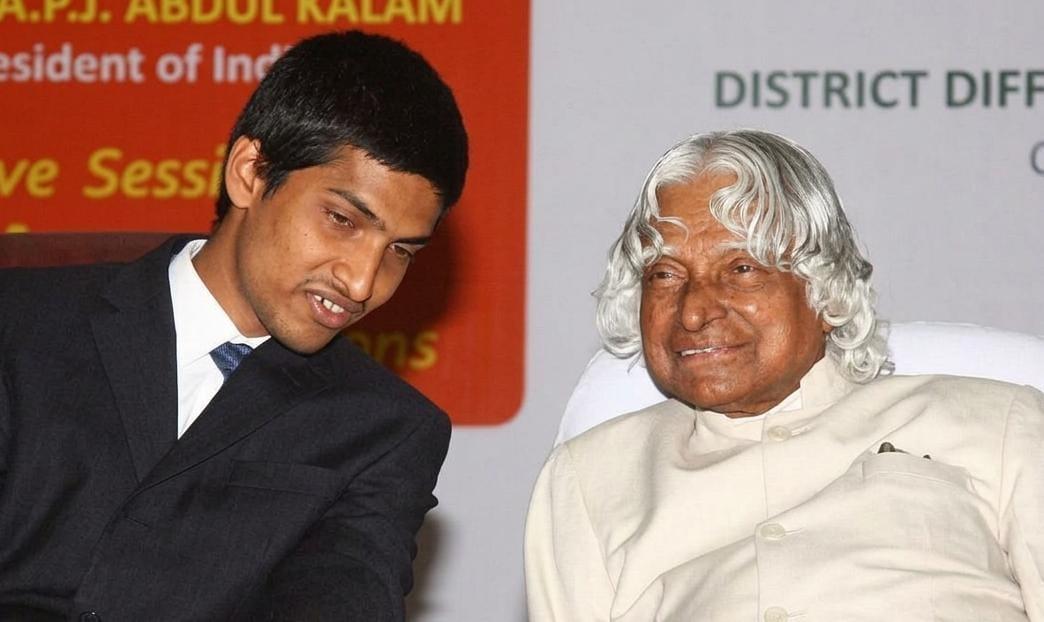
No great company is built alone. Srikanth's story is also the story of the people who chose to believe in him. Ravi Mantha was the first. A seasoned angel investor who saw something remarkable in this young blind entrepreneur's clarity of thought and depth of vision. After Mantha came a cascade of prominent Indian investors. The list of investors includes Srini Raju of Peepul Capital, Satish Reddy of Dr. Reddy's Laboratories, Kiran Grandhi of GMR Group, Anil Chalamalasetty of Greenko, Arun Alagappan of TI Cycles, and S.P. Reddy of SLN Terminus. And then came the most significant name of all. Ratan Tata India's most respected industrialist and philanthropist invested in Bollant Industries. Bollant soon attracted the trust of Ratan Tata, who came on board in 2016.When Ratan Tata puts his name behind your company, it is not just money it is a message to the entire country that this business is worth believing in. Bollant also had the blessing of another legendary figure. The company was also funded by former President of India, Dr. APJ Abdul Kalam a man who himself rose from nothing to become one of India's greatest icons. Like recognized like.
Bollant Industries is not a charity. It is not a corporate social responsibility project. It is a full, profitable business that also happens to be changing lives.
The company was established with the mission of overcoming employment barriers for more than 100 million physically and mentally challenged people, and to provide sustainable and competitive employment to both skilled and unskilled or uneducated Indians.
The company specialises in manufacturing areca-based products while also prioritising employment opportunities for individuals with disabilities. Workers are paid equal wages. They receive social security. They work with dignity.
Srikanth believes in using green solar power to run his machines, and so the plants at Bollant Industries partially run on solar power.
Every product Bollant sells carries three stories: the story of the environment being protected, the story of a differently-abled worker earning their own income, and the story of a blind boy from Andhra Pradesh who refused to accept the world's definition of possible.
The numbers tell a remarkable story.
Since its incorporation in 2012, the company has been growing at a steady rate of 20% per month and the compound annual growth rate has been 107% from 2015 to 2019.
Today, the company has grown both horizontally and vertically, is valued at approximately ₹500 crore, has an annual turnover of more than ₹100 crore, and has 500+ employees.
Bollant has four production plants one each in Hubli (Karnataka) and Nizamabad (Telangana), and two in Hyderabad (Telangana).
The Bollant Group is rapidly expanding, with logistics, retail, laboratories, packaging, and foods divisions. A new ₹14 crore automated plant is being set up in Andhra Pradesh's Sri City SEZ.
A company started with ₹10 lakh by a blind 21-year-old is now valued at ₹500 crore.
One of India's biggest production houses, T-Series Films, released a biopic on his life. Titled Srikanth, the movie stars Rajkummar Rao and Jyothika.
The trailer was released on 9 April 2024. During the trailer launch, Srikanth remembered how T-Series cassettes had helped him complete his education from Class 5 to Class 10. Full circle the same company whose audio cassettes once educated a blind boy in a village was now making a film about his life.
Success, for Srikanth, was never the destination it was the vehicle.
Srikanth currently leads a non-profit called Surge Impact Foundation as its Director. This organisation believes in finding and honing more entrepreneurs like Srikanth to build India into a developed nation. For Srikanth, entrepreneurship has been a spiritual yet lonely journey and he wants to nurture the spirit of entrepreneurship to motivate and guide other Indian youth.
Surge Impact Foundation, founded in September 2016, aims to enable individuals and institutions in India to achieve the Sustainable Development Goals by 2030.
Srikanth is not done. Not even close.
His only aim right now is to elevate his company's turnover to ₹1,000 crore within the next few years . Beyond that, he envisions taking the company public through an IPO and securing a listing on the stock exchange.
The boy nobody wanted. The student India's colleges rejected. The entrepreneur who started with ₹10 lakh. He is now aiming for ₹1,000 crore and a public listing.
"I had a clear vision since I was a young kid. When the world looks at me and says, 'Srikanth, you can do nothing,' I look back at the world and say I can do anything."
"I lack eyesight, but not vision."
These are not motivational poster quotes. These are the words of a man who was told to be abandoned at birth, who walked 5 kilometres to school every day in every season, who sued the government at 16, who left MIT for a village in Andhra Pradesh, and who built a ₹500 crore company out of waste, willpower, and an unshakeable belief in human dignity.
His story is not about blindness. It is about vision.
It is about what happens when you refuse to accept the story other people write for you. It is about choosing the hard road not because it is easy, but because it is right. It is about building something that solves real problems for real people, and making money doing it honestly.
Every disabled worker at Bollant Industries who earns a salary and goes home with dignity that is Srikanth's real net worth. Every eco-friendly plate that replaces a plastic one that is his real product. Every young person who reads his story and dares to dream bigger that is his real legacy.
The world said he could do nothing.
He built a ₹500 crore company to prove them wrong.
Srikanth Bolla Born blind. Built an empire. Still going.
Quick Share