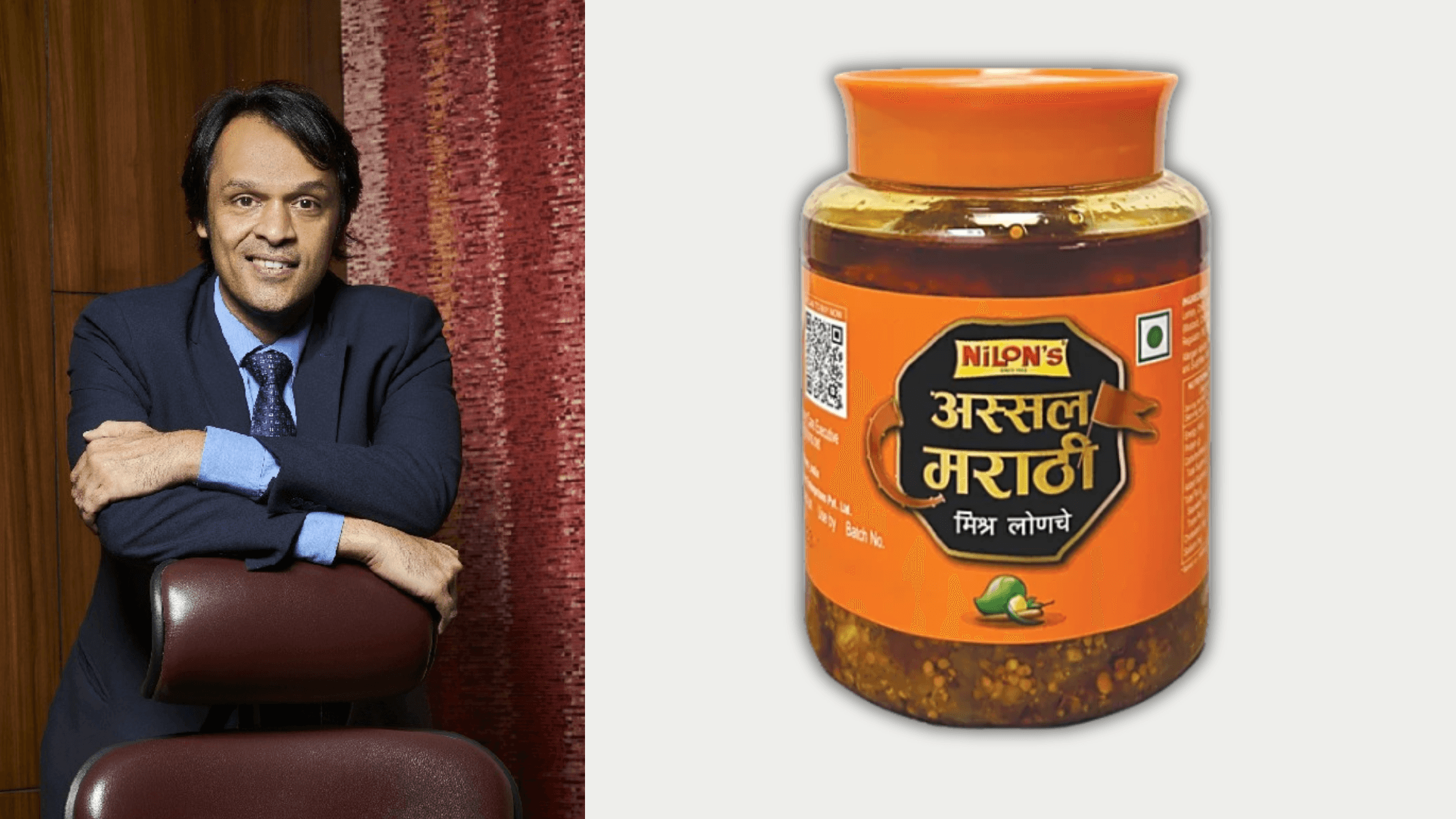
In India, some of the toughest businesses are not built in boardrooms or pitch rooms.
They are built in factories, warehouses, and distributor offices.
Pickles (achar) fall into one of the most brutally competitive FMCG categories in the country. Low entry barriers, thousands of local players, minimal product differentiation, and razor-thin margins make it a graveyard for brands that rely only on taste or price.
And yet, Nilons Enterprise quietly scaled itself into a ₹500 crore FMCG brand ecosystem .
No venture capital hype.
No celebrity founders.
No consumer-tech shortcuts.
This is the story of how Nilons did it—and what Indian entrepreneurs can learn from it.
Deepak Sanghavi , Managing Director and CEO of Nilons Enterprise, did not start his journey with exposure to venture capital, startup ecosystems, or global business frameworks.
He did not come from a “fancy college.”
He did not begin with pitch decks or valuation conversations.
What he did have was intent.
“Mujhe kuch apna banana tha.”
That intent was forged early, not through success, but through failure .
Coming from a business family is often assumed to be an advantage. In reality, it comes with a different set of pressures—legacy expectations, public scrutiny, and very little room for error.
Deepak Sanghavi saw 25% turnover loss at a young age , witnessed multiple product failures, and experienced first-hand how quickly a business can slide if decisions go wrong. That early exposure shaped his thinking: failure is not something to fear, but something to understand.
This mindset would later become crucial in steering Nilons through one of India’s toughest FMCG markets.
India has lakhs of family-run businesses. Very few scale sustainably.
The reasons are rarely capital-related.
Most family businesses struggle due to:
Resistance to professional management
Weak performance culture
Founder-centric decision-making
No long-term brand vision
Nilons faced the same risks. But instead of doubling down on control, the company chose a harder path: changing how the business was run .
This shift—from a family-run operation to a performance-driven organisation—became one of Nilons’ biggest competitive advantages.
One of the most debated philosophies behind Nilons’ growth is Deepak Sanghavi’s belief that marketing matters more than product or distribution .
This sounds counterintuitive, especially in FMCG.
But the Indian market tells a different story.
India has:
Over 5,000 pickle brands
Minimal taste differentiation
Similar raw materials and recipes
If product alone decided success, the market would look very different.
Instead, brands that win are those that own perception .
The logic is visible across categories:
Sting sells at ₹20
Red Bull sells at ₹80–₹100
Same energy drink category. Vastly different pricing power.
The difference is not formulation.
It is story, symbolism, and recall .
Nilons applied the same thinking to achars.
Most founders obsess over uniqueness of product.
Nilons took a more realistic view:
Truly unique products are rare
Most innovations are copied quickly
Taste advantage rarely lasts
Apple introduced the touchscreen smartphone once.
Every brand followed.
Amazon built e-commerce.
Thousands replicated the model.
Product advantage is temporary.
Brand advantage compounds.
This belief freed Nilons from chasing novelty and allowed them to focus on something far more powerful: identity .
Around three years ago, Nilons made a strategic decision that marked a turning point.
While most companies in the category were still focused on “making achar,” Nilons decided to build cultural ownership .
Instead of pushing one national identity, the company created region-first branding at scale .
Different states saw different brand expressions:
Maharashtra connected with a Marathi identity
Punjab saw a Punjabi personality
Delhi felt familiar and local
UP, Bihar, Odisha each saw cues that felt “apna”
The product stayed the same.
The factory stayed the same.
The quality stayed the same.
What changed was how the brand spoke .
Packaging, language, naming, and visual cues were redesigned to reflect regional emotion. Consumers no longer saw Nilons as just another FMCG product on a shelf. They saw it as something made for them.
That emotional shift is what turned distribution into pull instead of push.
Nilons’ marketing didn’t scream discounts or superiority.
Instead, it leaned into storytelling.
Campaigns like “Kahin na jaao, desh ko ghoom lo” didn’t just sell achars—they sold familiarity, nostalgia, and belonging.
In a country as diverse as India, this approach matters.
Consumers don’t want “pan-India sameness.”
They want local relevance with national reliability .
Nilons managed to deliver both.
One of the most critical growth phases came when Rajeev Agarwal was brought in to lead the company operationally.
This marked a shift from intuition-led management to system-led execution .
Key changes included:
Clear performance metrics
Demand-based planning
Decision-making autonomy for teams
Strong incentive structures
The impact was measurable.
In roughly six years, Nilons scaled from ₹8 crore to ₹100 crore in revenue.
No shortcuts.
No market windfall.
Just discipline.
Nilons understood something many brands ignore: distributors don’t care about your vision unless you help them earn.
The company restructured its distribution strategy by:
Introducing fast-moving entry products
Using mass SKUs to open doors for premium products
Targeting HoReCa with 5kg packs for dhabas and restaurants
This created relevance at the ground level.
Distributors who saw volume movement were more willing to stock premium SKUs. Incentives further aligned behaviour. At one point, top-performing area sales managers were rewarded with cars—a strong signal of performance culture in the mid-2000s.
From a regional player, Nilons has grown into a ₹500 crore FMCG brand ecosystem , built steadily over decades.
It operates in one of the most competitive categories in India, yet continues to scale by focusing on:
Brand over novelty
Culture over control
Execution over noise
Nilons is not a startup story.
It is a Bharat business case study .
Key lessons:
Marketing creates pricing power
Product is necessary, but not sufficient
Culture multiplies execution
Local storytelling beats generic branding
Family businesses can scale—if ego doesn’t block change
Quick Share