To get the story of how Parachute came about, you must take a throwback to India of the 1970s when hardly any of the basic needs were branded. Although this entrenched coconut oil in the Indian house, it used to be sold loosely in the kirana stores. Shopkeepers would empty it out of huge tins into containers that were carried by the clients. No labels, no quality assurance and no method of purity verification existed. Adulteration was prevalent, and people did not have another choice. Coconut oil was not optional, it was part of the daily ritual. It was applied in the care of hair, massaging of babies, cooking and even home remedies. The product, however, did not have identity or trust in spite of its importance. There was an opportunity that was waiting there--the gap between necessity and reliability.
Harsh was born in a conservative business family, Marwari, in the early 1970s and he joined his family business, Bombay oil industries. The company was involved in the sale of goods, oils and spices, but did not brand them, they just traded. But Harsh perceived them otherwise. He observed that although the demand of coconut oil was enormous, the customer experience was discontinued. Every buying was done with uncertainty.
It is that question which gave rise to the Parachute in 1974.
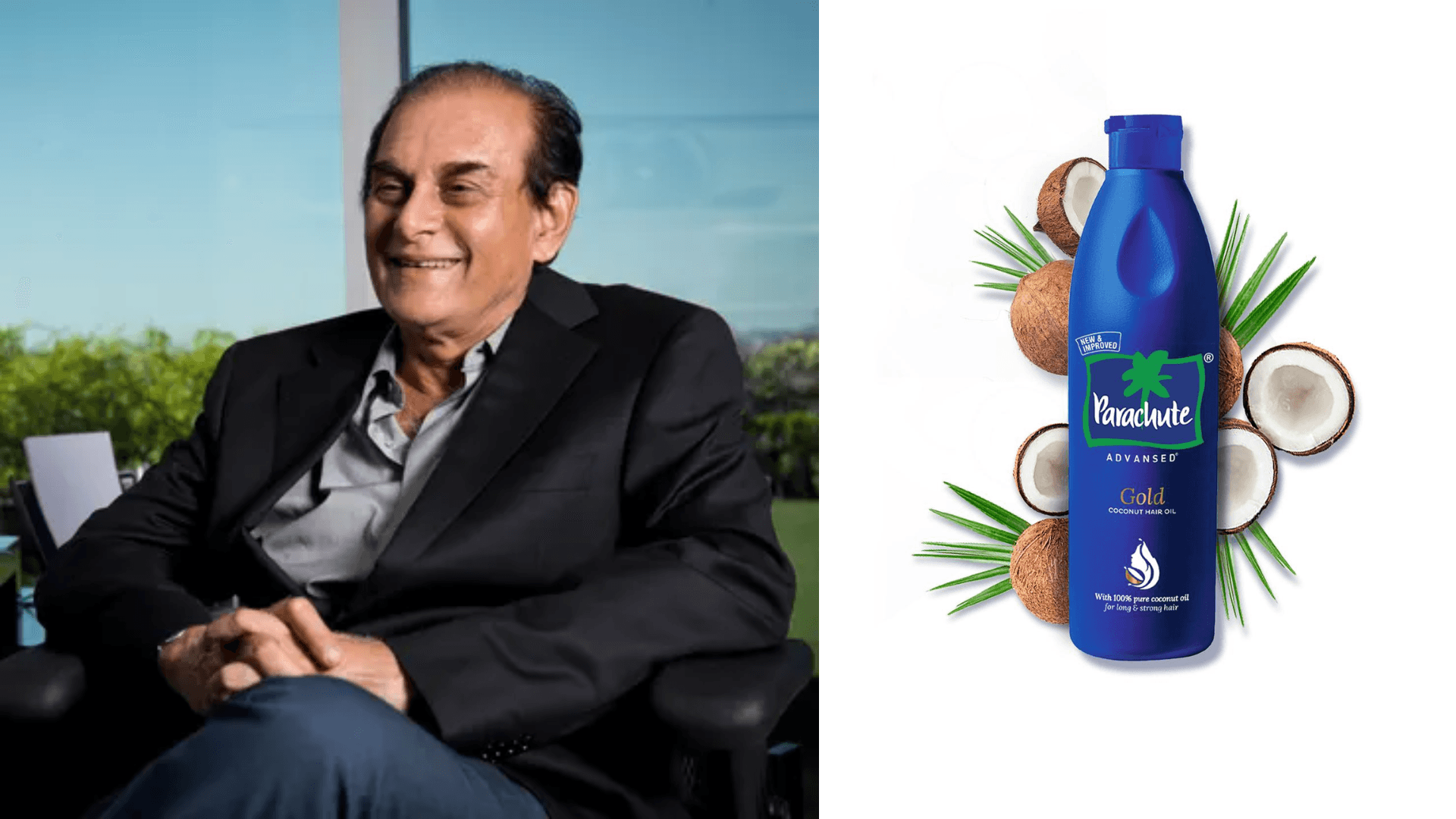
Parachute was in a bottle, clean, uniform and branded, unlike the loose oil which was routinely sold in tins. Its packaging decisions were groundbreaking in nature. It was not just that the iconic blue bottle was a design, but it was a signal. It represented innocence, trustworthiness, and security in a high-fueled market that was characterized by uncertainty. The very name of the brand, Parachute, was a symbol of safety and security, which was subtly supporting the brand promise. However, it was not easy to create a brand in an unplanned and low-end market. Retailers were skeptical. Customers would not want to pay more on the things that they were already purchasing at a low price. Distributors hesitated. The value of packaging or branding was not instantly apparent to the consumers. For years, growth was slow. It was not enough that Harsh Mariwala and his team were able to sell a product, they needed to educate the market. They warned of the dangers of adulteration, showed the advantages of sealed packs, and gradually gained credibility. It wasn’t overnight success. It was persistence. The thing that kept Harsh going was his knowledge of Indian consumers. He was aware that people were price-conscious but greatly treasured trust particularly when it came to the care of family. Hair oil was not a product, but a part of nurturing. And in cases where trust comes into play, people are ready to pay a premium. With the growth of Parachute, its brand image shifted out of functionality. The company did not use heavy feature-based advertisements. Rather, it emphasized emotional narratives: the scenes of mothers oiling their children hair, the scenes of caring and interactions.
Such emotional attachment also turned out to be its greatest asset. At the end of 1980s, the business extended enormously. But Harsh was well aware that to create a contemporary consumer brand, he had to have a different structure. He further split the consumer products division in 1990, and created Marico Limited.
Marico was constructed as a professional progressive FMCG company. It was unlike a traditional family business that adopted meritocracy, professional management, and paid much attention to branding and consumer insights. Parachute was its flagship product but the vision was a lot bigger. The distribution strategy was one of the major success factors that Parachute had. India represents not a single market, but a thousand micro-markets. It will take intensive distribution to meet consumers in cities, towns, and villages. Marico spent a lot of money on the development of this network. Gradually, Parachute is sold not only at the urban supermarkets but also in the smallest villages.
Marico introduced small affordable sachets instead of sticking the product to full size bottles. This made Parachute affordable to low-income customers who could not pay a full bottle, but still felt like having a reliable brand product. It also assisted the brand to compete with the loose oil at the same price. This was not a strategy that merely boosted sales but loyalty was created at the grassroots. There was a switch in the consumers who initially were taking sachets, to bottles as they increased their income. They did not change their brand as they already had faith in Parachute.
The problem of counterfeit products came up to a big challenge. False Parachute bottles, which comprised of low-quality oil, began to be sold in the market. Marico reacted to the pressure with constant packaging innovation; tamper-proof seals, better bottle designs and sensitization to inform the consumer. There was also increased competition. The old and the new competitors attempted to gain market share. Yet Parachute remained true to its main strength: trust. It did not follow fads and blindly use celebrities as a marketing tool. Its core was maintained in the quality and extensive presence. Regulatory complexities were also another challenge. Coconut oil falls in a special category because it can be eaten as well as applied on the skin. Taxation and regulations imposed changes that forced the company to change at all times. Nevertheless, every challenge enhanced the performance of Marico. The only thing that made Parachute stand out was that it managed to evolve, yet, not to lose its identity. The brand also came up with variations such as Parachute Advansed, Parachute Therapie and Parachute Naturale over the years. These products responded to the trends of the contemporary consumers like fall of hair and the use of natural ingredients. Simultaneously, the fundamental declaration of innocence and nurture did not change. This compromise in the form of innovation and consistency made the brand intergenerational.
As early as the 2000s, Marico started going abroad. Bangladesh, Sri Lanka, and the Middle East were some of the markets that had high demand of coconut oil. In multiple of these regions, Parachute has become a leader in a very short period. This was to be unexpectedly boosted in the 2010s as coconut oil developed into a worldwide wellness fad. It was promoted by influencers and health experts in the West to serve several purposes - cooking to skincare. It happened that a product that was considered to have been in use in Indian homes was popular across the globe.
On the one hand, Marico is one of the most successful FMCG companies in India today, and on the other, Parachute is leading the branded coconut oil market at more than 50% coverage. The company accesses hundreds of millions of customers in various nations. Nevertheless, what is more successful than numbers is the fact that Parachute has had a cultural impact. It is not only a product to many Indians. It belongs to childhood memories, the blue bottle, the comfortable smell, the process of oiling hair. These associations do not come into existence based on marketing campaigns only. These are constructed on decades of reliability and dependability.
He believed in building institutions, not just businesses. He brought in professionals, encouraged innovation, and wasn’t afraid to admit failures. His openness created a culture where experimentation was possible, and growth was continuous. His approach also reflected in the brand itself. Parachute’s promise of purity wasn’t just a marketing message—it was a reflection of how the company operated.
The story of Parachute teaches an important lesson: Great businesses don’t always come from groundbreaking inventions. Sometimes, they come from reimagining something ordinary. Coconut oil already existed. What Harsh Mariwala did was give it identity, reliability, and meaning.
And that transformation was not driven by complexity, but by clarity—clarity about what consumers needed and the patience to deliver it consistently. From loose oil sold in unmarked tins to a globally trusted brand, Parachute’s journey is a testament to the power of trust. It shows that when a company focuses on solving real problems with honesty and persistence, success is not just possible—it becomes inevitable.
In the end, Parachute is more than a blue bottle on a shelf. It is proof that even the simplest ideas, when executed with vision and discipline, can create something timeless.
Visit Karostartup for more insights into the intersection of technology, policy, and the future of India.
Quick Share