STARTUP STORIES
Sarvam AI Success Story: ₹1,900+ Crore Startup Building India’s Own AI
“We need to bring something that works best for Indian people and Indian languages.”
When you try to translate something in the proposed ChatGPT Gemini or other available chatbots, there are problems with Indian languages, including errors and issues.
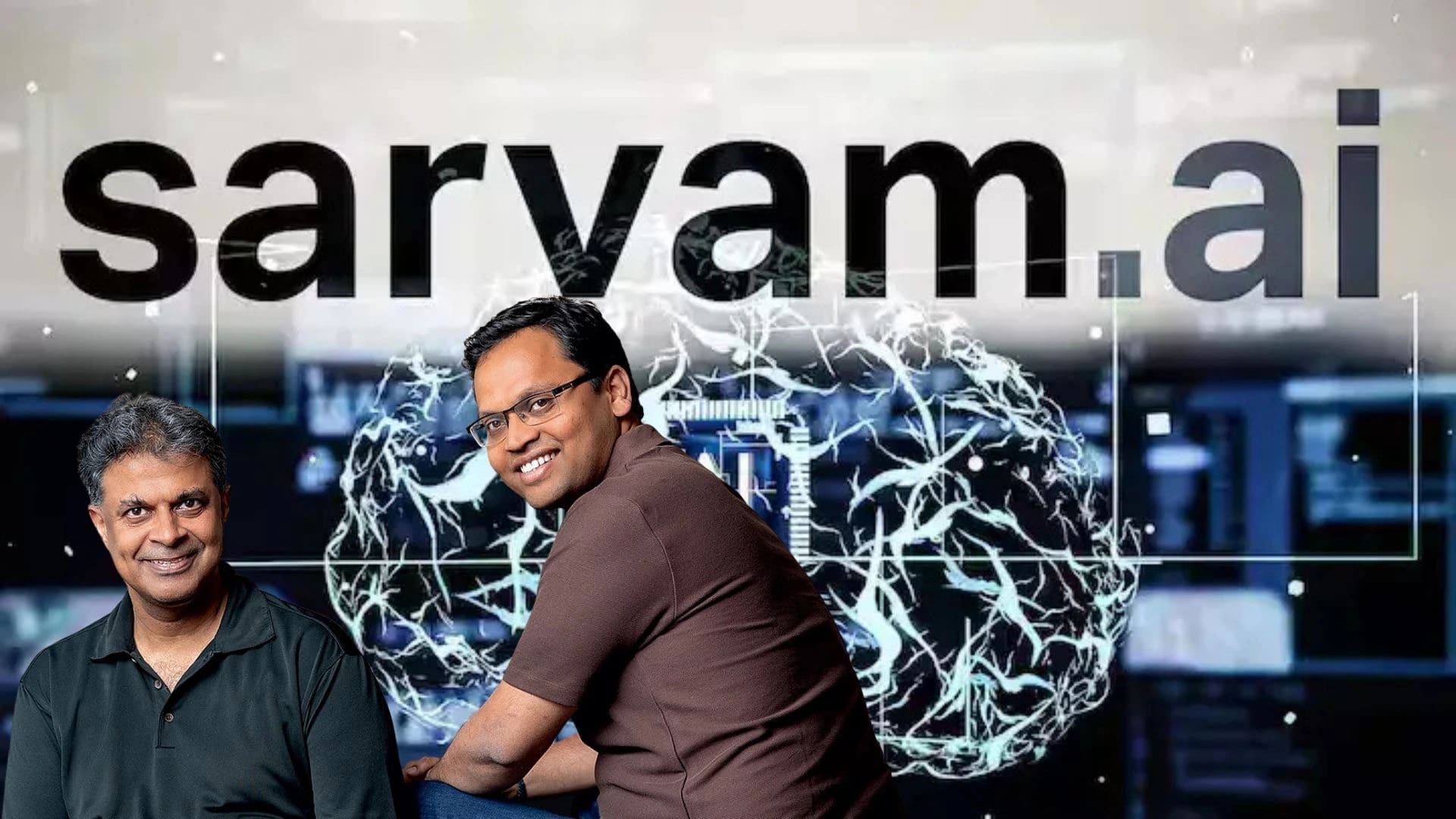
So now the question is: “Why doesn’t AI truly understand India?” and what we can do about it. This was the same question that occurred to the two men, Pratyush Kumar and Vivek Raghavan. Not about building another app.But about building India’s own AI backbone. And that gap led to the birth of Sarvam AI, one of India’s most ambitious AI startups.
But there is one more reason behind the birth of Sarvam AI. Back then, India did not have any foundational AI model, unlike countries such as the U.S. and China, which own and control their AI technologies. This became one of the key reason indians own AI to come into existence “ We need something that is Indian and is controlled by India, not other countries”
The Founders Behind the Mission
Before Sarvam AI became one of India’s boldest AI bets, two deep-tech builders were quietly working on a problem most people ignored: AI doesn’t truly understand India.
One was in Zurich, training AI models that struggled with simple Hindi sentences. The other was in Bangalore, watching India build massive digital infrastructure and realising the next layer was missing. They didn’t know each other yet. But they were asking the same question: Why is India building apps on foreign AI, instead of building the AI itself?
Pratyush Kumar had always been drawn to hard problems. After earning his B.Tech from IIT Bombay, he pursued a PhD in Computer Engineering from ETH Zurich and worked with Microsoft Research and IBM Research. But something bothered him. AI worked beautifully in English. But it failed miserably in Indian languages. So instead of chasing prestigious positions abroad, he started AI4Bharat creating open-source datasets and models for Indian languages. It laid the foundation for Sarvam AI.
Vivek Raghavan took a different path. After his B.Tech from IIT Delhi and PhD from Carnegie Mellon, he came back to India. For 15 years, he worked on India’s Digital Public Infrastructure, including Aadhaar, UPI, and the GST Network. He understood scale. And he understood that the next layer India needed was AI infrastructure foundational models that could serve 1.4 billion people in 22 languages.
The two met through India’s AI community. Pratyush was building language models. Vivek was thinking infrastructure. When they talked, they realized: they were solving two halves of the same problem. Together, they could build foundational AI and deploy it at population scale. That’s how Sarvam AI was born. Not out of hype. But out of conviction: India needed its own AI layer. And if they didn’t build it, no one else would.
The issue that gave birth to Sarvam AI
Despite India having more than 140 crores of people and a substantial internet user base, and yet there is no sovereign AI model designed specifically for the Indian population, is a problem that needs to be acknowledged. The fact that AI has become a necessary infrastructure makes this problem even more important to address. The fact that the world is dependent on foreign AI systems is a problem in itself, particularly because most of these models are designed to work in English and a few international languages. India has 22 official languages and many more dialects, which are still not adequately addressed, with regional subtleties being misunderstood, leading to a tech and linguistic divide.
Other nations are developing and managing their own foundational AI infrastructure. OpenAI, Google, Microsoft, and other US firms, Baidu, Alibaba, Falcon LLM of the UAE, and Mistral AI of France are all managing the foundation of intelligence through large models.
What Are They Actually Building?
Sarvam AI isn’t just another chatbot company.They’re building something much bigger than India's AI stack.Think of it like this when you use Google Translate or ChatGPT, you’re using AI built by foreign companies. Sarvam AI is building the Indian version of that foundation.Here’s what they’ve created so far:
Sarvam-1 – Think of it as India’s answer to GPT. A smart AI that understands and speaks multiple Indian languages fluently.
OpenHathi – A free, open-source AI model built specifically for Hindi. Anyone can use it, modify it, and build on it.
Sarvam Vision – Ever tried scanning a document in Hindi or Tamil? This technology can read and understand text in Indian scripts.
Bulbul V3 – Type something in English, and hear it spoken back in Tamil, Bengali, Marathi, or 8 other Indian languages. Natural, human-like speech.
Shuka 1.0 – An AI that doesn’t just understand text, but actually listens and responds to your voice in Indian languages.
In simpler words They’re building the complete AI toolkit that India needs:
∙ AI that understands you (Large Language Models)
∙ AI that listens to you (Speech-to-text)
∙ AI that talks to you (Text-to-speech)
∙ AI that translates for you (Translation engines)
∙ AI that reads documents for you (Document intelligence)
∙ AI that businesses can use (Enterprise APIs)
∙ AI that works on your phone (On-device AI)
Just like UPI became India’s payment infrastructure, Sarvam wants to become India’s AI infrastructure.Before Sarvam AI was formally founded, the founders were already working on something significant. They were developing open-source datasets and models for Indian languages. Then ChatGPT came along. That was the turning point. They understood something very important. AI was not just another product. It was infrastructure. And India could not afford to just build apps on top of foreign AI models. India had to build at the foundational layer or be left behind. Sarvam AI was formally founded in 2023. And they moved quickly.
One of the India’s Biggest AI Funding
In December 2023, just months after officially launching, Sarvam AI raised ₹340+ crore in Series A funding.This was one of India’s largest AI funding rounds at the time.The round was led by Lightspeed Venture Partners, with participation from Peak XV Partners (formerly Sequoia India) and Khosla Ventures.
Investors were betting before it came into existence , so early when they saw what Sarvam was building wasn’t just a startup it was national infrastructure.
Access to Critical AI Infrastructure
Sarvam AI was also selected under India’s IndiaAI Mission, granting them access to 4,096 NVIDIA GPUs for model training.
“Why does this matter?”
Training AI models requires massive computing power. High-end GPUs cost lakhs each, and you need thousands of them. For most startups, compute costs run into crores monthly often the biggest barrier to building foundational AI.This infrastructure access allowed Sarvam to focus on research and development rather than just infrastructure expenses.It reflects India’s broader recognition of AI as critical infrastructure similar to how UPI and Aadhaar were prioritized.
ChatGPT vs Sarvam: What Makes It Different?
You might be thinking: “Why do we need Sarvam when we have ChatGPT?”Here’s the difference. ChatGPT is global-first.Sarvam AI is India-first.
ChatGPT is amazing at English and works worldwide. But when it comes to Indian languages, local context, and voice interaction it struggles.Sarvam AI is different because it’s:Trained deeply on Indian language datasetsOptimized for voice interaction (critical for India’s non-English users)Designed for government & enterprise deploymentBuilt with sovereignty & compliance in mind Focused on population-scale use (1.4 billion people)Will Sarvam replace ChatGPT globally? Probably not.But for Indic language voice and local use cases. It’s built specifically for India.The Real Challenge: Building AI Isn’t Cheap
“Why compete with OpenAI? They’re light-years ahead.”“Can India really match the US and China in AI?”“Isn’t this too ambitious for a startup?”Valid questions.But here’s the counterpoint, Foundational work is slow.And it’s absolutely necessary.India can’t afford to be dependent on foreign AI infrastructure forever. Imagine if India didn’t build its own digital payments infrastructure and relied entirely on Visa, Mastercard, and PayPal.
We’d never have UPI. We’d never have financial inclusion at the scale we achieved.The same logic applies to AI.The time to build is now.Yes, it’s expensive. Yes, it’s hard. But the cost of not building it? That’s far higher.
After multiple funding rounds, Sarvam AI’s estimated valuation stands at approximately₹1,720 – ₹1,950 croreFor a company founded in 2023 that’s significant And remember it’s still early.The real value will show when their models go mainstream and power millions of Indian voices, apps, and enterprises.
The Vision: India’s Own AI Backbone
India is investing heavily in AI infrastructure.And it’s not just Sarvam. There’s a broader national strategy at play.
The IndiaAI Mission aims to:
∙ Build sovereign AI models
∙ Create large-scale datasets
∙ Democratize AI access
∙ Train AI talent
∙ Support AI startups
Every Indian app could be powered by Indian Ai. Imagine opening Paytm, and the chatbot speaks fluent Tamil. Or using a government portal where you can ask questions in Marathi and get instant, accurate answers. Or calling customer service and talking to an AI that understands your Punjabi accent perfectly.That’s the future Sarvam is building.Digital inclusion at scale
Today, millions of Indians are left out of the digital economy because they don’t speak English and can’t navigate text-heavy interfaces.Voice AI in their native language changes everything.Suddenly, a farmer in Bihar can use AI to check crop prices. A shopkeeper in Jaipur can manage inventory using voice commands in Hindi. A grandmother in Kerala can video-call her grandkids and use AI-assisted translation.
India becomes an AI exporter, not just a consumer.Right now, India is a consumer of AI. We use ChatGPT, Google’s AI, Meta’s AI all built elsewhere.But if Sarvam succeeds, India could export AI models to other multilingual, developing countries. Southeast Asia, Africa, Latin America regions that face similar language diversity challenges.
India could become the AI hub for the Global South.Just like UPI transformed payments and made India a global fintech leaderSarvam could transform how 1.4 billion people interact with technology in their own languages, on their own terms.That’s the vision.And it’s not a dream. It’s a roadmap.
Why This Matters: Building, Not Just Consuming
Let’s zoom out for a second.Why does all of this matter?Because AI is not neutral.The AI you use reflects the values, biases, and priorities of whoever built it.If India only uses AI built in Silicon Valley, then:
∙ The models will prioritize English
∙ The data will reflect Western contexts
∙ The features will serve Western needs
∙ And India will always be an afterthought
That’s not acceptable.India has 1.4 billion people.22 official languages.Thousands of dialects.Diverse cultures, religions, and traditions.Our AI needs to reflect our reality.
Sarvam AI wasn’t built because AI was trending.It was built because India needed its own AI layer.And today, at nearly ₹1,900+ crore valuation, it represents something bigger than a company.It represents India choosing to build not just consume the future of AI.That’s the difference between being a market and being a maker.
For decades, India was a market. Companies came here to sell. We consumed products built elsewhere.But in the last decade, something shifted.We built UPI. We built Aadhaar. We built digital public infrastructure.And now, we’re building AI.Sarvam AI is betting on India becoming a maker Not just in AI. But in everything that comes next.And if they succeed?India won’t just participate in the AI revolution.India will lead it.