“Right systems are the roots of every growing business .”
This is the philosophy behind one of India’s most quietly powerful companies. And this is the story of how a boy from a Tamil Nadu village built it from scratch, without ever asking anyone for a single rupee.
If you run a business in India today, chances are you’ve already used Zoho without even realising it. Zoho One brings together 50+ applications covering sales, HR, accounting, marketing, customer support, and project management, all in one place, all connected, all under one subscription. One login. One dashboard. Everything a business needs to run, without jumping between ten different tools before 10am.
Over 75,000 businesses worldwide run on it today. And it costs a fraction of what its competitors charge.
But this product didn’t come from a well-funded office in San Francisco or a shiny co-working space in Bangalore. It came from a question a young boy in a Tamil Nadu village could never stop asking himself: why are we so poor?
Sridhar Vembu was born in 1968 in Umayalpuram, a small village in the Thanjavur district of Tamil Nadu. His father was a stenographer at the Madras High Court. It was a simple household. No internet, no connections, no shortcuts. Just a newspaper every morning and a boy who read every word of it.
He worked hard. Got into IIT Madras. Earned a PhD in Electrical Engineering from Princeton. Then landed a job at Qualcomm in San Diego, working on satellite communication systems. The kind of trajectory that makes a family breathe easy for the first time in years.
And then he walked away from it.
Not because things weren’t working out. But because wherever he looked, he kept seeing the same gap. The software world was building expensive, complicated tools for big corporations that already had everything figured out. The small business owner, the first-generation founder, the growing team of ten people trying to hold things together, nobody was building for them. And that bothered him deeply.
In 1996, Sridhar quit Qualcomm. He had zero investors lined up. No funding. No safety net. Just personal savings that barely covered the first few months, and a belief that most people around him probably thought was naive. He called his IIT Madras senior Tony Thomas, who had been quietly writing software back in India, and looped in his brothers Kumar and Sekar. Together, they started AdventNet Inc. with nothing but a rented office, their own money, and complete conviction.
When a venture capitalist walked up to their booth at a trade show in 1997 and told them they were thinking too small, Sridhar didn’t argue. He just kept going. Because as he would later say: “We don’t need to be in Silicon Valley to build world-class software.”
Tony Thomas wrote their first product, WebNMS, a network management tool, almost entirely on his own in three months. It worked. Telecom giants like Cisco started buying it. By 2000, the company had crossed 50 crore rupees in sales. An investor made an offer of 50 crore rupees at a 700 crore rupee valuation. Sridhar said no.
Then the dot-com crash came in 2001 and hit the entire industry like a wall. Revenue fell by nearly half, almost overnight. Companies that had been flying suddenly had nothing holding them up. AdventNet survived because they had never been flying to begin with. They had been building. They launched ManageEngine, a subscription-based IT management suite, kept every single employee on board, and quietly rebuilt from scratch. No layoffs. No outside money. Every rupee went straight back into the product.
By 2009, the company had grown enough and changed enough that the old name didn’t fit anymore. AdventNet became Zoho Corporation. And that is when things really started moving.
What followed is the kind of growth story that rarely gets told because it has no dramatic funding rounds or splashy IPO to anchor it. Zoho went from 700 crore rupees in revenue in 2010 to 1,050 crore rupees by 2012, then 1,680 crore rupees by 2016. By 2019 they were at 3,500 crore rupees, doubled that to 7,000 crore rupees by 2022, and closed 2024 at 11,600 crore rupees with a valuation of 1.04 lakh crore rupees, a 58% jump from the year before. All of it without a single rupee from outside investors. Sridhar Vembu’s personal net worth today stands at 48,000 crore rupees. He still cycles to work in Tenkasi.
In 2017, Zoho launched Zoho One. The thinking was simple but nobody had really pulled it off at this scale before. Instead of selling businesses one tool at a time, give them everything upfront. 50+ applications, all integrated, all talking to each other, at a price that a growing business could actually afford.
Most software companies thought that was a strange way to make money. Zoho thought the other approach was the broken one. Businesses didn’t need more tools cluttering their workflow. They needed the right foundation to build on.
Today, Zoho One serves over 75,000 business customers. Zoho as a whole has over 10 crore users across 180+ countries. They reinvest 60% of revenue back into research and development, nearly four times the industry average. No ads inside the product. No selling of user data. And through every downturn and crisis, not one employee has been let go because of market conditions.
Sridhar has always been clear about that: “Layoffs would destroy morale. We have never resorted to it, and we won’t.”
In 2005, long before the big numbers arrived, Sridhar quietly started Zoho Schools of Learning with just 6 students. Not IIT graduates. Six Class 12 kids from rural, low-income families, given two years of real training in computer science and communication, then brought into the company full time.
No degree required. Just a chance that nobody else was offering.
Today, 15% of Zoho’s workforce came through that programme. Young people from small towns across India, building software now used by companies like Apple, Amazon, and Netflix. Sridhar moved back from California to Tenkasi permanently in 2019. Padma Shri in 2021. CNN-News18 Indian of the Year in 2022. Still unlisted. Still independent. Still entirely on his own terms.
He once wrote: “To earn true respect in the world, Indians have to develop deep capabilities in India. Achievements abroad won’t do it.”
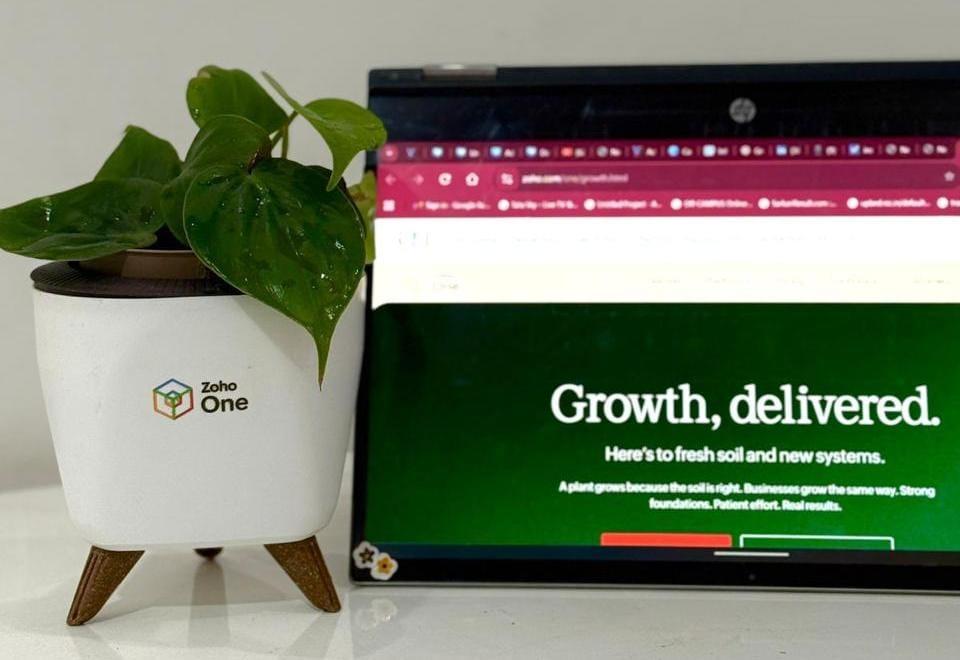
Zoho One ran a campaign called “Growth, delivered.” No ads. No discount codes. No influencer deals. They simply sent real, labelled desk plants to founders, creators, and customers across the country. The note said: just like a plant needs the right soil, sunlight, and water to grow, a business needs the right systems, structure, and support to flourish.
The plant was not a giveaway. It was a symbol of everything Zoho has stood for since day one.
Most startups today are in a rush. Raise fast, grow fast, exit fast. Zoho did the opposite of all of that and still ended up with a valuation of 1.04 lakh crore rupees, 10 crore users across 180+ countries, and a workforce of 16,000 people, 15% of whom never went to college.
The lesson is not complicated. Build something people actually need. Price it fairly. Take care of your people. Stay patient. And never let someone else’s definition of success become yours.
Sridhar Vembu started with nothing, built everything, and still cycles to work in a small town in Tamil Nadu. That alone tells you everything about what kind of company Zoho One really is.The roots were always strong. Everything else followed
Visit Karostartup for more insights into the intersection of technology, policy, and the future of India.
Quick Share