PRESS RELEASE
Bacancy Systems Secures Granted Design and Utility IP for Its CCS2 EV Dispenser, Locking In a Charging Architecture Built to Scale
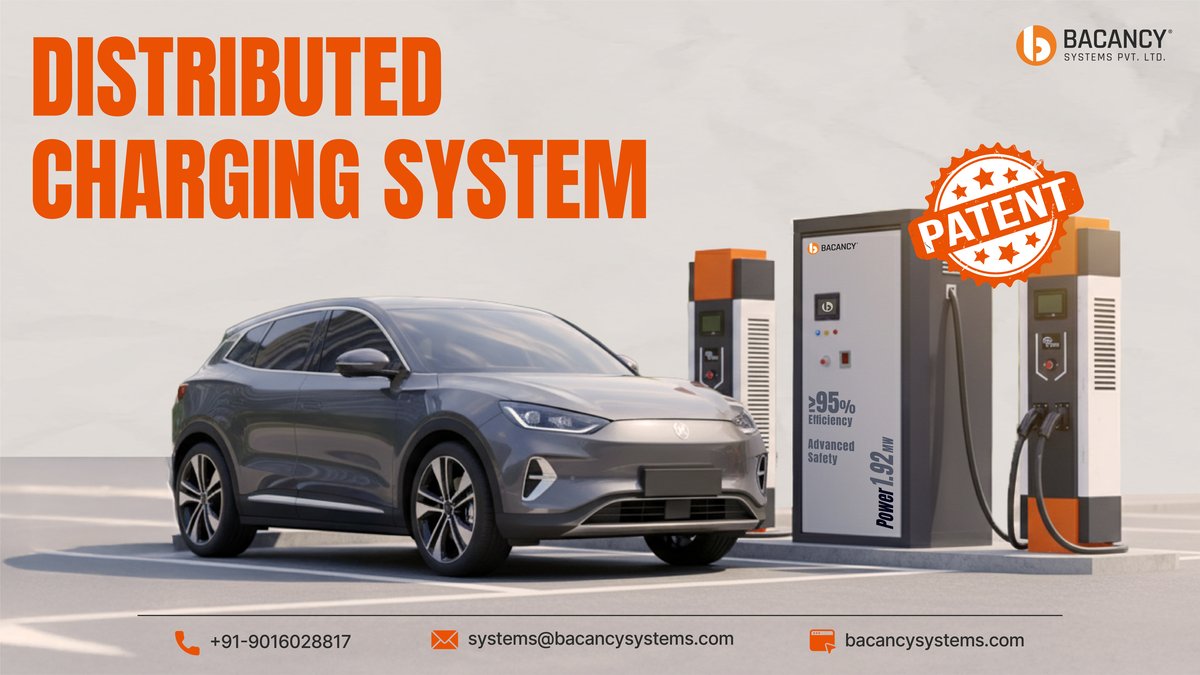
Granted design and utility intellectual property now protects the engineering split behind Bacancy's CCS2 EV Dispenser — securing an architecture that lets one 1.92 MW power unit feed up to 12 charging points against being replicated.
15 September 2026 ,AHMEDABAD, INDIA — Ahead of National Engineers Day on September 15 — observed annually on the birth anniversary of Sir M. Visvesvaraya — Bacancy Systems PVT LTD, an Ahmedabad-based EV charging hardware manufacturer, has secured granted design and utility intellectual property protection for its CCS2 EV Dispenser Unit — the customer-facing charging point at the center of the company's Distributed Charging System.
In a conventional DC fast charger, the power conversion electronics, cooling system, and connector are all built into a single cabinet at each parking bay. Bacancy's architecture separates the two: a centralized Power Unit — supporting up to 1.92 MW and configurable to feed as many as 12 output terminals — handles power conversion, while each Dispenser Unit is reduced to a compact, floor-mounted terminal carrying only the connectors, authentication hardware, and display a driver interacts with.
That separation is what the newly granted IP protects: a dispenser that delivers up to 375A per CCS2 gun through natural air cooling alone, without carrying its own power conversion or liquid-cooling hardware, drawing power instead from a shared, centralized unit.
“The core engineering challenge was moving the power conversion and cooling load out of the dispenser without giving up current delivery,” said Hardik Sheth, CTO, Bacancy Systems. “We got the dispenser to run up to 375A per CCS2 gun on natural air cooling alone, at under 44 kilograms, by keeping the power electronics centralized in the Power Unit instead of duplicating them at every bay. Securing design and utility IP on that split architecture protects the actual engineering decisions behind it, not just the enclosure it sits in.”
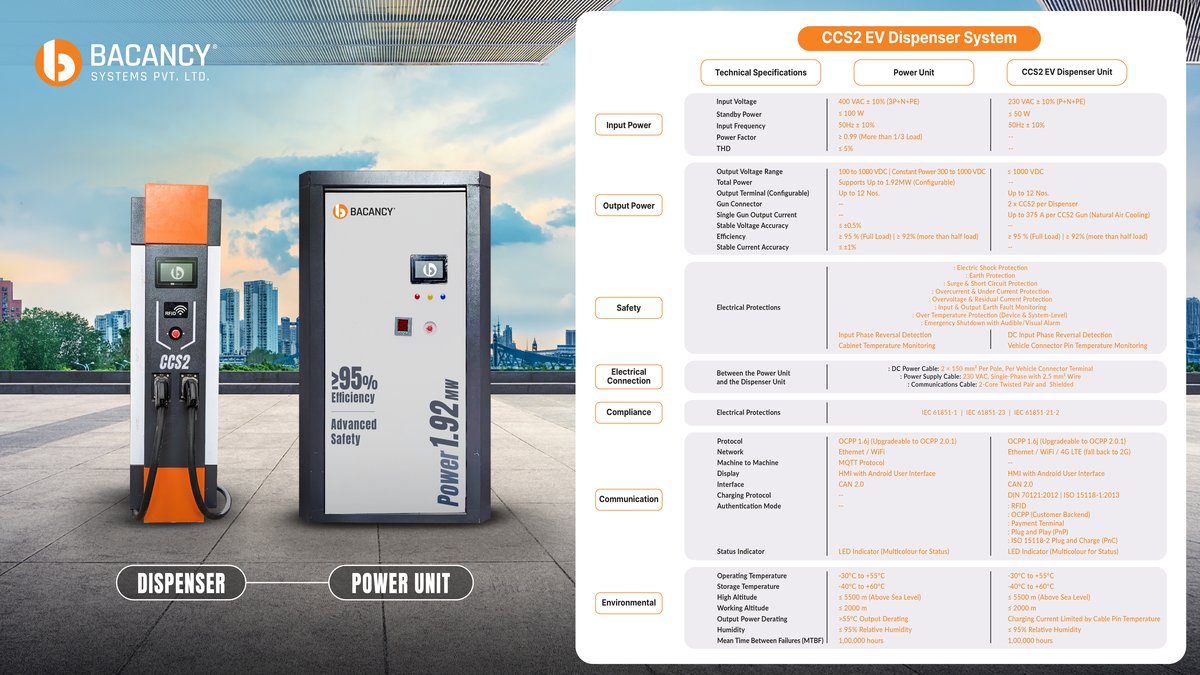
Power Unit and CCS2 EV Dispenser Unit — full technical specification comparison
Why the architecture matters for charge point operators
- Lower footprint and cost per bay: expensive power conversion electronics live once in the centralized Power Unit rather than being duplicated inside every dispenser
- Faster field service: a dispenser can be swapped or serviced without touching the power conversion hardware feeding it
- Simpler scaling: operators add dispensers to an existing power unit as demand grows, rather than installing a full standalone charger per bay
- Reduced site works: one Power Unit (up to 1.92 MW) can supply up to 12 output terminals, cutting cabling and civil work versus one-charger-per-bay installations
“This IP protects more than a design — it protects the commercial model our CPO customers are building around,” said Binal Patel, CEO, Bacancy Systems. “Operators are no longer thinking in terms of one charger per bay; they want infrastructure that lets them add capacity as demand grows, without redoing civil work or cabling each time. That's exactly what this architecture gives them, and now it's ours to defend and scale as the market moves that way.”
CCS2 EV Dispenser Unit — key specifications
- 2 x CCS2 connectors per dispenser, up to 375A per gun (natural air cooling, no liquid cooling required at the dispenser)
- Compact footprint: 450 x 450 x 1675 mm, ≤44 kg per dispenser, floor-mounted
- Android-based HMI with multicolour LED status indicator
- Authentication via RFID, OCPP customer backend, payment terminal, Plug and Play (PnP), and ISO 15118-2 Plug and Charge (PnC)
- Charging protocol per DIN 70121:2012 and ISO 15118-1:2013; communication via Ethernet/WiFi/4G LTE with 2G fallback
- Built-in vehicle connector pin temperature monitoring and DC input phase reversal detection
- Compliant with IEC 61851-1, IEC 61851-23, and IEC 61851-21-2
As India's public charging network continues to scale under government programs like PM E-DRIVE, Bacancy positions the Distributed Charging System as infrastructure built for sites that need to grow — parking operators, fleet depots, and highway plazas adding bays over time rather than committing to fixed, one-charger-per-bay buildouts from day one. The now IP-protected Dispenser Unit is available as part of the Distributed Charging System for CPOs and OEMs across India.
“Landing this on Engineers Day feels right for an engineering-led company,” said Krunal Patel, COO, Bacancy Systems. “The dispenser is already deployed in the field with our CPO and OEM partners, and this protection means we can keep scaling that deployment with confidence in the architecture underneath it. As India's charging network keeps expanding, we're positioned to deliver at the pace the market needs.”
About Bacancy Systems
Bacancy Systems PVT LTD, headquartered in Ahmedabad, Gujarat, designs and manufactures EV charging hardware — including AC and DC charger controllers, EVCC, EV simulators, battery management systems, and distributed charging infrastructure — for OEMs and charge point operators in India and internationally. Learn more at bacancysystems.com.
Media Contact
Bacancy Systems PVT LTD
15-16, Times Corporate Park, Near Thaltej-Shilaj Road, Opp. Copper Stone Flats, Thaltej, Ahmedabad, Gujarat, India, 380059
systems@bacancysystems.com | +91 90160 28817 | Website: https://bacancysystems.com/