Deepfake Voices Are Getting Harder to Spot. This 21-Year-Old Is Building a Solution
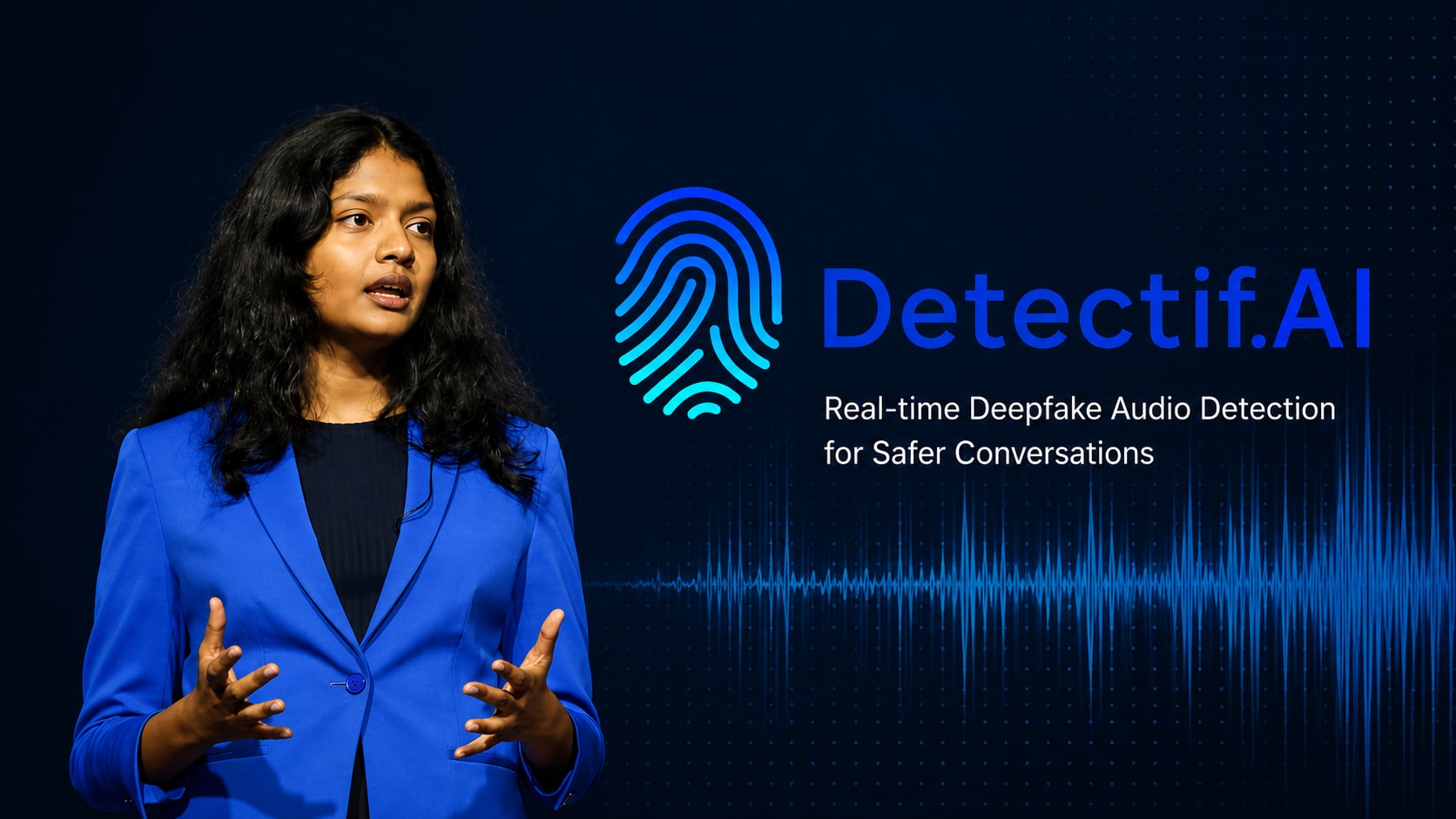
Tarini Padmanabhuni started learning about machine learning when she was still in class 6. Most children at that age play games or watch videos. She was already exploring how computers can learn and make decisions. But a personal shock later turned that early interest into a clear mission.
A deepfake scam targeted her grandfather. Someone used artificial intelligence to create a fake voice and try to trick the family. That moment changed everything for Tarini. She realised the problem was much bigger than code or algorithms.
A Personal Wake-Up Call
“It became clear that this was not just a technical problem,” Tarini explains. “AI-generated voices and synthetic media can affect families, financial institutions, customer support systems, identity verification and the entire idea of digital trust. That realisation eventually led me to build DetectifAI.”
Today she is 21 years old. She has graduated in Computer Science with a special focus on Cyber-Physical Systems from MIT Manipal. Her work sits at the meeting point of artificial intelligence, cybersecurity and deepfake detection. Over the past two years she has been building practical tools to spot fake audio and manipulated media. She currently has five patents pending in the area of deepfake detection.
What DetectifAI Does
DetectifAI was founded in 2025. The company has bases in San Francisco and Bengaluru. Its main goal is simple: help people and organisations know whether the voice or audio they are hearing is real or made by AI.
Cybercriminals now use AI to create fake voices and images. These are used in phishing calls, money fraud and spreading false information. DetectifAI aims to stop this by spotting the signs of manipulated speech and video.
The technology is designed to work on the device itself or at the edge of the network. This means it can flag a fake caller in real time. There is no need to send the audio to the cloud and wait for a reply. Real-time detection is the company’s biggest strength. Most other systems only check after the damage has already been done.
Where the Technology Is Most Needed
DetectifAI focuses especially on two important sectors: banking, financial services and insurance (BFSI), and healthcare. In these areas, voice is often used to confirm identity. Banks use it for customer checks. Hospitals use it for patient validation. Fake voices can cause serious harm here — stolen money, wrong medical access, or broken trust.
The company currently has a team of ten people. Their long-term dream is bigger than any single industry. They want to create a trust layer across the entire digital world so that people can feel safer when they talk, listen or verify something online.
Building the Company and Finding Support
DetectifAI has raised a seed round from well-known investors. These include Josh Constine, who used to be a senior editor at TechCrunch, and Silicon Valley investor Manohar Kamath. The exact amount has not been shared.
Tarini says the early money helped, but the real boost came from people and connections. She took part in “The Residency,” a founder programme in San Francisco supported by Sam Altman. That experience helped her meet the right people and grow her network.
She has also built technology that can detect deepfakes directly on phones and computers. This makes the protection faster and more useful in daily life. The plan is to bring DetectifAI tools to banks, KYC companies, telecom firms and mobile services. “Ideally, anyone with a mobile phone should have access to some level of protection against AI-generated deception,” she says.
Looking Ahead: Becoming the Dolby of Trust
Tarini has a clear picture of the future. “In the long term, we want DetectifAI to become for audio trust what Dolby became for audio quality — a recognisable layer that helps people and organisations understand if the content or interaction they are engaging with can be trusted.”
The problem she is tackling is growing fast. According to market research, the global deepfake market is expected to be worth $7.44 billion in 2026 and could reach $32.58 billion by 2033. As more people and businesses rely on voice and video for important decisions, the need for reliable detection will only increase.
Tarini’s journey shows how a personal experience can shape a useful company. She began with childhood curiosity about machine learning. A scam that touched her family gave her direction. Now she is building tools that try to protect the basic idea of trust in a digital world full of artificial voices and images.
DetectifAI is still young. But its focus on real-time, on-device detection and its clear aim to serve critical sectors like banking and healthcare give it a practical edge. If the technology works as planned, ordinary people and large organisations may one day have a simple way to ask: “Is this voice real?” — and get a trustworthy answer.
The story of Tarini Padmanabhuni is a reminder that technology problems often start as human problems. Solving them requires both technical skill and a strong sense of why the solution matters.