HirePro Report Reveals the Biggest Shifts in India’s 2026 Campus Hiring
College hiring in India is entering a more mature phase. Opportunities remain strong, companies continue to hire, and technology is reshaping processes. Yet a clear theme runs through HirePro’s latest report, “The State of College Hiring in India 2026”: students, colleges, and corporates are investing more effort than ever in understanding one another, but many decisions are still based on outdated assumptions. The gap between perception and reality has become one of the defining stories of this year’s campus recruitment cycle.
What Students Actually Want from Their First Job
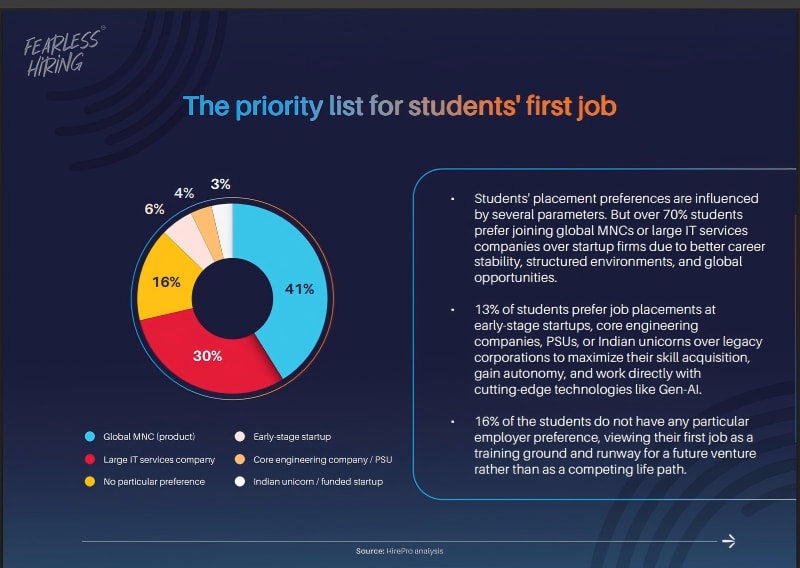
Placement preferences reveal a strong lean toward stability. Over 70% of students prefer joining global MNCs or large IT services companies. They cite better career stability, structured environments, and global opportunities as the main reasons.
A smaller but significant group, about 13%, actively seeks early-stage startups, core engineering firms, PSUs, or Indian unicorns. These students prioritise faster skill acquisition, greater autonomy, and the chance to work directly with emerging technologies such as Gen-AI.
The remaining 16% express no strong employer preference. For them, the first job is primarily a training ground and a runway for future ventures rather than a long-term destination.
These numbers show that while the classic preference for large, established employers still dominates, a meaningful minority is deliberately choosing paths that offer more ownership and exposure to cutting-edge work.
Virtual Hiring Has Become the Default With a Perception Gap
Virtual recruitment, once a pandemic necessity, is now mainstream infrastructure. The operational advantages are widely accepted. 86% of corporates and 78% of students say virtual hiring has improved recruitment speed. 89% of corporates and 76% of students believe it has enhanced convenience through lower costs, access to a wider talent pool, and better time efficiency.
Students are particularly comfortable with the format: 98% say they are fine with virtual interviews, pointing to reduced travel costs, lower social anxiety, and greater scheduling flexibility. Most prefer virtual rounds for early-stage screening.
Yet perspectives diverge sharply on the quality of interaction. Nearly half of students (48%) feel virtual interviews allow them to present themselves more authentically. In contrast, 47% of corporates believe authenticity has deteriorated. A similar split appears on interaction quality: 52% of students say it has improved, while 45% of corporates feel it has worsened.
Both sides still agree that face-to-face conversations remain valuable for assessing cultural fit and building stronger personal connections. The emerging consensus points toward hybrid models that combine the efficiency of virtual processes with selective in-person engagement.
AI Is Changing Roles More Than Headcount
Despite widespread discussion about automation, the fear of large-scale displacement of entry-level jobs appears overstated. Three out of four corporates expect entry-level headcount to remain flat or increase. Only 10% anticipate a significant reduction.
Instead of shrinking numbers, AI is reshaping the nature of roles. 41% of companies say entry-level positions will transform to require different skills while headcount stays similar or grows. Another 17% report minimal impact on hiring volumes so far. Notably, 15% of corporates admit they have not yet modelled AI’s effect on their hiring strategy, indicating that a portion of the market remains in a wait-and-watch mode.
The Gen-AI Paradox
One of the report’s most striking findings is what it calls the “Gen-AI Paradox.” While 85% of corporates say they prefer students to be Gen-AI-ready, only 12% currently treat it as a mandatory hard filter. About 40% keep it in the “preferred but not mandatory” category, and 29% apply it strictly only for technical or data-focused roles.
This creates a gap between student preparation and actual hiring practice. Many students investing heavily in visible AI credentials may be preparing for a filter that does not yet exist for most roles. Corporates, for now, appear more inclined to train new hires than to screen them out on Gen-AI proficiency at the point of entry.
Sentiment around AI is largely positive. 70% of students and 59% of corporates view it as a net positive for hiring, citing potential gains in productivity, creativity, and the creation of new kinds of roles. Still, 27% of students remain concerned that AI could shrink traditional entry-level opportunities, a worry shared by only about one in ten corporates.
The Broader Alignment Challenge
Beyond specific technologies, the report highlights deeper mismatches in expectations. Students often believe corporates prioritise coding scores and communication polish above all else. In reality, cultural fit and learning agility carry comparable weight. Corporates, meanwhile, tend to assume compensation is the single biggest factor in a student’s employer choice, when career growth ranks almost equally high for many candidates.
Skills-first hiring offers another example of narrative running ahead of practice. Colleges have largely embraced the idea, yet many organisations still quietly rely on CGPA and institutional pedigree even as skills-based assessments gain ground.
First-year attrition among campus hires remains relatively low and is driven more by external poaching than by dissatisfaction. Most colleges report improved placement outcomes and rising company visits this year, suggesting that demand for fresh talent continues to hold.
Looking Ahead: Hybrid Models and Potential Over Signals
The future of college hiring is unlikely to be defined by a pure choice between virtual and in-person methods, or between AI tools and human judgment. The most effective approaches will combine the speed and reach of technology with richer ways of evaluating potential, adaptability, and long-term fit.
Organisations that move beyond traditional signals and focus on learning agility will gain an edge. Institutions that strengthen industry relevance will better prepare students. And students who develop a broader mix of technical capability, business understanding and the ability to keep learning will be best positioned for a workplace that continues to evolve rapidly.
HirePro’s 2026 findings paint a picture of a hiring ecosystem that is still adjusting, confident about demand, experimentally adopting new tools, and slowly closing the gap between what each side assumes and what the other actually values.