How Karnataka Startup Businesses Can Benefit from Incubators
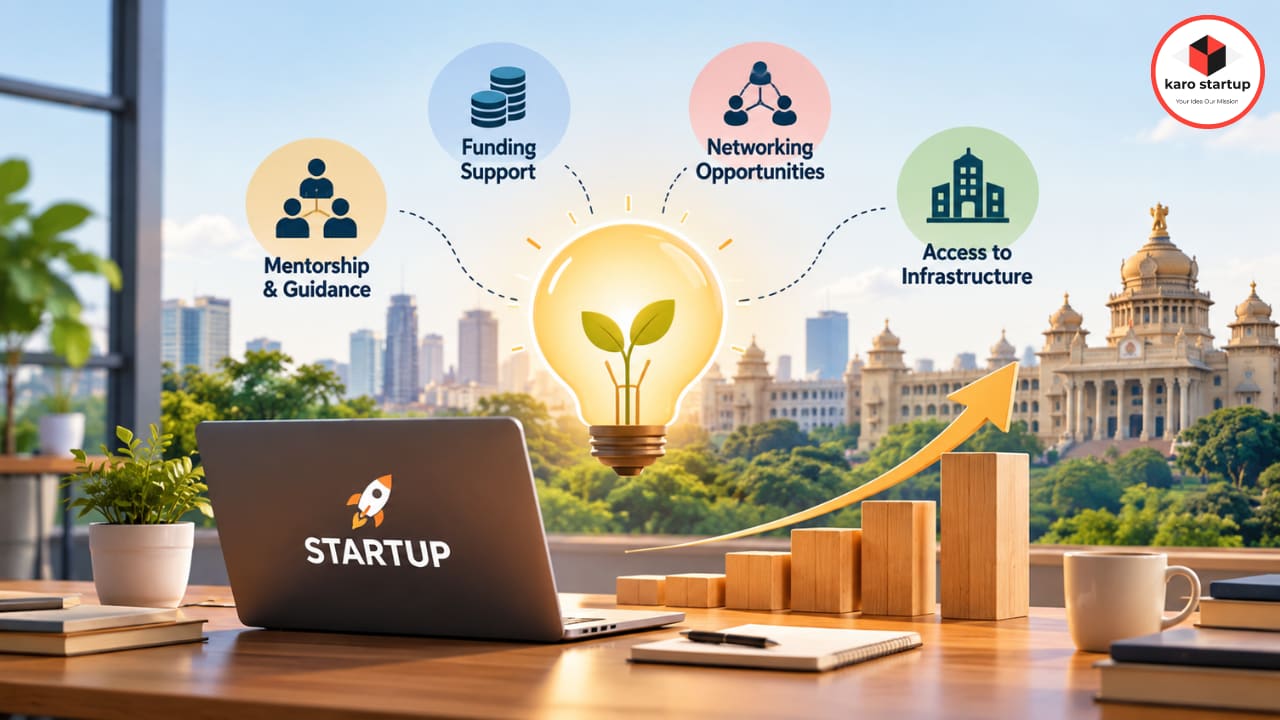
For businesses—especially early-stage startups, SMEs, women-led ventures, student founders, and those working on emerging or local-language technologies—incubators are no longer optional nice-to-haves. They are practical growth accelerators that deliver infrastructure, expertise, capital access, market connections, and credibility that most young companies could never afford or build alone. Under the Karnataka Startup Policy 2025–2030, the state is actively expanding and strengthening this network, creating clear pathways for businesses to plug in and scale faster.
Here’s exactly how businesses benefit:
1. Access to World-Class Infrastructure and Operational Support Without Heavy Capex:
Incubators provide ready-to-use workspace, high-speed connectivity, specialized equipment, labs, prototyping facilities, test beds, and digital platforms. Technology Business Incubators (TBIs) housed in institutions of higher learning go further, offering business advice, financial counselling, assistance with management and accounting, legal and regulatory guidance, and mentor access—plus physical infrastructure tailored to the incubator’s thrust areas.
Business benefit: Founders avoid large upfront investments in offices, labs, or tools. They gain professional environments that signal credibility to customers, partners, and investors while focusing capital on product and growth. Private incubators and accelerators setting up state-of-the-art centres in emerging technology clusters can themselves receive a one-time capital grant of up to 50% or ₹50 lakh (whichever is less) for fixed-cost investments (excluding land and building). This expands quality options for startups across the state.
2. Mentorship, Skills, and Hands-On Guidance That Compress Learning Curves:
Incubators connect businesses with experienced mentors, industry experts, academicians, and peer networks. Programs deliver structured training in business skills, market and customer analysis, business-plan development, pitch preparation, leadership, financial literacy, compliance, digital skills, product design, digital marketing, governance, and financial planning.
Business benefit: Early-stage teams move from idea to validated business model faster and with fewer costly mistakes. Personalized mentoring (especially in hybrid onsite + virtual formats) ensures support is tailored rather than generic. Student projects gain particular value through linkages between New Age Innovation Network (NAIN) centres and external incubators/accelerators or anchor institutes of repute. These partners provide handholding, mentoring, implementation support, and industry connects that help convert ideas into technology-based solutions, working prototypes, or full entities.
3. Funding Pathways, Grants, and Investor Readiness
Incubators act as gateways to capital. They help with grant applications, provide endorsement letters validating project relevance and feasibility (useful for R&D Project Grants), prepare startups for investors, and facilitate angel-network connects. The Karnataka Startup Cell (under KITS) serves as a single point of contact for information on incentives, government-sponsored events, K-Tech hubs (CoEs, TBIs, CIFs, incubators), industry-mentor connects, and investor networks. It also supports outreach through international trade shows and exhibitions.
Business benefit: Higher success rates in securing seed/go-to-market support, R&D funding, and follow-on capital. Progress monitoring and structured reporting help unlock subsequent tranches efficiently. Women-led and other priority ventures receive targeted pathways that improve access to both government and private capital.
4. Specialized, High-Impact Support for Women-Led Businesses:
Karnataka places strong emphasis on inclusion. Dedicated programs and Women-Led Accelerators/Incubators deliver tailored value:
WEscalate: A dual incubation + acceleration program supporting 30 women-led startups per year (two cohorts of 15). Sector-focused (Biotech, AgriTech, MedTech/Healthtech, Cleantech) and region-specific. Incubation (6 months, hybrid) covers skills training, mentoring, peer learning, market analysis, business planning, pitching, and investor connects (Department grant-in-aid up to ₹20 lakh per cohort). Successful graduates move to 6-month acceleration focused on market validation, funding, and expansion (up to ₹30 lakh per cohort, including an ₹8.7 lakh deployment grant for top performers). Minimum 30% transition rate targeted. Corporate matching grants and social-deployment projects are encouraged.
Women-Led Accelerators and Incubators: New and supported centres across the state provide physical infrastructure and labs, international market-access missions, cross-border partnerships, strong mentor networks (women leaders, academicians, industry experts), specialized training, prototyping/test-bed/pilot access, fundraising/IP/commercialization support, outreach to diverse socio-economic backgrounds, and investor-readiness workshops.
Private incubators can receive up to 70% of eligible project costs (capped at ₹5 crore), with priority for those demonstrating strong women-focused programs and sustainability models. Selected centres submit quarterly progress reports on women-led startup support, IP creation, fundraising, and ecosystem activities.
Business benefit: Women founders gain equity in resources, reduced isolation, higher investment readiness, and structured pathways from idea to scale. The ecosystem becomes more diverse and resilient, opening new talent, market, and partnership opportunities for all participants.
5. Market Access, Networking, Visibility, and Localization Advantages:
Incubators open doors to customers, corporate partners, global missions, trade events, and pilot opportunities. The Startup Cell facilitates broader networking and awareness. A dedicated push promotes technologies in the Kannada language—AI-aided translation, transliteration, transcription (speech-to-text), and other services between English-Kannada and additional languages—aligned with NEP 2020’s emphasis on local context, culture, and knowledge systems. Startups building Kannada-language tech solutions receive collaboration, promotion, and mentor support for greater digital adaptability and advocacy.
Business benefit: Faster customer acquisition, pilot deployments, international exposure, and relevance in local markets. Kannada-focused solutions unlock large underserved user bases and government/education opportunities while differentiating products.
6. Credibility, Compliance Ease, and Long-Term Ecosystem Tracking:
Association with recognized incubators, TBIs, or the K-Tech network provides third-party validation. Legal, accounting, and regulatory guidance reduces compliance friction. APIS-style tracking (adapted here via KITS/Startup Cell and policy mechanisms) and progress-linked support ensure continued assistance as businesses mature. R&D projects gain endorsement strength, and overall growth is monitored to keep support timely.
Business benefit: Stronger brand perception, smoother operations, better governance, and sustained runway as the company scales.
Practical Next Steps for Businesses
1. Identify relevant incubators, TBIs, K-Tech hubs, CoEs, or Women-Led centres aligned with your sector and stage (use the Karnataka Startup Cell as the starting single window for information, events, and connects).
2. For women-led ventures, explore WEscalate cohorts and dedicated accelerators/incubators—applications typically run through selected implementing partners.
3. Prepare strong documentation: detailed cost justifications, project endorsements, progress metrics, and compliance records.
4. Leverage NAIN linkages if you are a student or academic-linked founder.
5. Engage early for mentorship, infrastructure, and grant facilitation; maintain clean reporting to unlock follow-on support.
6. Explore Kannada-language tech opportunities if your product has localization potential.
Karnataka’s incubator ecosystem turns isolation into advantage. Businesses gain the infrastructure of large enterprises, the wisdom of seasoned mentors, targeted capital and grants, powerful networks, and specialized programs—especially for women founders and deep-tech or local-language innovators—while the state continues expanding capacity through capital grants, Women-Led centres, and strengthened facilitation via the Startup Cell.
The result is faster validation, lower risk, higher survival and growth rates, and a clearer path from idea to sustainable, scalable business. In a state that already powers a huge share of India’s GCCs and unicorns, plugging into incubators is one of the highest-leverage moves a founder or growing company can make.
Ready to accelerate? Start with the Karnataka Startup Cell and the nearest aligned incubator or K-Tech hub. The stack of support that once felt exclusive is now designed to be accessible—and built for businesses ready to build.
Sources:
https://eitbt.karnataka.gov.in/startup/public/uploads/media_to_upload1778583281.pdf
https://eitbt.karnataka.gov.in/startup/public/uploads/media_to_upload1763380262.pdf
Related Articles
Incubators for Startups: Why should Start Ups take their help?
Why should your StartUp in Uttar Pradesh take the help of an Incubator?
Why should Andhra Pradesh StartUps take the help of incubators for their business?