How One Man Built a ₹1,000+ Crore Brand by Changing How India Thinks About Water
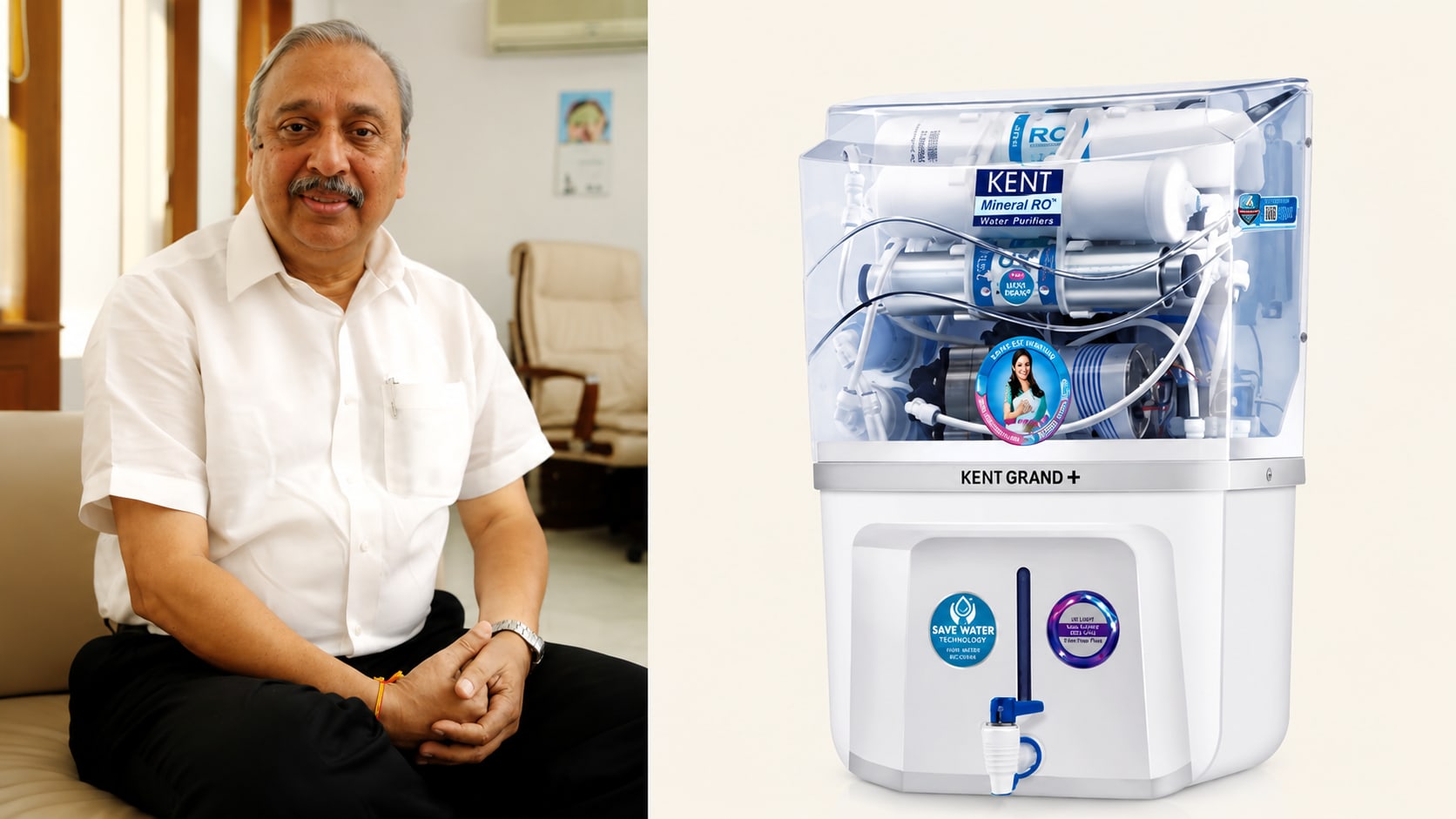
Dr. Mahesh Gupta was a corporate executive. Before Kent, he had no connection to the water purification business at all. His career had followed a conventional path until a personal crisis forced him to rethink everything.
The turning point came when his wife fell seriously ill after drinking contaminated water. What seemed like a routine household risk suddenly became a life-altering event. That single incident pushed Gupta to research water purification technology with unusual intensity and focus. He was no longer looking at the problem as an outsider or a consumer; he was looking at it as someone whose family had paid a real price for inadequate solutions.
The State of Water Purification in the 1990s
In the early-to-mid 1990s, most Indian households relied on two basic methods: boiling water or using simple candle filters. Boiling killed many harmful microorganisms, and candle filters trapped visible dirt and some suspended particles. Neither approach, however, effectively removed dissolved impurities such as heavy metals, excess salts, or chemical contaminants.
The average consumer had little awareness of these invisible threats. If water looked clear and had been boiled, it was generally considered safe. The concept of measuring water quality through parameters like Total Dissolved Solids (TDS) was largely confined to technical or industrial circles. For ordinary families, spending significant money on advanced purification technology felt unnecessary.
A Contrarian Bet on Reverse Osmosis
Gupta focused specifically on Reverse Osmosis (RO) technology. At the time, RO was a niche, expensive process used mainly in industrial applications. Adapting it for everyday home use in India was a genuinely contrarian decision.
Most of the market viewed RO purifiers as overpriced and excessive. Families were accustomed to inexpensive filter candles that cost around ₹50. Convincing people to invest in a sophisticated machine required more than product features — it required changing how they thought about water itself.
Kent had to create consumer awareness around why dissolved impurities mattered. The company began teaching urban India a new health vocabulary centred on TDS. It was an education-heavy, uphill battle, similar to how brands like Ujala once had to convince households that liquid blue was superior to traditional powder blue. The challenge was not just selling a product; it was selling a new way of understanding purity.
Building a Category from Scratch
Kent did not simply launch a water purifier. It set out to build an entire category of awareness.
Through persistent marketing and educational campaigns, the brand shifted the conversation from “Is the water clear?” to “Is the water actually pure?” Once that mindset change began to take hold, demand for home RO systems started to grow. Consumers who had previously been content with boiling or basic filtration began questioning whether those methods were enough.
Even after the category gained traction, Kent still faced formidable competition. Eureka Forbes (Aquaguard), LG, and later Livpure and other players already possessed stronger brand recognition and wider distribution networks. Kent lacked their history and scale, yet it continued to push forward on the strength of its product focus and relentless consumer education.
The company’s approach was methodical. It invested in explaining the science behind RO in accessible language, demonstrating the limitations of older methods, and positioning its products as a necessary upgrade for modern urban households concerned about long-term health.
Expanding Beyond Water Purifiers
Fast forward to today, and Kent is commonly cited as one of India’s top two or three water purifier brands by revenue and market share. The company has expanded well beyond its original product line. Under the same brand umbrella, Kent now offers vacuum cleaners, air purifiers, and a range of other home-health appliances.
This expansion followed a logical brand path. Once Kent had established credibility as a company that protected family health inside the home, it became easier to extend that trust into related categories. Air quality, surface hygiene, and water purity all form part of the same broader concern for a safer domestic environment.
What began as one man’s response to a family health scare gradually reshaped how large sections of urban India think about drinking water. The brand’s journey demonstrates that a strong consumer category can be built by solving a problem others were not yet addressing with sufficient seriousness or technical ambition.
Lessons from a Category-Creating Brand
The story of Kent offers several clear lessons. First, personal conviction can be a powerful starting point for entrepreneurship, especially when it is rooted in a real and widely shared problem. Second, education is often as important as product innovation when introducing a new category. Third, competing against larger, more established players is possible when a company maintains focus and consistently reinforces its core message.
Kent’s rise also highlights the value of patience. Changing consumer behaviour around something as fundamental as drinking water does not happen overnight. It required years of messaging, product refinement, and market presence before RO purification became a mainstream expectation in many urban households.
From Crisis to Category Leadership
From a household health emergency in the 1990s to a multi-category home appliance business with revenues exceeding ₹1,000 crore, Dr. Mahesh Gupta’s journey shows how a focused, education-driven approach can turn a niche industrial technology into an everyday household essential.
He did not invent Reverse Osmosis. What he did was recognise its relevance to Indian homes at a time when few others were making that connection, and then invest the effort required to make the technology understood and accepted. In doing so, he helped shift an entire generation’s standards for what “safe drinking water” should mean.
In a market that once considered basic filtration sufficient, Kent made purity measurable, visible, and desirable. That shift — from assumption to awareness — remains the foundation of the brand’s enduring success.