Kalam Labs: From a BITS Pilani Edtech Startup to Stratospheric Defence Drones
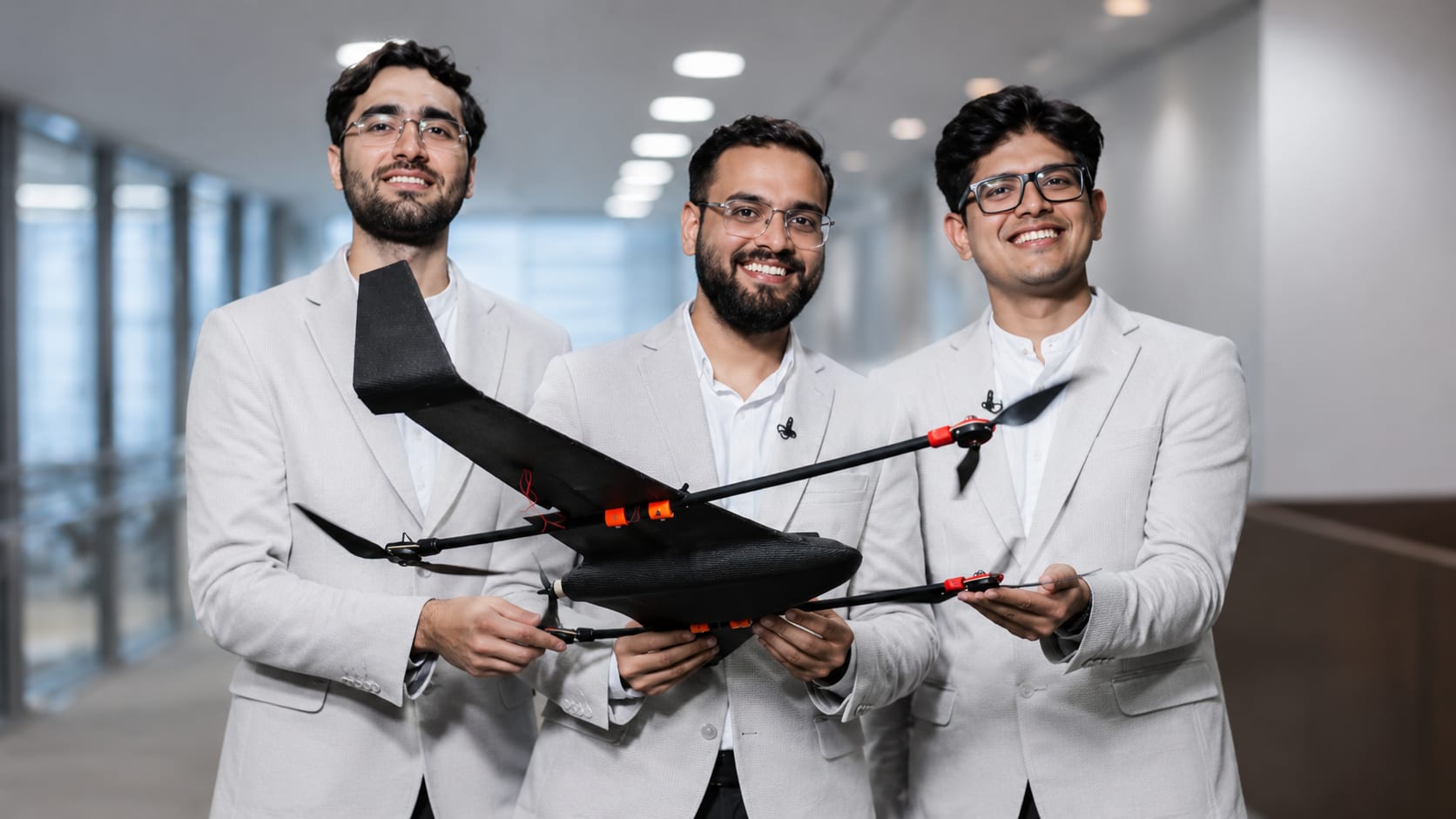
In the dorm rooms of BITS Pilani, where startups such as Pixxel took shape, Ahmad Faraaz, Sashakt Tripathi and Harshit Awasthi founded Kalam Labs in 2018. What began as a gamified edtech platform teaching children about space has evolved into a deeptech company building specialised drones for the stratosphere and working with India’s defence and scientific agencies.
An Edtech Beginning
The original product was a multiplayer educational experience. “We had a multiplayer game like a metaverse of the solar system, where kids joined as gaming characters to join ‘space instructors’ on a tour of the universe and learn space facts along the way,” recalls Faraaz.
Early results were strong. The startup generated about Rs 2 crore in revenue in its first four months, joined Y Combinator and raised $2 million. From the outside, the trajectory looked promising. Internally, the founders realised their ambitions extended beyond space education.
They wanted to run their own space-related missions.
The Pivot to Hardware and Near-Space
The shift crystallised around a high-profile demonstration. In January 2024, as part of promotions for the film Fighter, Kalam Labs unfurled the Indian flag near the edge of space with Hrithik Roshan involved in the campaign. “That made it clear to us that we wanted to do more than educate. We wanted to build tech that was impactful and was deeply unique,” Faraaz says.
The company moved from B2B SaaS into drone manufacturing focused on the stratosphere—altitudes roughly between 33,000 and 164,000 feet. This region sits above conventional drones that operate in the troposphere and below the domain of orbital rockets. Lucknow-based Kalam Labs now operates with a 15-member team and maintains its own manufacturing and testing facility at its headquarters.
The company has been recognised by the American Institute of Aeronautics and Astronautics for achieving what it describes as the world’s highest UAV flight, reaching 9,790 metres above sea level in one of its missions.
The Insight That Shaped the Technology
The technical direction was influenced by a conversation about the “edge of space,” often associated with the Kármán line at 100 km above sea level. At that altitude, the atmosphere becomes so thin that a vehicle would need orbital velocity to remain aloft rather than relying on aerodynamic lift.
Harshit Awasthi pointed out that one of the simplest and cheapest ways to reach the upper atmosphere is not a rocket but a balloon. That insight shaped Kalam Labs’ approach: use balloons to carry payloads high into the atmosphere, then deploy specialised UAVs for the return or mission phase.
First Major Mission with IMD
The startup’s first significant institutional mission came with the India Meteorological Department in March 2025. IMD regularly sent balloons carrying weather modules into the upper atmosphere but lost the equipment because balloons could not be recovered.
Kalam Labs attached its UAV to the balloon along with the weather module. Once the system reached about 30,000 metres and the balloon detached, the module recorded data on the UAV, which then glided back to Earth. The ability to recover the payload and the aircraft demonstrated a practical advantage over one-way balloon launches.
Attention from the Armed Forces
That altitude capability drew interest from the Indian Army. Operating a UAV at 30,000 metres—roughly twice the maximum altitude of a Rafale fighter jet—opened discussions around surveillance and other specialised missions. According to Faraaz, the Army explored collaboration on deploying UAVs via balloons for surveillance and kamikaze-style missions.
Modern conflicts have underscored the growing role of drones. Conventional systems flying around 15,000 feet remain vulnerable to anti-drone systems and GPS jamming. “Our drones fly in the stratosphere at about 100,000 feet,” Faraaz explains. “At that height, they’re immune to jamming, interception, or terrain interference.”
Kalam Labs says its systems are currently deployed at Pokhran and along the Indo-China Line of Control. Its key platforms include a Stratospheric ISR UAV for surveillance, a Stratospheric Retrievable Radiosonde for weather monitoring, and a Stratospheric Kamikaze UAV Swarm that is in final testing.
Cost and Capability Claims
The company argues that operating in the stratosphere provides both operational and economic advantages. Faraaz states that the UAVs can conduct surveillance and other tasks while remaining difficult to intercept, at roughly one-tenth the cost of competing systems. The combination of high altitude and lower cost is central to the startup’s positioning.
Kalam Labs is also developing a supersonic ramjet-powered UAV targeting speeds up to Mach 2.5, or about 3,000 km/h, with completion expected within 18 months. In parallel, it is working on manoeuvrable airships for dynamic surveillance and real-time terrain mapping. Discussions with the Indian Navy are also under way.
Funding and Competitive Position
Kalam Labs has raised about $2 million to date, led by Lightspeed Venture Partners. Hemant Mohapatra, Partner at Lightspeed, has described the founders as “deeply first-principle thinkers” who executed an unexpected but successful pivot.
The startup plans to raise $3–5 million in a Series A round by the end of 2025 to expand research and development. It competes with companies such as Mumbai-based iDeaForge and Chennai-based Garuda Aerospace, but differentiates itself through its focus on near-space and stratospheric UAVs.
Revenue so far includes about Rs 1 crore from nano UAV sales, with military contracts expected to contribute more meaningfully in the near term.
Building for the Long Term
Faraaz frames the company’s ambition in national terms. “India’s defence tech ecosystem is at a very healthy stage right now. All of us need to stay in the market and provide our USP to the armed forces. We at Kalam Labs will continue to innovate and try to stay ahead of the mark,” he says.
From a gamified space education product in a BITS Pilani dorm to stratospheric drones operating at altitudes far above conventional systems, Kalam Labs has followed an unusual path. The through-line is a consistent interest in the upper atmosphere—and a willingness to rebuild the company around hardware capable of reaching it.